

Rio Kosta on LA Venues, Dancing, & Europe Touring : A Handstamp Interview
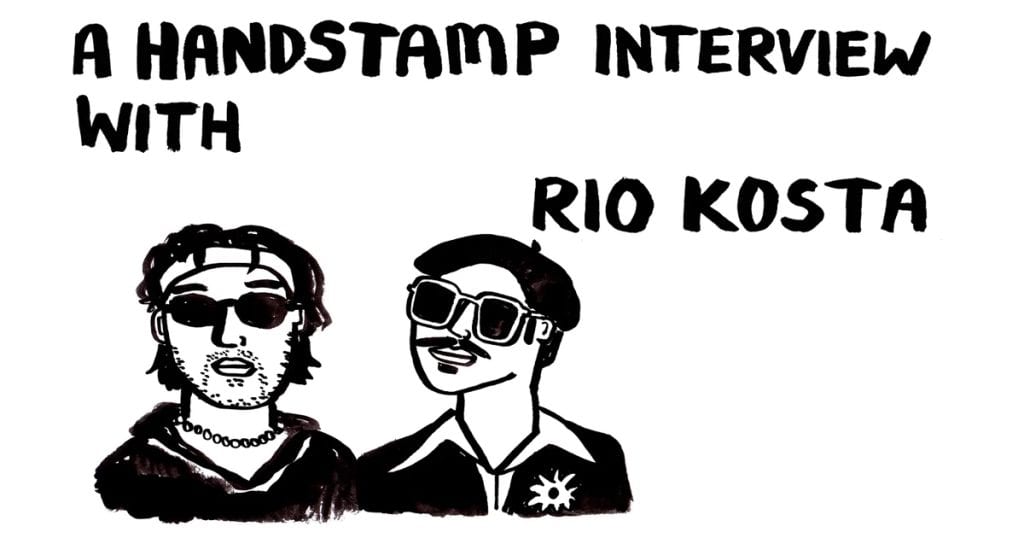
From Handstamp, an interview with Kosta Galanopoulos and Mike Del Rio of the band Rio Kosta, on Florida beachside music, Greek dancing, seeing ageing rockers, and more.

This interview originally appeared on Handstamp
What a week in music, full of data sharing and age shaming, not to mention the overwhelming influx of tastemakers’ end-of-year lists. In fact, I found out somebody topped a very high-profile song ranking, as I was metres away from them performing on stage, sat at a spotlit piano. A truly significant time of year for being told what you should be listening to and how you should be listening to it.
One of the benefits of running Handstamp is the constant reminder of why people perform and what inspired them, beyond the metrics. I was recently able to have one of those conversations with LA-based duo Rio Kosta.
Currently on a European tour, Kosta Galanopoulos and Mike Del Rio were brought together through mutual admiration. What started as a post-pandemic experiment has taken them across the planet, but I wanted to know where their respective journeys began.
Kosta Galanopoulos: “My parents would avidly go to see live music. Luckily, I grew up in a town where there were a lot of bar bands playing blues and stuff like that. I was around it a lot as a kid. That’s where I experienced music the first time.”
Handstamp: “That’s in Cocoa Beach, Florida, right?”
Kosta: “Yeah. There’s this place called The Beach Shack, then there’s Coconuts on the Beach, a VFW on the other corner. There were about 12 bars and everywhere had music, which would be Jimmy Buffett, Stevie Ray Vaughan, Sublime and other random stuff.”
Handstamp: “Just with those artists you named, you’ve described a postcard version of an American beach town. What about you Mike?”
Mike Del Rio: “I actually grew up in Queens, New York. I feel like my first instance with music was through dance, as I was a dancer when I was a kid. I would go to a lot of family parties, where there would be a DJ, then I was in a dance school from like six years old. So, when I think of live music, I first think of that kind of congregation, classic disco songs, showtunes and that kind of thing.”
When I was a teenager, I moved to Long Island, which was like the Seattle of Emo. Everybody was in a band. So, you were constantly jamming and figuring out what the hell you were supposed to be doing.”
Handstamp: “Do you have a distinct memory of the first show you attended?”
Mike: “I think it was The Beach Boys…”
Kosta: “I saw The Beach Boys too!”
Mike: “Well, the Mike Love ‘The Beach Boys’, you know?”
Handstamp: “That’s a pretty important asterisk, thanks for clarifying.”
Mike: “[laughs] Yeah, I think it was at Westbury Music Fair. My parents took me as an infant, I think.”
“There’s always a little competition man on one shoulder, then the appreciator on the other. There’s always something to learn too, whether that’s learning what not to do or something new to try…”
Handstamp: “The love of dancing is a unique entry point in these conversations. Was there a dance performance that made you want to do it?”
Mike: “There was. My cousin was a couple of years older than me, a non-related Italian cousin, that’s what they call it. I remember going to his recital at a high school when I was five years old. It felt like the whole world was encapsulated in this place, I remember the electricity of it. Have you ever seen the videos of Ryan Gosling performing in sequins?”
Handstamp: “Yeah, sure. Mickey Mouse Club energy?”
Mike: “That kind of thing. My cousin Greg was that guy. He was an amazing dancer and I’ll always remember the spirit that was in the room, the music. I’d definitely say that was a lightning bolt moment. What drew me in that day is the same thing that keeps me going now. I have to feel it in my body, that’s important to me.”
Handstamp: “Kosta, did you have anything that caused a similarly visceral reaction?”
Kosta: “Back to the dance thing, my parents would take me Greek dancing. So, the spark for me was that and seeing a Greek folk band playing, the festivities around that. It was mostly in our household, in a similar way to Mike’s.”
Mike: “It’s one thing to have those influences, but it’s another to just see how your family reacts to those things, realizing they’re laughing, or singing along for example. I remember seeing people sing Frank Sinatra on Christmas Eve until 4 in the morning, or whatever. There was so much joy being brought to the people that I knew and when you’re a kid you pick up on those things, with no dogma, or preconceived idea of what’s cool. You may not have the vernacular to articulate it at the time, but as children you realize it’s something bigger than all of us.”
Handstamp: “Well, Mike, when you eventually wanted to experience that feeling away from the family, you were in a part of the world where your options were almost limitless. Did it feel that way?”
Mike: “Yeah. I grew up in a suburb of one of the cornerstones of the western world, which makes me feel lucky. Long Island is very comfortable. You can either choose to ignore everything at your fingertips or immerse yourself in it. The first concert that I took myself to was a Limp Bizkit & Korn concert. Then you start meeting kids from other neighborhoods, find your own culture with it. I tried to make the most of it.”
“Being raised in New York, you do realize it’s a rat race early on and let’s be real, if you are trying to make music your profession, you kind of have to be a little bit of a maniac.”
Handstamp: “So, did you meet when Kosta moved to New York?”
Kosta: “We met when we both played a festival in Northern California, playing with different projects. We just had mutual interests and styles. We talked about what we were working on and decided to see what happens.”
Mike: “Well, the truth is that we were at soundcheck and Kosta had a keyboard next to him, but was also playing drums. I remember thinking “who’s this guy? He looks like George Harrison in a beanie.” It was right before the pandemic, so we exchanged info and took the flight home together. We then started sending music back and forth to each other, then the pandemic happened, but after Kosta started coming by, it seemed so fun, so fruitful and we decided to continue.”
Handstamp: “Both of you have been on the road for a while, doing this professionally. Has that impacted your ability to consume live music objectively?”
Kosta: “I try and think of it as art, like you’re going to a museum to see somebody’s piece of work. There’s always a little competition man on one shoulder, then the appreciator on the other. There’s always something to learn too, whether that’s learning what not to do or something new to try…”
Mike: “Yeah, rarely am I spending money to go to see somebody just to judge them. That’s why we take it so seriously, because if people are going to spend their time and resources to see us, we need to make it worthwhile. Any time you are around somebody who is doing the best with what they have, that’s inspiring. People being committed to their vision and that level of tenacity are what it takes to be in a band and make it work.”
Maybe in my early 20s, I was thinking in a more judgmental way. But not anymore. I like to surrender to things. Kosta went to see a Johannes Brahms piece recently.”
Kosta: “Yeah, the LA Phil.”
Mike: “Stuff like that, it’s so beautiful that you’re able to fully immerse yourself and those are the things that I’m paying the most attention to nowadays. As a musician, it’s sometimes hard not to deconstruct stuff, but it’s healthier to allow yourself those moments.”
Handstamp: “You can definitely get in your head watching fellow performers and spend the whole show wondering if you could implement certain ideas into your set, which I guess is it’s own form of inspiration. You mentioned about the attitude in your early 20s, I do feel that makes sense, as when I was younger, I definitely, regrettably forged my identity as much on the things I didn’t like, as the things I actively loved. I feel that may be a rite of passage though…”
Mike: “Definitely. It’s better to respect everybody’s journey, because there is room for everybody, man. But being raised in New York, you do realize it’s a rat race early on and let’s be real, if you are trying to make music your profession, you kind of have to be a little bit of a maniac. If you’re doing something like this, it can be constructive and positive, but there kind of has to be a bit of mania. That’s something Ko and I understood about each other quickly.”Subscribe
Handstamp: “You’re both living in LA now. Where are your favourite places to see shows in the city?”
Mike: “The Hollywood Palladium, I love it. It reminds me of Roseland Ballroom in New York. I can’t express how nostalgic I am about Roseland, it makes me think of being sweaty, in a mosh-pit. The Palladium has the same gunk to it. LA doesn’t have the same level of history as New York, as it is a newer city. The Palladium just feels like it does.”
Handstamp: “Have there been any standout shows that you’ve seen there?”
Mike: “I saw Prince there. It was on my birthday, he played for like five hours, did six encores. It was otherworldly, it felt like you just had to be there.”
Handstamp: “What about you, Kosta?”
Kosta: “Not really. I haven’t really been blown away by venues in LA. It’s always been a good experience but I don’t have anywhere that I think sounds incredible.”
Handstamp: “Fair enough. Beyond LA and generally, what show has moved you the most?”
Kosta: “Honestly, a Mahler symphony I saw, like last month. That really blew me away.”
Handstamp: “Mike?”
Mike: “My wife and I have tried to see all the aging rockstars, before it’s too late. I would say, for nostalgia reasons, I saw the Red Hot Chili Peppers around the time of Stadium Arcadium, in a venue for around 1,000 people.”
Handstamp: “Was that a big entryway for you, the Chili Peppers?”
Mike: “Absolutely, for a talent show once, I was in the Red Hot Cayenne Peppers.”
Handstamp: “I’ve spoken about it in these interviews before, probably too much, but I also have a dark past of RHCP covers.”
Mike: “Oh, man. Some people HATE the Chili Peppers. I could talk about them forever, there’s a spiritual element to it. I saw them two years ago in LA and the chemistry between those four guys was incredible. Frusciante basically taught me how to play guitar.”
Handstamp: “The album’s out. How have you felt about the way fans are connecting with the songs?”
Kosta: “I can’t speak for anybody, but I think it’s been well received. Honestly, I’m one of those artists who puts the music out and then walks away from it. The people can rent the boat and drive it themselves. I made the boat, go enjoy the cruise.”
Handstamp: “Sure, more specifically then, how has it felt sharing the songs live?”
Kosta: “The shows have been super fun. It feels like we’ve been connecting with audiences in a positive and fun way, you know?”
Mike: “We’ve always considered this the true entry point to our music, especially as it’s how we met, at a festival, playing. Live music is the last form of true congregation, with no rules and people just coming together for the experience. It’s sacred, there’s this ancient feeling you have when you’re around other people experiencing something special. This wasn’t an after-thought, we always wanted it to be experienced that way.
The fact that we’re able to have our own little headlining run in Europe is incredible. This thing started as a little idea and the fact that people are willing to share this with us, around the world, is amazing. We get messages from people around the world, so it’s great to actually see who is connecting to the music. It’s one of the coolest things ever to have someone enter the conversation that you started.”
Rio Kosta released their latest record Unicorn via Verdigris this year.
Subscribe to Handstamp on Substack for future interviews, follow @itshandstamp on social media and just bloody listen to Chief Springs on your chosen platform, will you? Illustrations by the excellent Alice Bowsher.
