

_________________________
Guest post by Leticia Trandifir of LandrIt’s hard to image the mind-boggling amount of work and logistics that goes into a five-minute long animated movie.Especially Pixar’s Piper the animated short directed by Alan Barillaro that took home the academy award for best animated short film.It’s a lot easier to focus on how incredibly adorable that tiny bird is… But behind that miniature bundle of feathery fluff is three years of vigorous production to make Pipera reality. And a huge part of that process was the score, composed by guitar legend Adrian Belew.While the final score fits the film perfectly, the creation of it was a little less conventional. Belew needed a mastering solution that kept pace with the Pixar’s fast and flexible production process.We’re humbled to say that LANDR provided that solution by delivering what Belew, and his co-producer (and LANDR Family) Daniel Rowland needed to create a score that is equal parts historical know-how and an open-minded to innovative solutions.Adrian Belew: Future Facing Legend
The trait of true music legends is that they’re always thinking about the future.What they’re known for—a technique, a style, a new instrument—was new before it was iconic. By the time the world catches up with them, they’re already onto the next thing.American multi-instrumentalist, songwriter, producer and guitar guru Adrian Belew is a perfect example of a musician firmly embedded in music history, but with an unwavering gaze towards to future.He’s played and toured with David Bowie, Frank Zappa, the Talking Heads, Tom Tom Club and Nine Inch Nails to name a few. He’s got 20 successful records under his belt. He was also the singer, guitarist and frontman for King Crimson from three decades.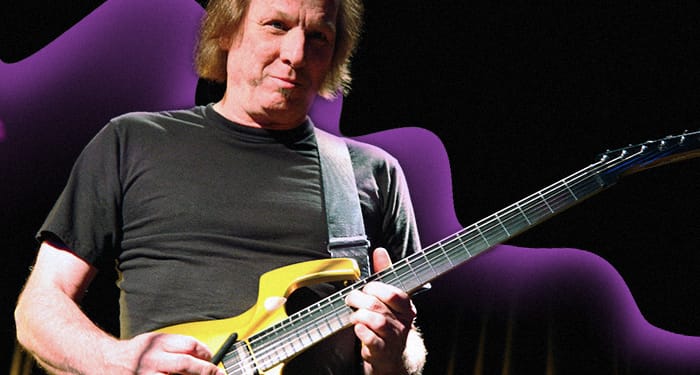
You’re known for using guitars and processing as its own instrument. What’s your philosophy on recording and producing?
You know, at first I was trying to be a songwriter. That’s what I learned and thought I would be. But as my interest grew in what you could do with the guitar (this was in the 1960s when some new guitars were coming out that were starting to do interesting things) it inspired me to try and find my own sound, my own voice.Something that I realized I did that no one else was doing was making the guitar sound like other things. So I started trying to make the guitar sound like animals, car horns and other things. And then people started paying attention to that. It gave me a piece of real estate in the world of guitar players.Something that I realized I did that no one else was doing was making the guitar sound like other things. So I started trying to make the guitar sound like animals, car horns and other things.My passion for sound goes beyond that though. It’s in my music, it’s even between my songs—it’s grown beyond just being guitar. So when I’m working on songs or writing records—especially my solo stuff—I’m always thinking how to orchestrate my music with interesting sounds. Not just sounds you’ve never heard before, but also common, ordinary everyday sounds. Because I think blending those into the music somehow makes it sound more human.So if you’re listening to something like my recent FLUX app, there’s so much stuff in there—you’ll hear it. I want the music that I make to sound more like real life. And doing that often means that it gets interrupted and changes quickly from one thing to the next—essentially that’s exactly what the FLUX concept is.I was going to ask you about the FLUX app. How did you come up with the idea of combining randomness, music, and mobile technology?
In the late 70s I toured Europe with my band and we did a stop in Marseille, France. I went to the harbour by myself and I sat outside between two cafés. They each had their door open and there was music coming out of both. There were also boats, many people walking and talking in French, laughing, car horns and seagulls. Everything was there. At that moment I thought: “That’s what I want my music to be like: life itself.”That’s what I want my music to be like: life itself.So I went on a quest eventually to figure out how I’m gonna make music that isn’t always the same, that changes as you’re listening to it each time. And that took us about five decades to get to that point because there was never the technology available—until they invented apps!Once they invented apps, I went back to thinking about this, to how I could do that—something I’d been wanting to do all my life. I worked with some people in Amsterdam to create a very cutting edge technology in the world of apps. It uses algorithms that do things like never play the same thing twice, while making sure that it all lines up properly without any gaps.
How do these ideas apply on the work you’ve done with ‘Piper’?
I always thought that my music was cinematic in nature. When I write a piece of music I try to make it something you can visualize—something happening in there that allows you to make up your own little movie. So I’ve always been attuned to the field of scoring music. I listen to it, I like it a lot, it’s always informed me. I like animations, I like movies. So it was just a matter of time before someone was going to think: “oh wait a minute, maybe Adrian should do this!”So then I started working with Pixar, and now we have Piper under our belt. It won the Annie Award and now the Oscar, which is very prestigious. So the door might finally be swinging open for that. I’m not in a hurry, it’s just another thing that I’d like to have in my plate of things to accomplish. I know it’s a difficult world to get into, but we’re on our way.Tell me about the process of making Piper. Did you use any of your famous animal sound guitar techniques?
When I first started, I wanted to try to create some sound FX for the movie. I made many bird sounds, and made the wave seem monstrous a little bit. We did tackle that on guitar, but there’s lots of way to create those things.It was a three year process. Because there’s no dialog, the music makes all the emotional content, it carries more weight. So the director wanted to work hand in hand, have me there throughout the whole process. It was amazing.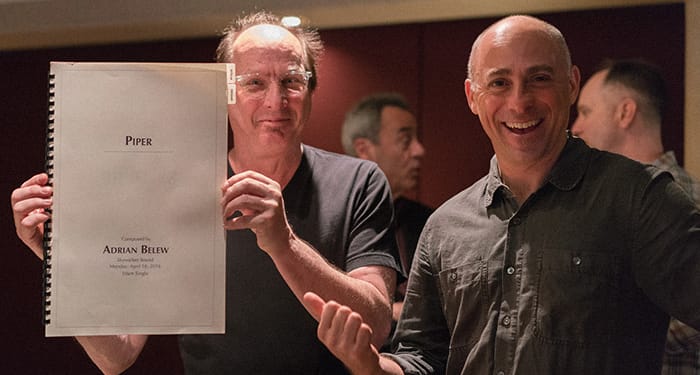
Where do you usually work out of? I’ve seen pictures of the modular recording closet.
The magic closet! It’s a walk-in closet off the side of our control room. Downstairs from my house is the studio. It contains a room for someone who might be staying here. And there’s a recording room that is sonically treated and a pretty small control room that works well. There’s ton of different instruments here!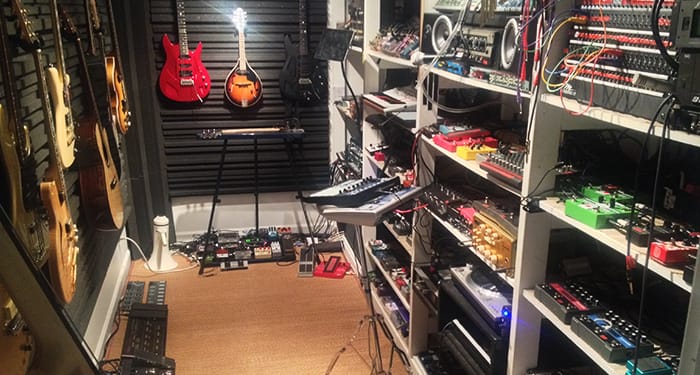
What’s your favorite instrument from that collection?
I work with my guitar with something called an AXE FX—that’s a supreme kind of guitar box. You can do so many things with it. You can keep creating, and going deeper into it and finding things you didn’t know it could do before. It’s the main box that I travel with. So I’ll give that an award right there!What are the music technologies and new avenues that excite you the most nowadays, given all your experience?
The most exciting thing for me is still performing. And I have a very good performance situation with my trio, and we travel the world and it’s still exciting and fun. So I don’t want to give that up. But to be honest, being in the studio has always been my favorite thing. That’s where the magic happens.Aside from that, there’s just a continual process of more exciting things coming up, new software, new gadgets, new things. I don’t let myself get lost in them, but I try to be very aware of them and know what I can get out of them.
Lastly, tell me about the tour you’re preparing. How are you gearing up for it?
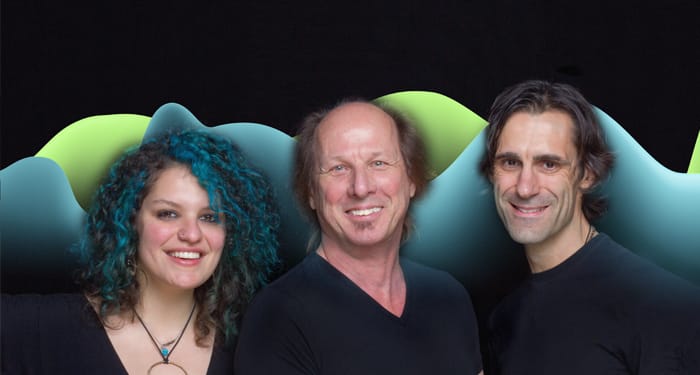
It’s the trio I’ve been working with for two few years, Julie Slick on bass and Eric Slick on drums. We’re trying to push some new things into what we’re doing. It’ll be a conglomerate of everything we have to offer, from King Crimson songs to David Bowie, and more. And it changes all the time, we don’t use a fixed concept in the live performance. We might be playing a song, and suddenly take a left turn and it could turn into something else! And I think it’s really nice, because it’s surprising and exciting. You never know what’s gonna happen. It keeps it exciting for us too, and keeps us on our toes.