

🔥 How Artists Can Turn a Good Live Performance Into an Unforgettable One
You’ve been playing local shows, performing on stage more often, tightening your rehearsals. Now it’s time to really focus on creating something memorable. Let’s talk about it!

Intro
1. Start With the Basics. Then Go Beyond Them.
Let’s get one thing straight. If you’re not able to play your songs perfectly 9 times out of 10, you shouldn’t be regularly booking gigs for your band. Practice makes perfect, and perfection is only the first step to creating a live performance that stands out from the other 150 artists your fans are likely to see in a year.
But that said, the small details really do matter. So let’s take this one step further.
If you know your songs inside out and you can play them with your eyes closed, great. Now you’re ready to focus on crafting the extra little details that take them over the edge:
- Add a slowdown section. Is there a moment you can slow everything down and talk directly to the crowd in the middle of a song? Or tell a story? Or introduce the band members?
- Enhance all dynamics. Can the loud parts get louder? can the soft parts go without mics and amps and get really quiet? Work the energy of each song into a wider spectrum of experience.
- Create transitions between songs. Song->stop->song->stop gets pretty boring after a while. Write a few choice transitions to be placed in between songs in the setlist so the flow becomes a little unpredictable.
- Leave space for spontaneity. Audiences always respond when they sense genuine, present energy.
2. Craft a Purposeful Narrative With Your Setlist
A setlist isn’t just a list of songs — it’s a story you tell in real time. It’s also a tool you can use to move your audience’s emotions, attention, and bodies. Some tips for creating a setlist that results in a greater experience than the sum of its songs are:
- Design a full curve. Start strong, build the vibe, and offer moments where the audience feels something — not just hears something.
- Build emotional peaks and valleys. Fast song->slow song, epic, loud song->quiet, lyrical song. Use the dynamic range of your catalog to your advantage in a live setting.
- Use breaks to connect. Which are the best songs to fully stop, leave room for applause, and then say a few words to the audience? Figure it out! Sharing brief anecdotes and banter is a great way to interrupt the flow of your set with intention.
- Do the lyrics tell a story across two or three different songs? If you’re writing lyrics about love and loss, or grief and and resilience, for example, how can use the subject matter of the songs almost like a movie script to the screenplay of your performance?
3. Elevate the Environment
Good shows simply happen; great ones immerse. When you’re playing a live gig, you’ve essentially got between 30 and 90 minutes of people’s attention to play with however you want. This immersive environment goes way beyond music. Think about how you can transform the room into a place best suited to house your performance.
- Customize the lighting. While your band likely doesn’t have the budget for a fully installed lighting rig, that doesn’t mean you can’t make some adjustments. From tailoring the house lighting to your setlist (which can be done in partnership with the house tech person), to bringing a few lamps and vintage bulbs on stage with you, all the way to using on-stage triggers for spotlights or lasers, lighting doesn’t have to be just decoration, it can be emotional storytelling.
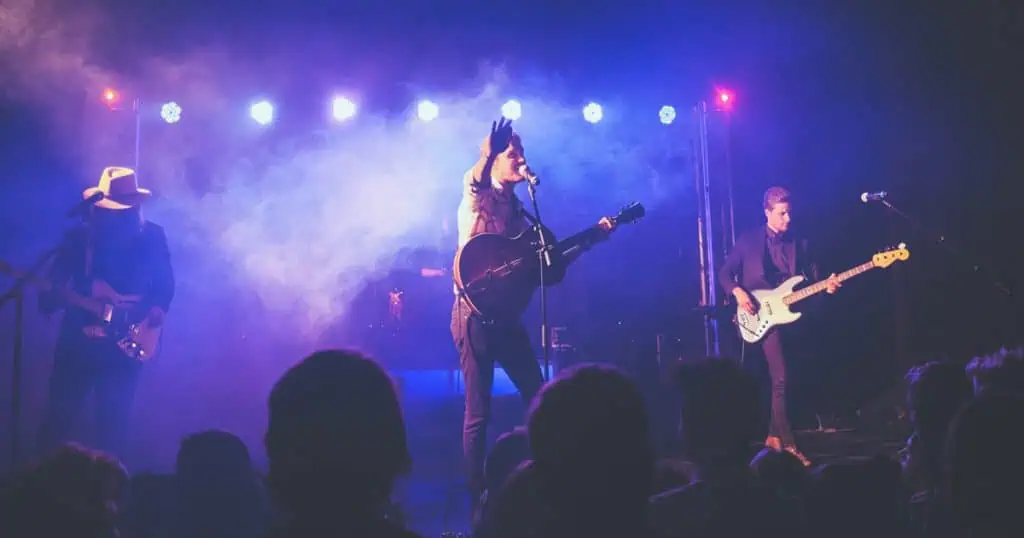
- Fog machines are a hip, cloudy dreamscape. Most venues these days keep one. Think about using a fog machine to create a dreamlike haze in the space.
- Stage layout and setup. Consider how you use your stage — front to back, left to right — and don’t just stand in one spot. Alternatively, are there interesting ways your band can position yourselves to make people stop and notice the change?
- Installation fixtures. You’re an artist, make art! Treat every space like a personal gallery where you bring objects and works to install around the room so that it gives your fans yet another memory or story to tell their friends about your show.

4. Turn the Audience Into Collaborators
Great shows are shared experiences. Encourage participation when the moment is right, and vary up the ways you’re asking your audience to participate too; don’t always reach into the same bag of tricks.
- Invite claps, shouts, or sing-alongs. When the crowd is actively involved, they feel ownership of the night. If they don’t know the lyrics to your songs, pick a song with some simple repeated lines and teach it to them.
- Make eye contact and acknowledge gratitude. Even a brief glance at someone in the crowd creates intimacy.
- Create a spontaneous song. Bobby McFerrin used to tune the crowd, and have different sections sing different notes so that he could play them by pointing. Maybe have the band take five and let the crowd hum the notes to your song while you sing over it?
- Make it a dance party. Bringing 1-2 audience members up to dance on your big groovy tune is a fun way to show the rest of the crowd that it’s okay to let loose a little bit.
- Incorporate a guessing game or merch giveaway. Sometimes bands will play little games of trivia about their music with the audience and whoever gets a question right will earn a merch item.
Get creative! Human connection on stage beats perfection every time.
5. Perform With Intent — Not Just Technique
Technical skill might impress initially, but emotional delivery makes it unforgettable. Your strength is your vulnerability, don’t be afraid to show how a song feels to you. Emotion resonates.
And let your feelings guide your choices in the live environment. If a moment feels alive, let it breathe — even if it means deviating slightly from the planned set.
6. Use Technology Wisely
Backing tracks, samples, and tech should enhance performance — never replace presence. There’s nothing wrong with using pre-recorded samples or triggers to get the sound you want, but always remember that unless you’ve got eye-catching dance moves or big, uncompromising energy, it’s hard to entertain a crowd with just an iPod and a microphone.
Keep it human. Minimize reliance on tracks that isolate you from your audience. If parts must be pre-recorded, integrate them in ways that still spotlight your performance. MIDI pads, controllers, and loops can add depth, but energy on stage must still come from you.
7. Imperfection Goes a Lot Further Than People Think
Great shows don’t avoid mistakes — they adapt to them. Audiences love any opportunity to think that their show is unique, not entirely pre-scripted and duplicated. Mistakes, as embarrassing as they can be sometimes, are a great reminder to your audience that you’re human too, and that your live show is indeed live!
But there are good mistakes and bad ones. If you play one wrong note it’s not the end of the world; if you play two or three wrong notes, try turning it into lightly self-deprecating banter (ie: “Pardon the bassist ladies and gentlemen, he may have met the woman of his dreams last night here in Akron, he’s a little loopy today.”). It lightens the mood.
Always expect the unexpected and stay loose. Technical glitches, timing hiccups, wardrobe issues happen, and more frequently than people think. Just treat them like part of the adventure, and move on. Audiences will respect your composure.
8. Refine Through Reflection
Every show is a learning opportunity. Whenever possible, try to get feedback from objective parties about whether your shows are improving or stagnating. You can also feel free to solicit critiques from trusted friends, family members, and other bands in your scene, about what stands out in your live performance so that you can double down and improve on the things that are truly connecting with an audience.
Don’t be afraid to record your performances. Capture audio and video so that you can rewatch it to see what works and what doesn’t. And if you’re lucky you’ll end up with some great content to post on social media to help grow your fan base next time.
To transform a good show into a great one, artists must:
- live the music (beyond just play it),
- shape the experience (beyond just perform),
- and build connection (beyond just deliver).
It’s about crafting moments that audiences remember — and feel — long after they leave.
