

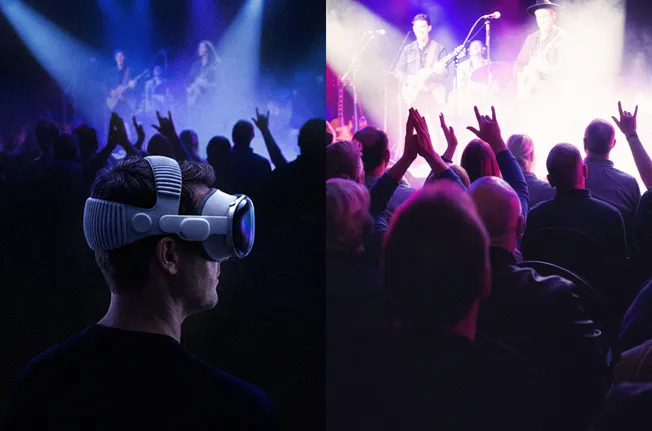
Blue Frog Brings Immersive Concerts to Apple Vision Pro
For decades, concert films and livestreams have tried to capture the magic of live music. But even the best recordings still feel like watching from a distance. Or it feels like its own video-game adjacent experience altogether.
Vancouver-based Blue Frog Studios is trying to change that. This spring, the studio who already livestreams hundreds of concerts per year, plans to launch Blue Frog Immersive, a new platform designed for the Apple Vision Pro that aims to put fans virtually inside the room with the artists performing.
But the best part is, you can go to see an incredible concert without leaving your home (or getting bumped by that dude holding two giant beers).
Using dual-8K stereoscopic video, spatial audio, and head-tracked mixes, the experience is built to recreate the feeling of standing just a few feet from the stage — letting viewers choose their vantage point and experience performances from angles that wouldn’t even be possible at a real concert.
For Blue Frog founder Kelly Breaks, the move into immersive concerts isn’t a sudden leap into tech hype. It’s the latest step in a long evolution of experiments designed to bring fans closer to live music. Breaks says:
“It’s been a natural arc. We went from recording albums to getting into video, then livestreaming. This is just an extension of what we already do well.”
From Intimate Listening Room to Immersive Concerts
Blue Frog Studios began as a recording studio in Vancouver, but it quickly grew into a hybrid recording space and intimate live venue. The studio’s small performance room — with capacity for around 100 fans — became known for its close-up concerts and pristine sound, giving audiences the rare experience of hearing artists in a listening-room environment rather than a noisy bar or club.
That intimacy quickly became part of the venue’s appeal — and its challenge. Shows regularly sold out almost immediately, leaving many fans unable to attend. Rather than simply expand the venue, Breaks and his team began experimenting with ways to extend the experience beyond the physical room.
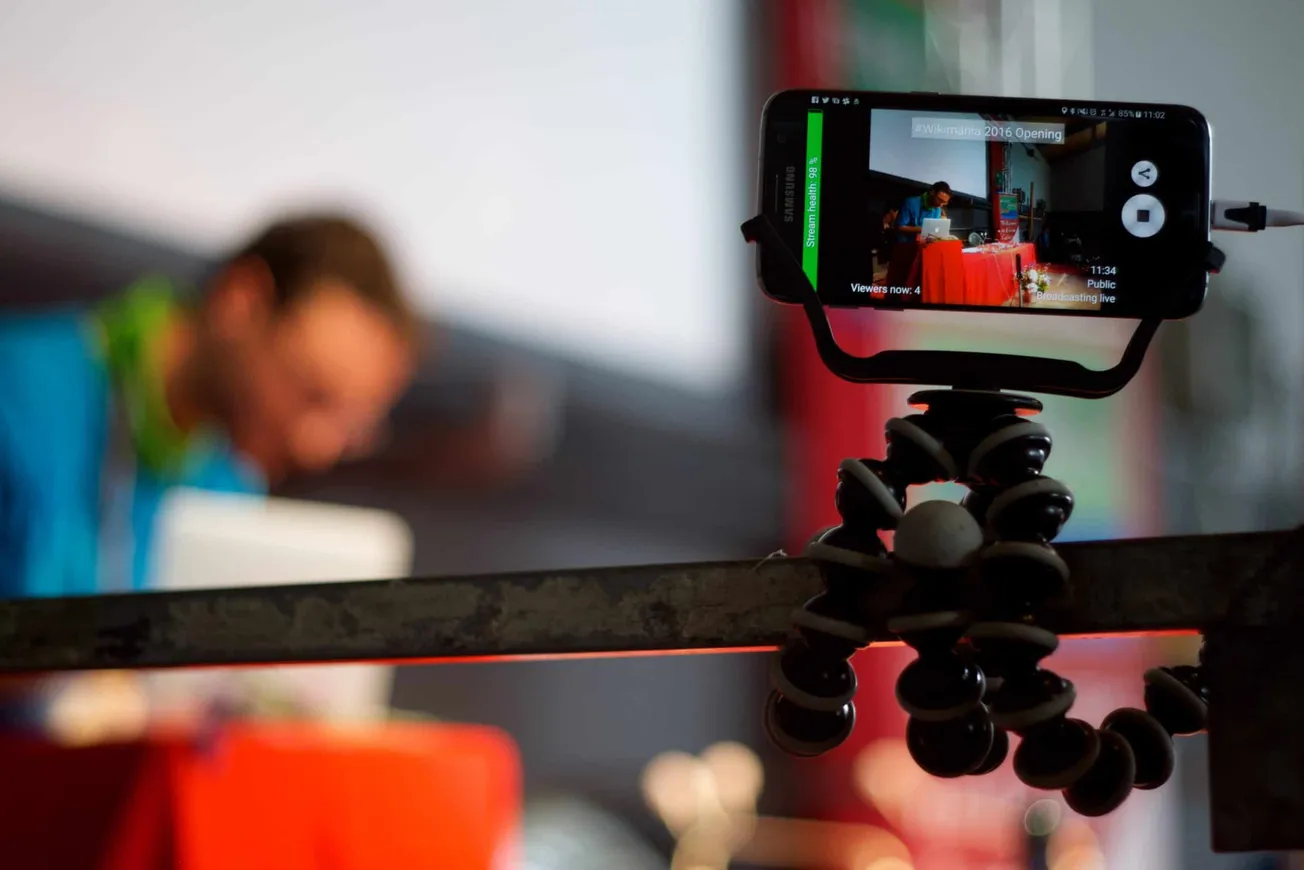
First came filmed performances, then video-on-demand. In 2014, Blue Frog hosted its first livestream concert featuring Jefferson Starship — long before the COVID-19 pandemic helped turn livestreaming into a standard tool for artists and venues. Since then, the studio has streamed more than 800 shows, steadily refining how live music could translate into digital formats.
Each step brought the remote audience closer to the experience of being there.
+Read more: "5 Ways to create a more compelling Music Livestream"
The “A-Ha” Moment for Immersive Music
That missing piece, however, finally clicked into place when Breaks tried Apple’s Vision Pro headset. For the first time, immersive video and spatial audio created the sense of real physical presence — the feeling of actually standing in the room with the musicians rather than simply watching them on a screen.
The technology suggested that concert recordings could evolve into something entirely new: performances captured specifically for immersive environments rather than repurposed from traditional video formats.
“We're always striving for an experience that helps you feel like you’re there in the room with us, not just staring at a screen,”
To make that vision possible, Blue Frog partnered with immersive technology studio Acute Immersive and installed specialized capture equipment, including cameras built specifically for immersive production. The result is a concert format designed from the ground up for spatial viewing and listening.
+Read more: "A Guide to Spatial Audio and Where It’s Heading"
A New Kind of Live Concert Experience
Unlike traditional concert films, immersive performances can place viewers in positions they would never physically occupy at a live show. Fans might watch from the audience, stand just feet from the singer, or even view the performance from behind the drummer — perspectives that transform the concert into something closer to an interactive experience.
For artists, this opens up creative possibilities as well. Performances can be staged and filmed with immersive storytelling in mind, potentially creating new forms of concert media rather than simply documenting a show.
The approach also reflects a broader shift happening across the music industry: the idea that concerts themselves can exist in multiple formats — physical, livestreamed, and increasingly immersive.
Immersive headsets like the Apple Vision Pro remain early-stage technology, but they’re already creating new expectations around digital entertainment. Early adopters are actively searching for high-quality immersive content, and music performances are emerging as one of the most compelling formats for the medium.
Rather than treating immersive video as a novelty, Blue Frog’s approach frames it as a natural evolution of the studio’s original mission: capturing the intimacy of live performance and sharing it accessibly with audiences who can’t physically be in the room.
For artists, immersive concerts could eventually become another way to extend the lifespan of a performance, reach global audiences, and experiment with new creative formats that blend live music, film, and spatial technology.