

Audio Mastering vs. AI Mastering and Why Human Expertise Still Matters
By Chris Huff of Disc Makers
Mastering is a mandatory step in the process of making a record. Your music must be mastered to compete with other music out there on streaming services and radio. With mastering, you get what you pay for; a world-class mastering engineer can take your music to levels beyond your wildest imagination.
But not every project necessarily requires that kind of investment.
Overview of audio mastering
Audio mastering is the process of applying compression and EQ to a finished mix in order to achieve a few objectives. One is making sure that the finished mix is optimized for playback across different kinds of systems and formats. Another would be to achieve comparable levels between tracks on the same album and to ensure consistent playback on streaming services and radio.
The mastering engineer also looks for possible errors, arranges tracks in the final sequence per your instructions, and ensures the final album feels and sounds cohesive.
Rise of AI in music production
With digital recording being the industry standard, it makes sense that artificial intelligence tools would catch on in music production. AI plugins to assist with everything from songwriting to mastering have exploded. Remember that AI tools are just that: tools. They are neither good nor bad — it’s how you use them that matters!
Use of technology for the creative process goes all the way back to the ‘50s with Les Paul and Mary Ford. If it saves you time, and that’s a good thing. But there is a backlash for those who rely too much on AI to create music. When the human element is lost, the music can become basically junk.
+Read more: "Charlie Puth Becomes Chief Music Officer at Moises AI"
Understanding audio mastering
Audio mastering is a complicated process mostly unknown to those outside of the music production industry. Whether you are new to making music or a seasoned professional, it’s good to remember the basics of how mastering works.
Traditional audio mastering process
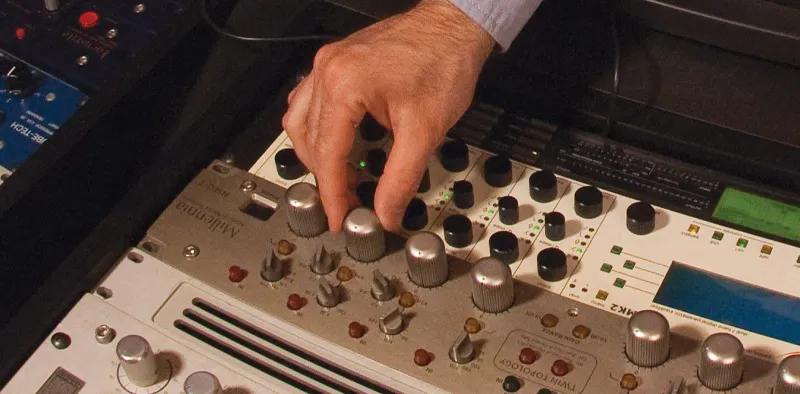
The traditional mastering process is a skilled task performed by engineers specializing in it. Their knowledge and awareness of the limitations of different media are invaluable. Historically, mastering engineers didn’t exist until the introduction of magnetic tape. It was found then that making a master after the final mix improved the overall sound of records. As technology has evolved, the purpose of mastering has stayed the same while the technical aspects of what is done have changed to suit the medium being mastered for.
Key elements of audio mastering
Mastering engineers will vary in their techniques but certain general principles apply across the board.
Equalization
Equalization (EQ) is the process of adjusting the volume of different frequencies to improve sound quality or achieve a specific effect on an audio track. Ideally the mixing engineer has analyzed the high and low ends of each track and has already made adjustments. The mastering engineer will determine if further EQing is needed on the finished mixes and overall project.
Compression
Compressors help control the dynamic range of your audio. They make the quiet parts louder and the loud parts quieter while putting a maximum limit on the volume. A high-end compressor can also be used to color the sound, adding warmth and depth. In the Loudness Wars of the ‘90s, compressors were misused to boost audio levels to their maximum point to match the levels of Nirvana and others. But when used judiciously, the compressor remains a vital tool in unifying the sound of an album.
Limiting
Limiters are a type of compressor used to set a hard threshold which the level of the audio cannot exceed. They are used to prevent clipping and other kinds of digital distortion if a track has been recorded too “hot.” Limiters usually come in after EQing and other compressors have shaped the sound so they are only being applied to the fastest transients (the attacks of each digital waveform). They can be used transparently (meaning inaudibly), but the harder you push them, the more you will hear their effects.
Role of the mastering engineer
What sets one mastering engineer apart from another is experience. The more projects someone has mastered, the more solutions they’ll be able to bring to the table. Some engineers specialize in specific genres like jazz or classical. If your genre relies on audio fidelity, you might want to consider working with a specialist. Ultimately decisions in mastering are not made by analyzing waveforms but with ears; “does it sound good?” is the final arbiter of any decision.
Emergence of AI mastering
The term “artificial intelligence” breaks into four categories: reactive, limited memory, theory of mind (autonomous decision making), and self-aware. So far only the first two actually exist, but these have been applied in some facet of music production for some time.
How AI mastering works
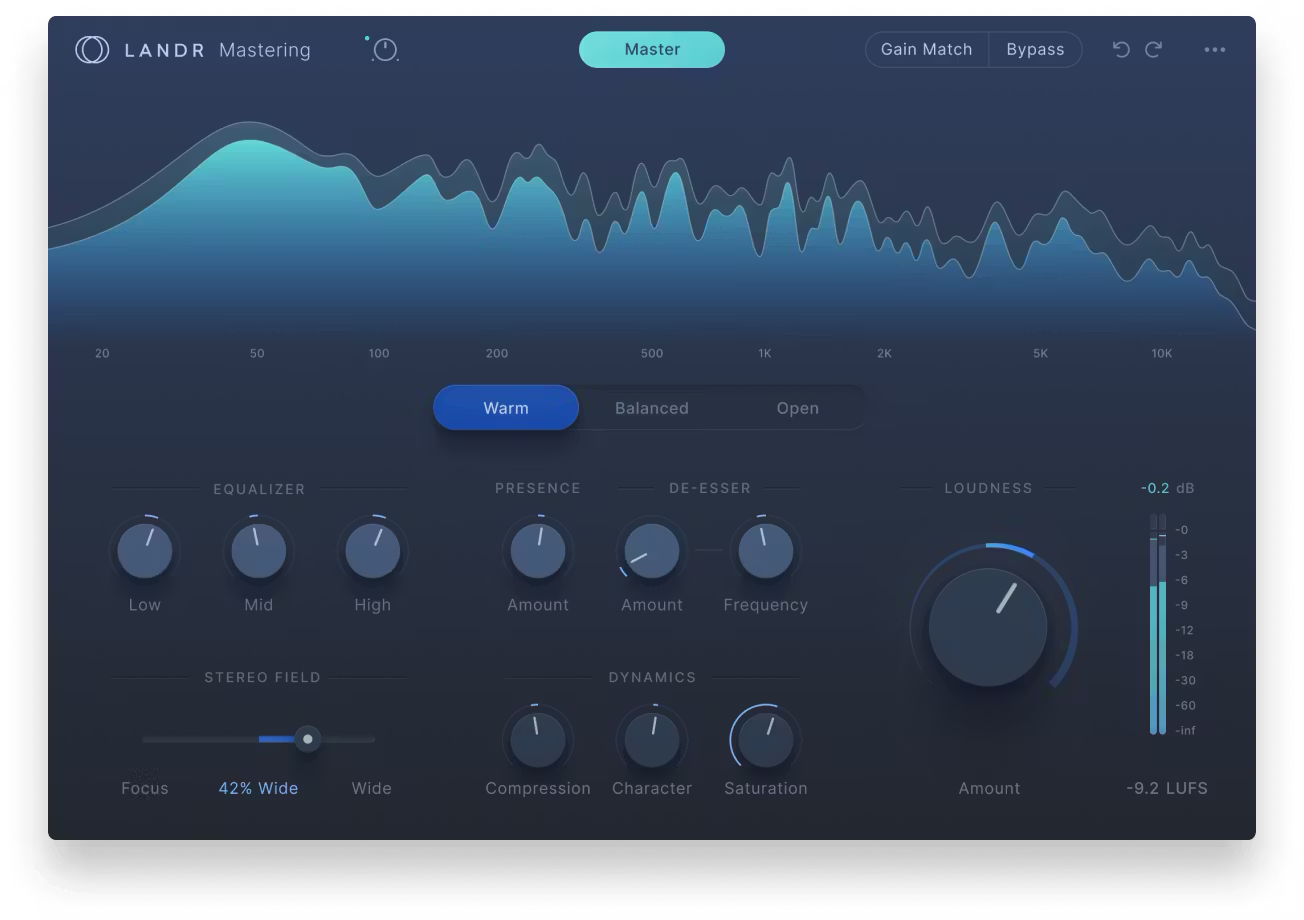
AI mastering analyzes your mixed tracks and applies a selection of processors to adjust different criteria much in the same way a traditional mastering engineer does. One difference is that AI mastering takes seconds whereas a human engineer can take several hours. Much like ChatGPT with words, AI software can analyze patterns and preferences across numerous genres and determine the best settings to apply to your tracks.
Popular AI mastering tools
Some of the most popular AI mastering programs are LANDR, Waves, iZotope Ozone, and Apple Mastering Assistant. Waves and LANDR are available by monthly subscription, Ozone is a suite of plugins you purchase, and Apple Mastering Assistant is included in the latest version of Logic Pro. The advantage to a subscription-based mastering service is that as the technology is constantly updated, so you receive access to the latest and most current updates.
Advantages of AI mastering
For independent artists, anything that saves time and money is helpful. AI mastering is inexpensive and happens quickly. When one is forced to go the DIY route, AI mastering will give you a better final product than one that you clumsily slap together with zero knowledge of what you’re doing. The ability to generate new masters very quickly also allows for experimentation, as you can figure out what it is that you like and don’t like without a large cost. The performance of AI mastering tools will also be very consistent; unlike a human, its ears don’t get tired and it will only be making decisions based on the data.
Comparison of human and AI mastering
Behavioral scientist B.F. Skinner said, “The real problem is not whether machines think, but whether people do.” When comparing human and AI mastering, keep in mind that the software and plugins are only as intelligent as the people who are operating them.
Accuracy and precision
In some ways the differences between human and AI mastering are similar to the differences between CDs and vinyl records. Many insist that there is nothing better than high-quality digital sound. Others insist that because sound is an analog waveform, only an analog process can accurately capture the entire waveform. This can also apply to mastering.
While all agree that the technology does not yet replace human engineers, its ability to work competently from a large dataset means that an AI master will have a certain degree of accuracy. But if you want your record to bring out your own unique voice, the best way to achieve that is to hire a human mastering engineer (like the experts at The SoundLAB) who can help you move in that direction. So far, AI is not able to correct for uniqueness.
Creativity and artistic interpretation
The advantage to AI’s access to aggregated data is that it shows creators more possibilities. More possibilities allow for more experimentation, and, with AI tools, you can do this faster than ever. But sometimes, more possibilities are overwhelming rather than constructive. Producer Brian Eno created a set of cards called Oblique Strategies designed to create new possibilities by setting artificial limitations.
The intention was to help people think out of the box in the studio. AI is not currently capable of this kind of thought. These kinds of methods can lead to new ideas and the creation of a space where “happy accidents” can happen.
Consistency and efficiency
When it comes to consistency and efficiency, AI tools excel, as they will proceed methodically and expediently all the time. Humans are consistently human, which means they make mistakes and respond emotionally. So, both humans and AI perform consistently in the ways expected of them. The best professional mastering engineers are highly efficient, but won’t deliver a master in seconds. However, the quality of their mastering will exceed AI’s capabilities.
+Read more: "Move Over Eno: The Creative Cards Are the New Prompts for Musicians"
Why human expertise still matters
Even though it operates on certain mechanical and technical principles, mastering at its core is more art than science. And machines are not yet capable of creating or shaping art in a way comparable to humans.
Understanding genre and context
AI might be able to see that your waveforms are similar to other melodic rock songs, but will they understand that your music is a combination of Big Star, The Replacements, and KISS? A human mastering engineer will be able to evaluate what you give them based on historical context and a nuanced assessment of genre.
Emotional and artistic nuance
If you explain to a mastering engineer that a song is about your deceased friend, they will approach the mastering with a certain sensitivity. You can’t explain to an AI mastering plugin that this song should have the vibe of standing outside your high school prom, sad that your date left with someone else. There’s a famous story about Bob Weir of the Grateful Dead requesting that a track have the sound of “heavy air.” Maybe someday AI will be able to grasp abstract emotional concepts, but that day is far away.
Flexibility and problem solving
When you pay for a world-class mastering engineer, you are paying for their experience. They have often mastered thousands of projects for artists on all levels of the entertainment food chain. Like lawyers with extensive case experience, they bring a depth of knowledge that machines cannot. Engineers can save you time and often solve problems beyond your own grasp because they have seen them before and know what the possible fixes are.
Limitations of AI mastering
There are definite limitations to using machine learning for mastering, no matter how cheap or expedient.
Lack of personalization
AI mastering relies on algorithms trained to optimize technical parameters. The masters it produces may sound professional and polished, but like any AI-related content, it will tend towards homogeneity rather than nuanced artistic expression. When planning a final master to compete with all of recorded musical history on a streaming service, it’s worth it to work with a mastering engineer who can help you to translate your own unique vision into sound.
Dependence on algorithms
As we all know, algorithms can be notoriously imprecise in many ways. You’re limited to the dataset that the AI mastering program is pulling from, and the options for EQ and compression will not generally be as customizable the way they are in real life. So with AI mastering, you’re limited by the tool itself whereas with a human engineer you are just limited by imagination and the available gear.
Challenges with complex projects
For certain styles of music, AI mastering is probably just fine. Certain kinds of repetitive electronic music are mastered in the same way whether it’s a human or an AI turning the knobs. But with a classical ensemble or a jazz combo, there will be variations in dynamic range that an AI won’t be able to address adequately. This music requires more careful attention from a human with experience.
The future of audio mastering
Technology will continue to evolve. Based on the value it provides and economic viability, AI mastering may grow or it may fade away. The democratization of mastering is one of the best and worst effects of AI being involved. On one hand, it’s wonderful when the means of production becomes available to everyone. On the other hand, it tends to increase the glut of mediocrity rather than stimulate the creation of better music as we’ve seen with digital recording.
Integration of AI with human expertise
AI tools have a lot to bring to the party. Like the analysis of statistical information in baseball, you can get a deeper understanding of certain things through data. But, continuing the baseball analogy, you can’t just rely on numbers to win the game; there is great value to old-school approaches based on intuition and personal experience. So an integrated approach where a human mastering engineer is directing the process using AI tools to enhance their work rather than relying on them to do all the work is one probable future.
Predictions for industry trends
Currently, AI mastering tools are still growing and more people are discovering them daily. Their quality and affordability are increasing, so for those without the means to use a pro human engineer, they will remain a viable option. However, there is a consistent backlash to AI. Artists even at street level are generally concerned about using the tools wisely and the public perception. AI tends to make everyone sound the same, so uniqueness will be even more important in the near future. One might see bands and artists using AI mastering for quick and easy limited releases and save the expensive human mastering for their official recordings.
Evolving role of mastering engineers
Only a handful of the great mastering engineers from the analog tape era remain working. World-class mastering engineers are still easily found, however! These engineers are artists in their own right. Their experience is priceless and it is worth it to hire them, as they will make your album the best it can be.
That being said, a new generation of mastering engineers is coming that will embrace the best of AI technology and combine it with old-fashioned expertise, synthesizing the best of both worlds. Perhaps your style of music has nothing to be gained from using AI tools. It’s ok to reject things in the interest of making your music be the best it can be! But perhaps the pluses of AI mastering tools can help you make slight improvements around the edges that are then refined by a professional mastering engineer.
If you want to learn mastering for yourself, by all means, pursue that path, but be aware that a little knowledge is dangerous. Remember that your experience as a dilettante will probably never match someone who has made mastering their life’s work. If you can stay humble and studious, the knowledge you gain can assist you in creating excellent recordings.