

By Ronnie Pye, founder of IQ Artist Management
There tends to be a specific pattern to how fraud scales. It always starts small, testing the waters, and often looks like a little "noise." By the time anyone notices and names it for what it really is, many years have passed and the money is long gone.
On 19 March 2026, Michael Smith pleaded guilty to conspiracy to commit wire fraud. Prosecutors presented to the court a scheme designed to deceive music platforms running from 2017 to 2024.
Seven years. In that time, Smith used AI tools to produce fake tracks and deployed automated bots to inflate stream counts, accumulating up to 661,440 fraudulent streams per day and diverting over $8 million from legitimate royalty pools. It was the first US federal prosecution of its kind.
You may be surprised that I wasn't surprised by any of those numbers. Not by the scale, not by the duration, not by the fact that it ran largely undetected for the best part of a decade. I'd seen the pattern before.
Whilst I have been managing artists, I also studied streaming fraud at postgraduate level at the University of Liverpool. The mechanisms Smith used are not particularly novel. Bot farms, royalty pool dilution, fake playlist injections.
These aren't abstract concepts. They have operational signatures, and anyone who has spent serious time studying how fraud actually works will recognize them immediately. The elephant in the room is everyone knows that it goes on and can even quite accurately theorize how it may happen. People you know and I know, speak about it, almost daily.
The Smith case matters enormously. But it is just one man, one prosecution, and one scheme. The question it raises is what everyone else has been doing in the seven years it took to get here.
In January 2026, Apple Music confirmed it had identified and demonetized 2 billion fraudulent streams in 2025 alone. Oliver Schusser, Apple's VP of Music, put it quite plainly:
"This is a zero-sum game."
A royalty calculator from the law firm Manatt Phelps & Phillips put that figure into context. 2 billion fraudulent streams represents nearly $17 million in royalties taken from artists who earned them legitimately.
Apple responded by doubling its fraud penalties. The sliding scale now runs from 10 percent to a 50 percent cap on top of losing the generated revenue entirely. Schusser's stated goal is zero fraud on the platform. He also described his competitors as, "really struggling with this."
Around the same time, Deezer have reported that 60,000 AI songs were being uploaded to its platform every single day, representing 39 percent of all daily uploads. Of the streams those AI tracks generated, 85 percent were fraudulent. The IFPI formally named streaming fraud as an industry talking point in its Global Music Report 2026. This is the first time the trade body, that sets the terms for platform policy discussions, has elevated this to a headline concern.
+Read more: "New Data Reveals That Streaming Is 70% of Total Recorded Music Revenue"
So, Smith hasn’t been operating in isolation. He was operating in a market that had been providing the conditions for exactly this kind of scheme for years, and the industry is just beginning to say so, out loud.
My postgraduate research covered streaming fraud in some detail. That work, and subsequent research and writings has given me a framework for thinking about this that sits slightly outside the standard music industry commentary. Fraud has mechanics.
It has patterns. And the patterns behind streaming manipulation are, in the end, not that different from the patterns behind any other financial fraud operating at massive scale.
Bot farms simulate human listening behaviours across distributed IP addresses, making bulk streams look organic. Fake playlist injections route fraudulent plays through playlists that appear editorially curated. Royalty pool dilution is the downstream effect: every fake stream added to the total reduces the per-stream value for every legitimate artist in that pool.
The fraud doesn't need to target anyone specifically. It just needs to exist in the pool. The damage is automatically catastrophic.
What strikes me about the Smith case isn't the methods used. It's the duration. Seven years of 661,440 streams per day before a prosecution was brought. That timeline tells you something about detection, something about platform incentives, and something about how long a fraud has to run before it becomes someone's problem to solve.
The pro-rata royalty model, where a single fixed pool is divided by the total number of streams on a platform, creates a structural condition where fraud is not just possible, but mathematically rational. Every fake stream injected into that pool dilutes the value of every legitimate play. The fraud doesn't need to be highly targeted and sophistication isn’t the point, scale is. It just needs to be large enough to justify taking the risk of capturing a meaningful share of the pool, before anyone notices.
Schusser called it a zero sum game, and he was absolutely right. But, the zero sum condition isn't just a feature of the fraud. It's a feature of the model. When the payment system works this way, streaming manipulation isn't a bug that bad actors have found a way to exploit. It's a predictable consequence of the foundations of the economic architecture.
Doubling fraud penalties is a perfectly rational response. Prosecutions like Smith's are necessary. But both responses address individual bad actors operating within a system that remains structurally hospitable to the underlying behaviour. A payment model where each subscriber's fee follows their own listening, rather than being pooled across all subscribers, would change the economics entirely. Inflating streams on another account wouldn't affect your payout whatsoever. It could be argued that the financial incentive to do so, largely, disappears.
That model exists. Some smaller platforms have experimented with it. It hasn't arrived at scale, and it won't without significant industry level pressure. The IFPI naming streaming fraud in the Global Music Report 2026 is the beginning of that pressure. Whether it translates into structural change or just better policing of the current architecture is the question worth watching.
From a management perspective, the practical response is straightforward, if a little unglamorous. The first thing I check on any client's royalty statements is whether revenues have shifted unexpectedly from one year to the next, particularly around periods when platform level fraud activity has been publicly reported. Of course, it won't always be fraud, and we shouldn’t approach it with that mindset. But it should always have an explanation.
When something looks anomalous, flag it to the distributor in writing. Not a phone call. An email. It creates a record, and if the platform's internal investigation surfaces something later, you want your client's concern documented before the restitution conversation starts.
The broader point is about registration. PRS for Music. PPL. SOCAN. BMI. ASCAP. Correct metadata on every release. If enforcement does scale up and restitution becomes a live conversation, the payment infrastructure will follow the same channels as existing royalty distribution.
Artists with incomplete or incorrect registrations will not receive what they're owed. This pattern played out with streaming. It will play out again.
The Smith conviction is genuine progress, no doubt. A precedent has been established, a message sent to anyone running a similar operation that the outcome is now more predictable. And, that matters.
What it doesn't change is the arithmetic. The pro-rata pool is still the pro-rata pool. The incentive to inflate it remains. And as AI lowers the cost of producing fake music towards zero, the barrier to entry for this kind of fraud falls with it.
Attention and structural change are different things. Confusing them is how this kind of problem runs for seven years before anyone gets prosecuted.
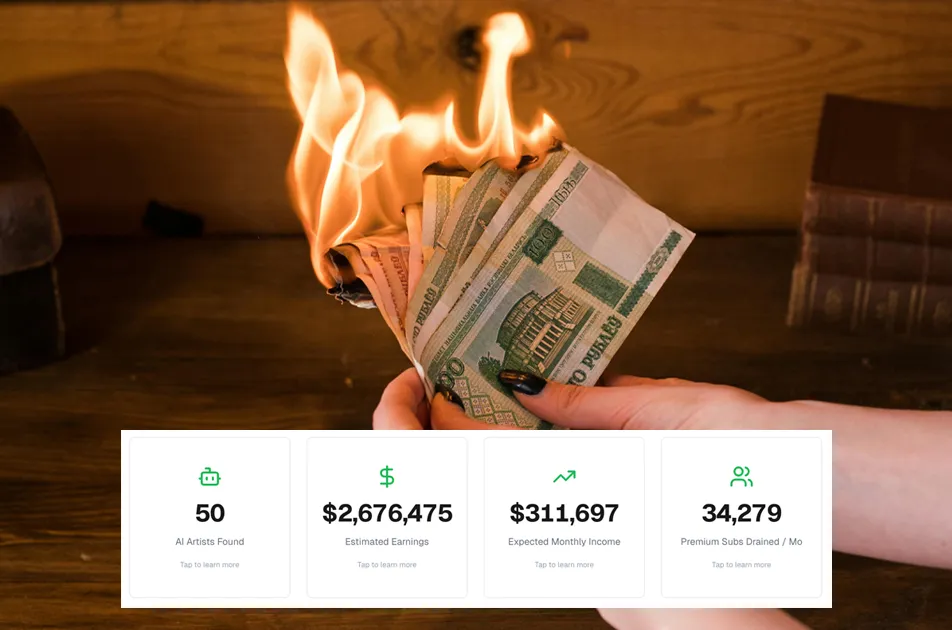
+Read more: "Want to Track How Much Money 'AI Slop' Drains From Artist Royalties?"