

"Success is changing the way people hear themselves, hear their neighbors, and hear their city."
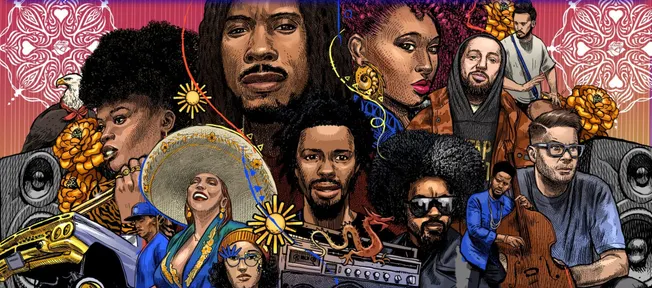
We’re always interested in how music professionals are pushing boundaries - not just sonically, but socially. Enter Art of the Crossfade, an ambitious new multi-city project spearheaded by cultural historian Josh Kun and legendary hip-hop DJ/producer J.PERIOD.
As America celebrates its 250th anniversary amidst deep social polarization, Kun and J.PERIOD are turning to a uniquely musical metaphor for democracy: the DJ crossfader. It’s a tool designed to blend two entirely different records into one harmonious groove, without silencing either voice. This ethos is the heartbeat of the project, a tour that combines musical lectures, hands-on community storytelling workshops, and real-time "Live Mixtape" performances.
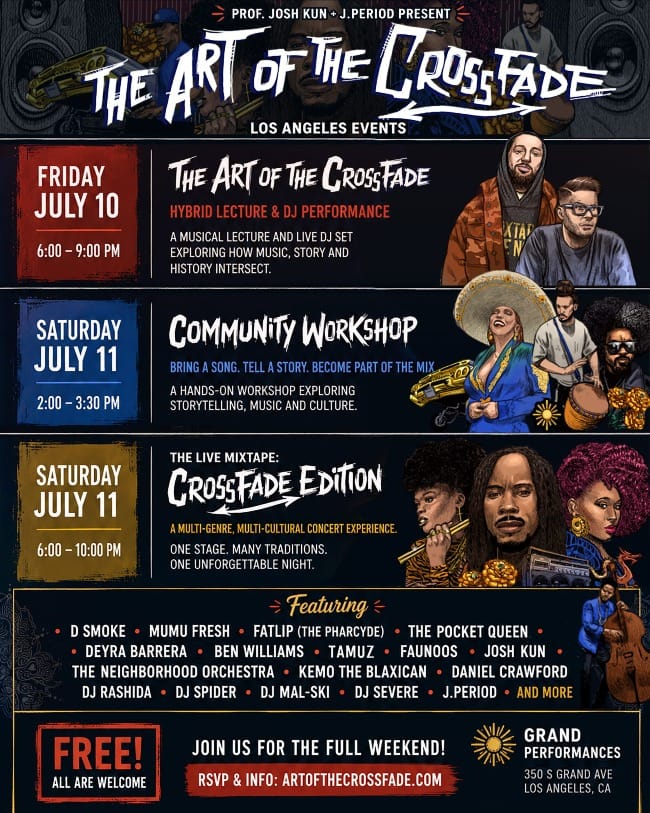
The tour kicks of this Saturday July 11th in Los Angeles with The Live Mixtape: Crossfade Edition at Grand Performances. Billed as a "live remix of Los Angeles itself," the free event boasts an strong lineup of national headliners and local powerhouses, including D Smoke, Mumu Fresh, Fatlip (The Pharcyde), The Pocket Queen, and more.
Learn more about Art of the Crossfade and RSVP for the free July 11th LA Event here.
Ahead of the highly anticipated LA kickoff, we sat down with co-founder Josh Kun to discuss the genesis of the project, the power of the crossfader as a tool for civic imagination, and how the music industry can help write a more inclusive story of American sound.
Josh Kun is an award-winning cultural historian, curator, and MacArthur Fellow. A Grammy-nominated writer, he is the author and editor of "Audiotopia: Music, Race, and America, Songs in the Key of Los Angeles," and "The Tide Was Always High: The Music of Latin America in Los Angeles". He is Vice Provost for the Arts at USC, where he holds the Chair in Cross-Cultural Communication at USC Annenberg.
Here's our conversation. Enjoy!
Hypebot: The Art of the Crossfade explores a powerful and alluring premise: that music connects people across cultures, generations, and communities. How did this joint project come about?
Josh Kun: "As a music historian and a DJ/producer we both operate under the fundamental belief that music is a unique tool of connection, both in terms of its listeners and audiences, but also in terms of the historical and cultural connections contained within any single piece of music."
As a writer and teacher I was drawn to the crossfader as a metaphor and method for thinking about music in new ways; as a DJ, J.PERIOD knows the power of the crossfader as a practical, technological tool — it allows him to mix different tracks together without erasing either of them. It allows him to slide the crossfader to land on points of connection and create new, unexpected conversations between sounds and songs."
H: Why choose a DJ's crossfader as your central theme and how will you bring the concept to life?
JK: "It is an innovation that is rich in both its applied technology when mixing, but also rich as a metaphor that can be extended into all sorts of social and cultural contexts."
In our events we bring it to life live on stage — J.PERIOD uses his crossfader to blend samples and beats together into new combinations and I tell stories of cultural crossfades over the decades. And then with the addition of live performers, we create a whole new mix live on stage."
"In places where polarities are prevailing and where difference is seen as a threat, we believe the crossfader is a useful tool for embracing difference, connecting across polarities, and telling new stories."
H: What else can people expect at the LA events?
JK: "As a lead up to the big show — a live mixtape featuring an all-star cast of MCs and musicians — we will be performing a DJ-driven musical lecture that explains the crossfade concept over live samples and beats, and then hosting a community workshop with key organizations working on belonging, community, and civic engagement in Los Angeles (ALMA Backyard Farms, CHIRLA, Miry’s List, and Boyle Heights Arts Conservatory)."
At the workshop, community guests will share their stories and favorite songs, and they too will become part of the LA mixtape we assemble."
H: You are also taking "The Art of the Crossfade" to Phoenix, New Orleans, and Lincoln, Nebraska, Why these cities and how will these shows differ from LA?
JK: "These are all cities that have been facing conflicts, division, and struggles, whether immigration and ICE raids, refugee resettlement, or large scale demographic swings."
In places where polarities are prevailing and where difference is seen as a threat, we believe the crossfader is a useful tool for embracing difference, connecting across polarities, and telling new stories."
H: If you've been to a great live show or spent a day at a music festival, you've seen how music brings people together. But with Americans more divided than at any time since the Civil War, is it realistic to think that music can make a meaningful difference?
JK: "Can music end political polarization, squash cultural tensions, and stop xenophobia and hate? No. But can music be a tool that helps us imagine ways out of those things and rehearse new political futures, that helps communities see themselves in the histories of others, that reminds us that it is in difference that we thrive, that the way music moves us can lead to new social movements? Yes, absolutely."
H: What would success look like for this project?
JK: "I look forward to the community workshops where in each city different communities share their stories and hear their music as part of a larger mix."
Success is providing opportunities for new platforms for where music is a bridge toward democracy and inclusive belonging. Success is raising money for our community partners and making their work visible. Success is changing the way people hear themselves, hear their neighbors, and hear their city."
H: For those not able to make it to a live show, are there ways that they can participate and learn more?
JK: "They can follow along on our website— artofthecrossfade.com— where there will be news of livestreams, general project updates, and most importantly info about the mixtapes that get made in each city."
![Inside RAMPD and Concord’s Inclusive Songwriting Camp [PHOTOS]](https://storage.ghost.io/c/3a/95/3a957c06-c825-4057-9939-0a274cc16d23/content/images/size/w1304/format/webp/2026/09/L1025988JENROSENSTEIN.jpg)