

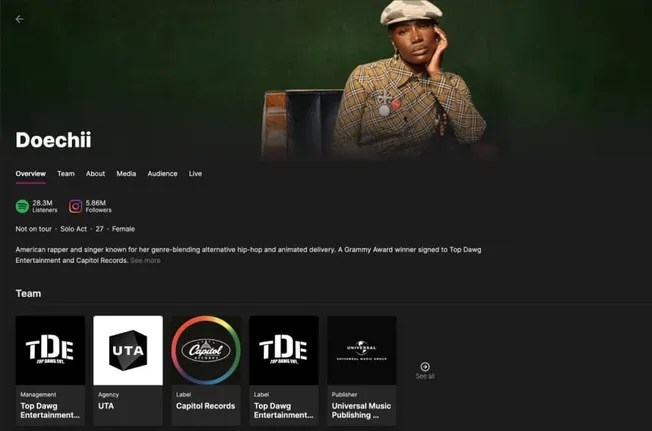
The launch of ROSTR 2.0 unifies what were previously separate tools into a single platform, combining contacts, directories, job listings, artist analytics, and industry news into one streamlined system.
The rebuild also includes a new tech stack, redesigned interface, and features like dark mode aimed at improving usability.
ROSTR says it now tracks more than 563,000 music industry professionals, up 62% year-over-year. It has 120,000+ monthly active users alongside 400+ enterprise customers, including labels, agencies, and management firms.
"When we started ROSTR, our mission was to help create a more modern, connected, and fair music industry. It was an ambitious goal — but one I’m now confident we’re actually achieving. With ROSTR 2.0, we’re making our biggest investment ever to go even further."

Shift Toward Data Driven Infrastructure
ROSTR is working to play a larger role in how artists and their teams discover partners, hire talent, and navigate an increasingly complex ecosystem.
The relaunch also highlights a broader shift toward data-driven infrastructure across the music business. As we’ve chronicled in coverage of AI’s growing role in music discovery and decision-making, access to reliable, connected industry intelligence is becoming essential.

Why This Matters For Artists, Managers & Venues
For independent artists and teams, access to accurate industry data has traditionally been fragmented, expensive, or gatekept.
Platforms like ROSTR, independent competitor CelebrityAccess and OakView Group's Pollstar are working to lower that barrier by making it easier to identify the right manager, agent, publicist, or label contact without relying solely on personal networks.
For venues and promoters, better visibility into artist teams and relationships can streamline booking, outreach, and partnerships; especially as competition for talent intensifies.
Hypebot's Bottom Line
Live music is finally moving from the Wild West phase to the Institutional phase, building the professional systems to manage global careers at scale.
As the music industry becomes more data-centric and AI-driven, platforms that organize and control that data are becoming as important to the business side of the music business as streaming services and social platforms.