_________________________________
Guest post by Josh Hayes of ChartmetricBillboard’s March edition proclaims “Women are Dominating The Billboard Hot 100.” Women have indeed claimed more no.1 spots on Billboard’s 2019 charts already than they did for all of 2018.Two years ago, Trevor Anderson also tracked how female-acts have increasingly claimed the No. 1 slot of Billboard’s Hot 100 over decades: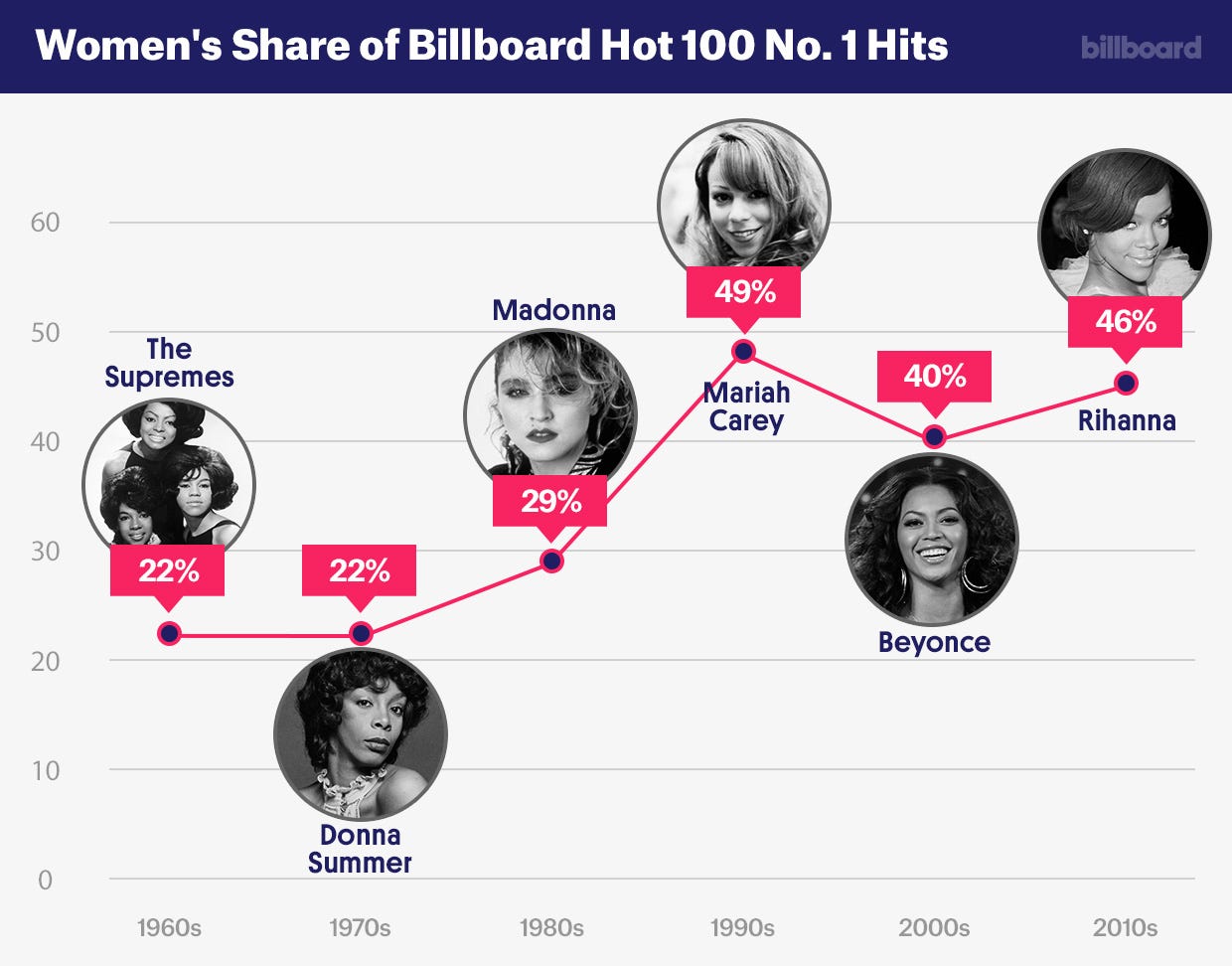
- How big is the gender divide for top performers?
- How different are streaming charts from the more universal Billboard chart?
- Have audience’s listening preferences changed over time?
First, a few considerations:
- Because lots of individuals can be credited on a song (multiple artists, or multiple members in a band) we’ll count just the primary song credit and for bands we’ll look at just the lead singer.
- Spotify chart means Top 200 chart. Spotify tracks the top 200 tracks but for consistency we’ll just look at the top 100. For this analysis, we took the data since July 2017.
- Apple Music chart refers to Apple Music Daily Top 100 chart. The Daily Top 100 chart was released in August of 2018. We started tracking it in September.
A Gender Divide of the Charts:
How many women make it onto the charts at all? To answer this question, we compiled a list of over 104,000 data points over the last two years across Billboard, Spotify, and Apple Music.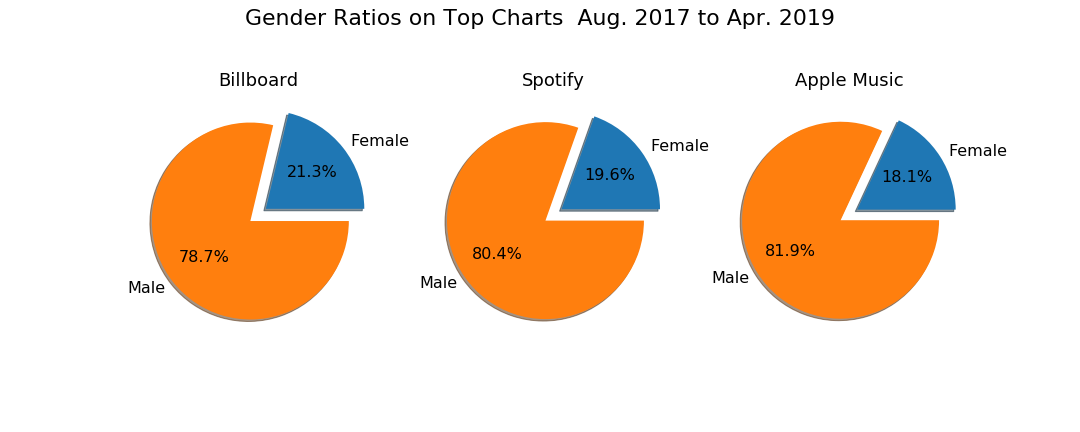
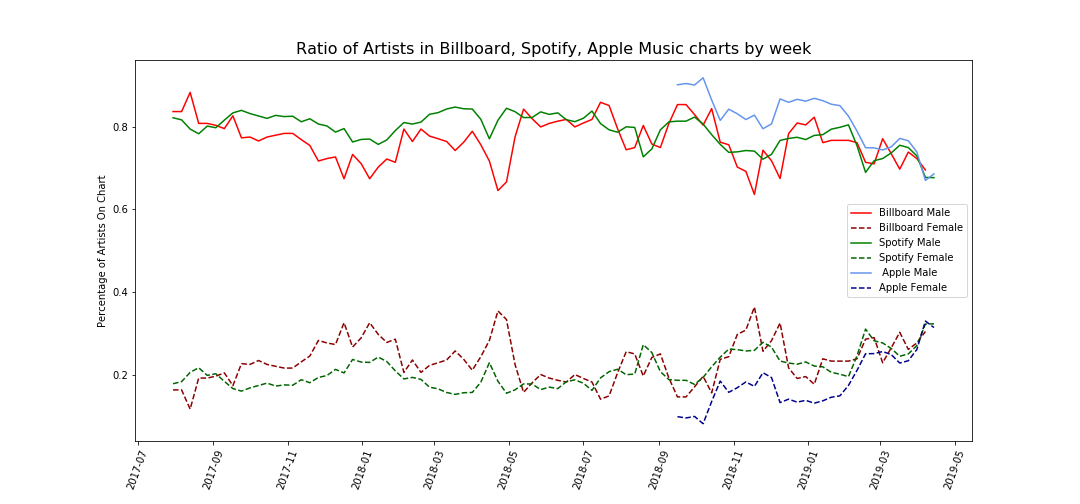
- Gender disparities are large across the board. On all three platforms, there is a significant gender divide. Each chart has been cruising close to the 80–20 split of men to women.
- Streaming is making Billboard rethink what it means to be Hot. Before June of 2018, the connection between the Spotify and Billboard charts was looser but from June on the two start to align a bit more. After Apple Music joins the party and we are moving into 2019, all three charts are starting to look very similar. Those patterns coincide with huge growth in streaming and sequential changes to the way that Billboard accounts for streaming.
- Female artists are growing their stream-share rapidly. Over the last 6-months, the weekly average of Spotify female performers on the charts has achieved roughly 110% growth. On Apple Music we can see a whopping 145% growth. That growth appears more significant and stable than the episodic gains that female acts had in the past. There are a lot of peaks and valleys across the charts for both genders, but based on the latest trends, my guess is that female performers will at least keep their new foothold even if their growth slows. It’s also possible they keep climbing.
Digging Deeper with Chartmetric Scores (CMS)
Comparing raw counts of performers is a good start. However, if an artist shifts from No. 99 to No. 1, they still count the same. If an artist moves from No. 100 to No. 101 they no longer count. Moreover, not all chart-positions are created equal. It is harder to jump from No. 3 to No. 2, than it is to shift from No. 100 to No. 99. To see just how competitive the upper ranks are, look at a sample of song streams from a global chart: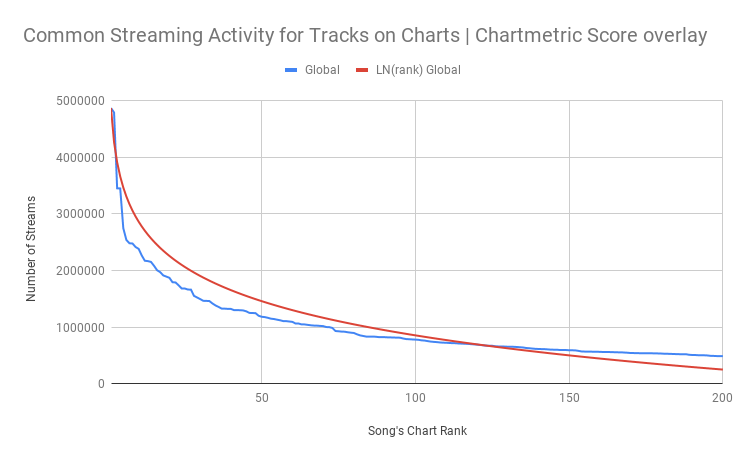

Chartmetric Score? Why is that interesting?
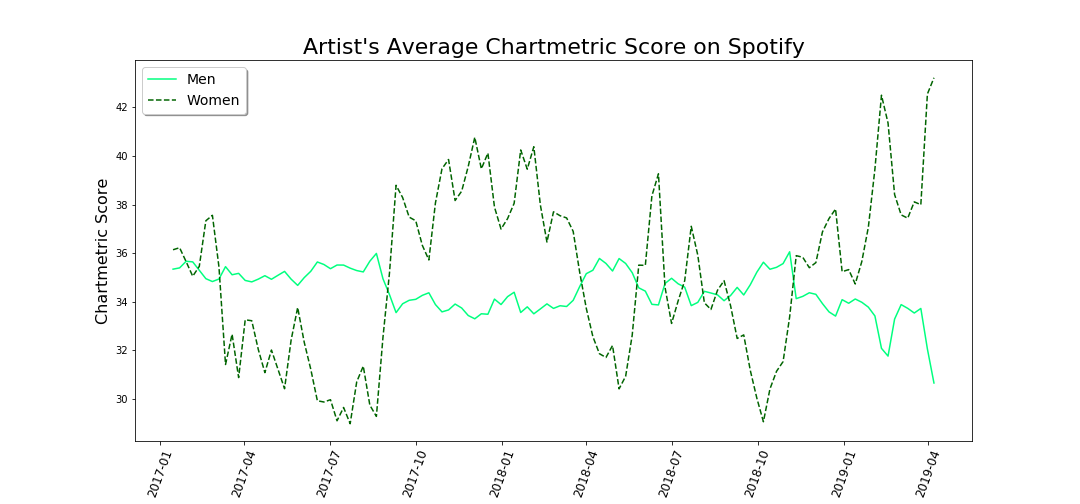
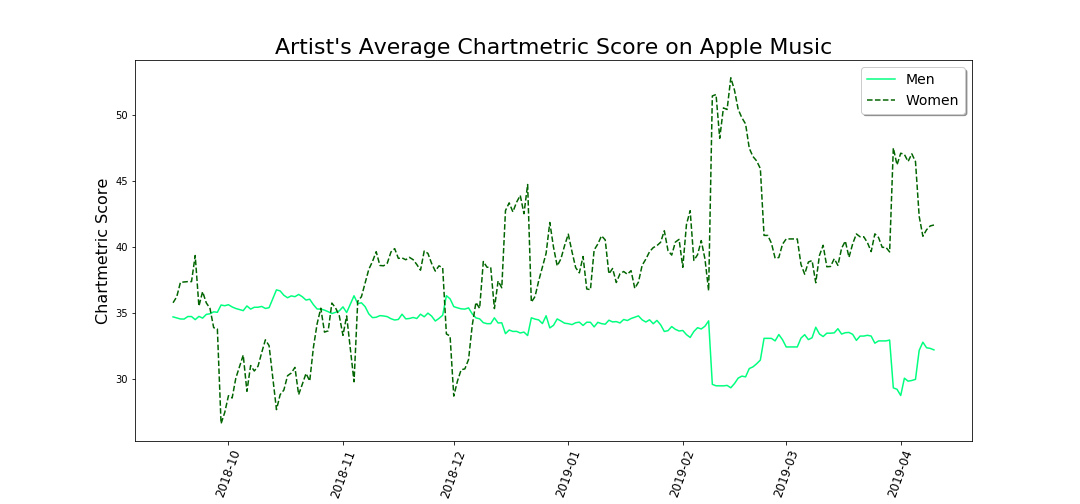
It is interesting because CMS allows you to track artists’ relative performance on the charts rather than just their inclusion on the chart. It’s like how FICO scores try to help you make sense of risk by plotting it in a single number on a linear line. Then, it is much easier to conceptualize what is happening.At its simplest, higher CMS means an artist is doing great and lower CMS means an artist is doing less well.With CMS, we can track how successful the average male and female artist have been, across our streaming platforms:Spotify Top 100 Global
Apple Music Daily Top 100 Global
What We Learned From Spotify and Apple Music Charts
- When women succeed, they succeed big. Across both platforms, when women enter the top 100 they tend to surge to the top of the charts. Either it is harder for female acts to linger further down the list, or perhaps there are just more male acts that linger in the top 100 but don’t reach the peak of the pile. Perhaps our next analysis should be on the lifespan of songs by male/female artists. Either way, when female artists hit they hit home-runs.
- Success is more concentrated for female performers. Male artists tend to have more conservative and stable reach, but women are less likely to make it into the charts overall. The averages for men are drawn down partly because male-led tracks routinely populate the lower portions of charts. For every male-led track with runaway success in the top-10, there is often a handful of male-acts trailing along in the lower ranks also.
- Hot and cold. It is not uncommon for women to have phases where they outperform men in regards to streaming reach and, thus, profitability. Neither gender has been simply winning out-right.
- Status quo no more. The old patterns don’t look like they are going to keep holding. Female performers’ success on Spotify has been trending up for the past year. On Apple, women just recently upset the gender balance all together.
Comparing Across Countries and Genres
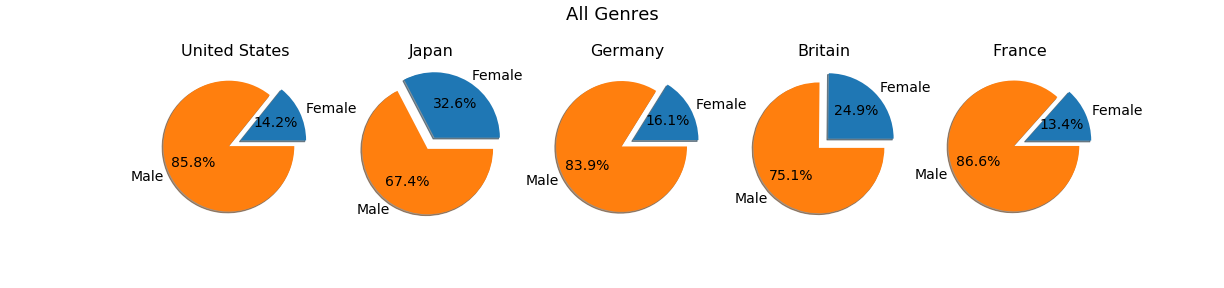
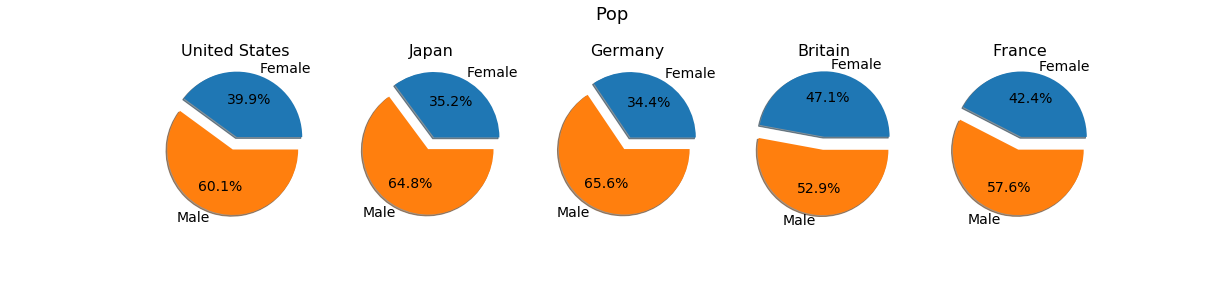
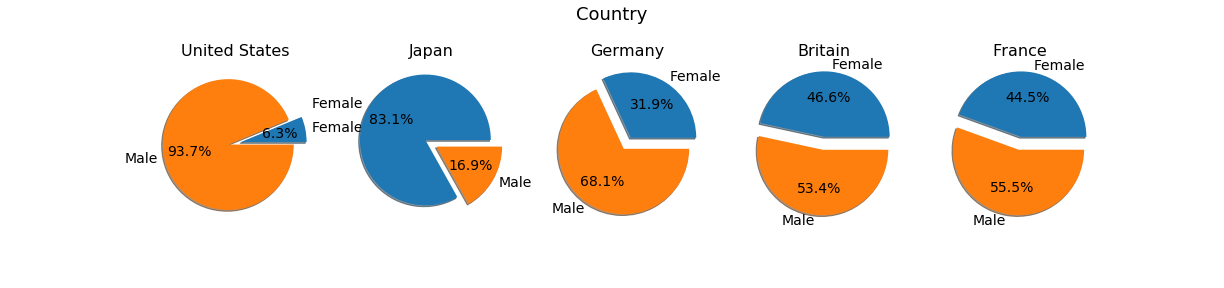
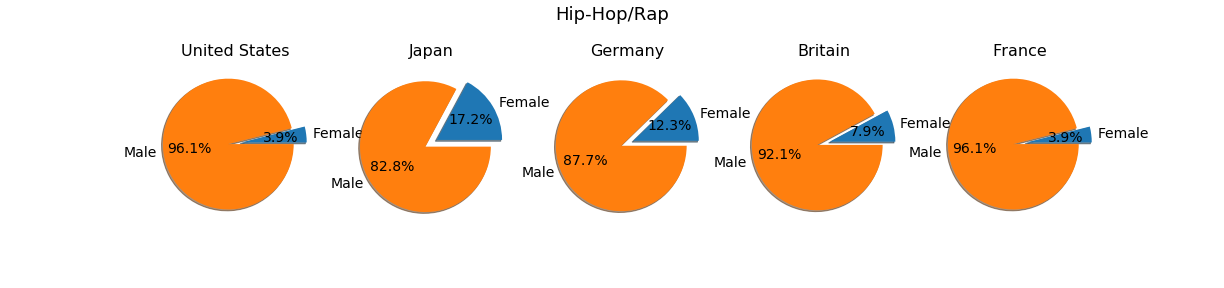
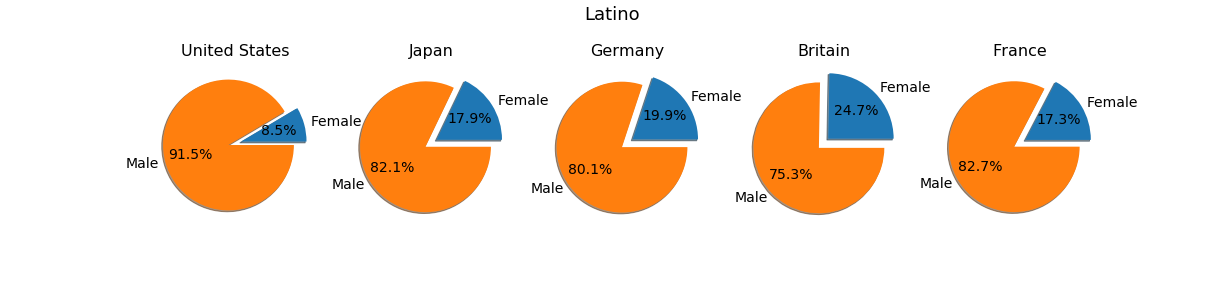
If we want to get an idea for how influential gender is across music markets and genres, we can turn to Apple Music’s genre chart. We have been tracking this chart since Sep. 15th, 2017.Again, a few considerations…
- We have data on more than 100 countries, but we will only look at the top five music markets: United States, Japan, Germany, Britain, and France
- There are 19 genres available, but that’s a lot to take in at once, so we picked 5 of the largest and most polarizing: All Genres, Pop, Hip-Hop/Rap, Country Music, and Latino.
Final Thoughts
How do you think these trends will change going forward?Perhaps the growth of streaming, and women’s tendency to drop mind-blowing tracks has started opening new doors. Will women continue to get more of the coveted chart positions? Or after the recent reign of Ariana Grande and Billie Eilish, are we due to see fans pendulum-swing back to more male artists?Apple Music and Spotify trends give us some insights, but of course music streaming is a wide world with many unique platforms. Still, the big changes taking place suggest that streaming-growth is disrupting old listener patterns. You should keep your eye on how audiences are engaging with top performers because “the times, they are a changin’.”Hungry for more? Let Jason Joven keep you in the loop on the music industry’s latest data gems by tuning into our podcast: Your Daily Data Dump from Chartmetric.Or if rolling up your sleeves and getting messy with data is more your style then head over to the Chartmetric website and grab your free account here.Or you can shoot us a message at hi@chartmetric.io.