

___________________________
By Mark Mulligan of MIDiA from his Music Industry blogFandom is fragmenting. Streaming personalization and falling radio audiences are combining to rewrite the music marketing rulebook, ushering in a whole new marketing paradigm. Hits used to be cultural moments; artist brands built by traditional mass media. However, this fire-hydrant approach to marketing lacked both accountability and effective targeting. Now, hyper targeting, both in marketing campaigns and streaming recommendations, is creating a new type of hit and a new type of artist. Global fanbases are being built via the accumulation of local niches, while a few big hits for everyone are being replaced by many, smaller hits for individuals. Niche is the new mainstream.The marketing rulebook is being re-writtenThree trends have reshaped how music marketing works:- Digital targeting: The rise of social media provided label marketing teams with masses of data and unparalleled targeting
- Linear decline:The steady decline of linear radio and TV audiences is eroding these platforms’ contribution to music marketing effectiveness
- Streaming curation:Streaming algorithms and curation teams are overriding label marketing efforts, delivering users what the streaming services want to deliver rather than what labels want to
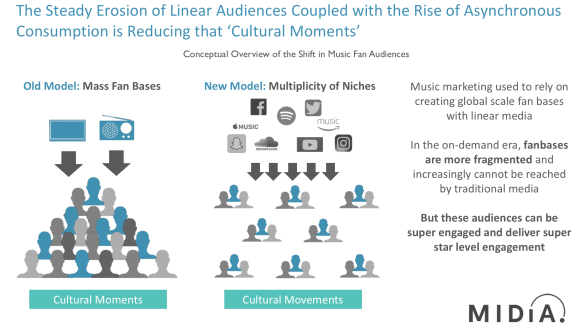
- The marketing transition:Marketing of media brands is locked in a transition phase, moving from the old model of one-to-many messaging to targeted digital campaigns. As in all transitions, the old and new models will co-exist for some time. For music marketers though, there is a greater need for emphasis on digital because this is where the younger music fans are that are so crucial to the success of so many frontline acts.
- Democratization of access:In the old model, mainstream linear media (TV and radio especially) was the power tool of big record labels. Access to these finite schedules is inherently scarce and bigger record labels have an inbuilt advantage due to their scale and influence. In on-demand environments access is democratized, with anyone able to run their own self-serve campaigns on platforms such as Facebook, Snapchat, YouTube and Google search. The result is that labels and artists of all sizes can reach their global audiences.
- From cultural moments to cultural movements:Linear schedules have the unrivalled ability to create simultaneous audiences at scale around a specific piece of content. Creating these cultural moments remains the crucial asset that TV and radio bring. But the weakness of this approach is that much of the impact is diluted. It is carpet bombing compared to the laser-guided missile of digital marketing, resulting in a lot of wasted exposure and effort. Mass reach is progressively less useful for driving fandom. Against this, the hyper-targeting of digital creates super-engaged fanbases that can often thrive under the mainstream radar. Kobalt artists such as Lauv (2.5+ billion streams) and Rex Orange County (0.8+ billion streams) are examples of this new paradigm, creating global-scale cultural movements rather than linear cultural moments. Niches thrive in this world of fragmented fandom, but niche no longer inherently means small. Indeed, the cumulative effect of many local niches is global-scale fanbases. Niche is the new mainstream.