______________________________
Guest post by Dae Bogan of Dae Bogan MusicI just spent the last hour giving a copyright law and music publishing crash course to a Principal Analyst at the Congressional Budget Office who’s tasked with determining the economic impact of the revised Music Modernization Act (which, by the way, now includes the Musical Works Modernization Act (which is an update to the originally proposed MMA, affecting songwriters and publishers), AMP Act (affecting producers and engineers) and CLASSICS Act (affecting recording artists of Pre-1972 records)) on states, DSPs and music creators.He emailed me yesterday and asked to speak with me about the magnitude of the unclaimed royalties market, although we ended up discussing much more than that. Apparently he had discovered a presentation that I gave at the Music Industry Research Association’s MIRA Conference last year titled “The State of Unclaimed Royalties and Music Licenses in the United States.”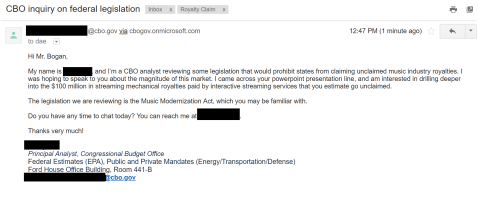


 If your property goes unclaimed too long (each state has their own statute of limitations), the state has the right to liquidate the property (e.g. sale an unclaimed vehicle) and absorb proceeds as miscellaneous revenue to the state’s budget [lawyers, correct me in the comments if I’m wrong].Because states unintentionally (benefit of the doubt) benefits from unclaimed property, I could see states with significant music industries (e.g. California (Los Angeles), New York (Greater New York City), Tennessee (Nashville), Georgia (Atlanta)) suing the federal government or the Mechanical Licensing Collective (the entity that would be granted under the MMA to administer a new blanket licensing system along with a centralized database of musical and sound recording copyrights to match works with usage reports submitted by digital services) over the right to collect unclaimed royalties, especially if the black box is hundreds of millions of dollars (which I believe it is).There are many other issues that I have with the MMA such as the proposed formation, structure (especially the imbalance of representation on its board where there would be 10 publishers and only 4 songwriters (why not 7/7?)), and governance of the MLC and similar unclaimed royalties issues related to the CLASSICS Act; among other issues. I’d be happy to discuss, but this post is already yuge!In a word, I am all here for improving royalty rates, ensuring the fair treatment of music copyrights and moving towards a more equitable representation of music creators. However, the MMA is not quite there yet and passing it as-is, with all of its ambiguity, would be a shame. I don’t know if the music industry will have another shot to make this kind of update to the Copyright Act in the next 20 plus years (the Digital Millennium Copyright Act of 1998 was the last significant update).We should probably get it right – now.
Related articles