

___________________________
Guest post by musician and artist advocate David Lowery from the TrichordistWhat appears to be a backdated NOI sent to the author. If this was intentionally backdated this is fraud. Note MRI is simply a third party that sent the notice on behalf of the service. All legal responsibility rests with the service. Digital music services are trying to end songwriters ability to ever sue broadcasters and digital music services for copyright infringement with this bill. In order to sue for copyright infringement you have to mount a case in a federal court. Not your local district court. This is extremely expensive. I would estimate you need about $250,000 to effectively fight a case. This bill takes away statutory penalties and legal fees, even when the songwriter prevails. This makes it impossible for independent songwriters to exercise their legal rights. NAB Broadcasters and digital services like YouTube and Spotify can safely ignore songwriters, especially independent songwriters with no resources. Songwriters and publishers would have never been able to achieve the recent settlements against Spotify, without statutory penalties and legal fees.So this may surprise you but I say “fine!” Take away our ability to mount copyright infringement lawsuits? We still have plenty of other (sometimes much more severe) remedies available. Most songwriters don’t really care about the money. The royalties are pretty paltry to begin with. This is really about the principle. This is about justice.I’m no lawyer but the more I learn about the predicament of songwriters in the US, it feels like something more than just copyright infringement seems to be going on. My layman’s reading of the situation makes me wonder if this isn’t exactly what the authors of the RICO laws had in mind. Imagine a digital music executive in the next season of Orange is the New Black! Not saying that’s what is going on happen here. Just saying something like that would restore creators faith in the fairness of the system. And that kind of outcome in my mine really matches the severity of the problem.Let me reiterate I am not an expert and I am not saying a criminal prosecution is really warranted but there are enough questions here that it seems like someone should at least look at it. My knowledge is limited, but it looks like lots of wrongdoing spread across many interrelated businesses, advised by a small group of consultants and lawyers with conflicted interests. Its very complicated. But isn’t this the kind of complex situation that a Grand Jury is designed to investigate?To be clear I’m not intending to mount a case myself, I’m just saying going forward rights holders should consult someone more knowledgable than myself and then consider whether conspiracy, fraud or other complaints are more applicable. Especially those songwriters that suspect they have received backdated or somehow falsified “notices of intent” from digital services or others. Backdated notices are key cause they clearly don’t pass the smell test. There is no honest reason to do that. Even without “smoking gun” evidence songwriters should not be shy about complaining to federal and state authorities that “something just doesn’t seem right.” And really what’s the harm in looking? Similarly lawyers and accountants who are involved (or have been involved) with this licensing mess, should perform a gut check: Is what I’m doing (I did) legal? What are the consequences for my career? Am I following the ethical guidelines of the organization that licenses my profession?LETS REVIEW:






Failure of fiduciary responsibility to shareholders?Can you imagine if a large publicly traded company claimed that they couldn’t pay suppliers because the suppliers didn’t supply billing information? But it turned out the company didn’t ask for billing information and provided no way for suppliers to submit billing information. And it wasn’t the suppliers responsibility anyway to provide the information. Wouldn’t this firm be guilty of misleading public and investors? Wouldn’t someone investigate?+++++++++++++Then when the lawsuits hit, many services began sending to songwriters what would appear to be fraudulent “notices of intent.” See example above. I have dozens of these from dozens of companies. I can’t imagine I am the only songwriter to receive such notices. These were sent to me via the US Mail. These notices seem designed to trick me into believing that I no longer have the right to make a potentially much more valuable direct license with the streaming service since the window on the compulsory license has passed.Mail/Wire Fraud?Can you imagine if lawyers from a large record label sent out letters to songwriters which misled them into thinking they had licensed their song to that record label? Wouldn’t someone investigate? (Ed note: Surely Spitzer would have investigated. Schneiderman?)+++++++++++++++++++++++
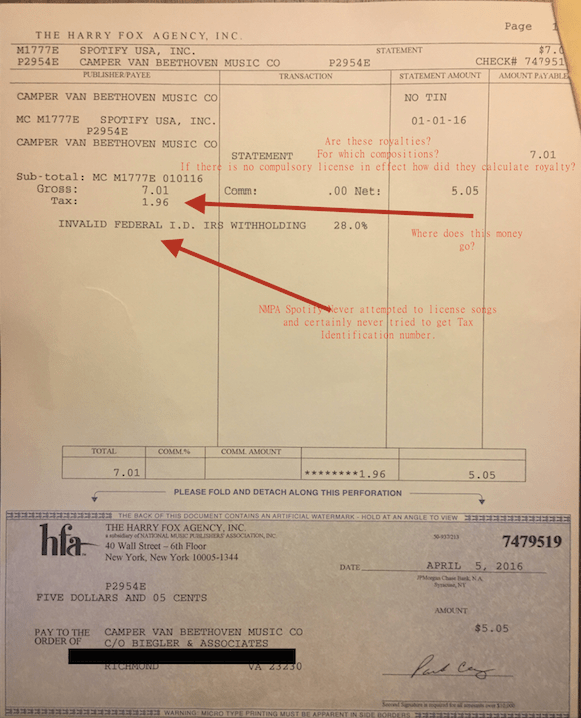
This check was received during the time the class action lawsuit against Spotify was active. Despite being told to communicate with my attorney. They sent these notices directly to me. How many class members received similar checks during this time?Improper communication with plaintiff and class members?Suppose there was a class action directed at a large pharmaceutical company like Pfizer for overcharging customers. Can you imagine what would happen if Pfizer had started sending refund checks directly to plaintiffs and potential class members? Surely someone would investigate this.+++++++++++++++++++++++Finally lets go back to the public accounting firms that certify the royalty statements and financials of the streaming services. How can they possibly claim to have fulfilled there legal obligation by certifying streaming statements from companies that lacked a significant number of valid licenses. Surely these public accounting firms were aware that the services had large numbers of unlicensed tracks. The key point here is if a track is unlicensed there is no agreement as to what the royalty rate should be. Since songwriter royalties are a pro-rata from a pool of revenue, this calculation is based on the false assumptions that the unlicensed tracks receive the same rate that the licensed tracks receive. The statements are ALL incorrectly calculated. Further, did these firms disclose to the investors the extent of the infringement liabilities? Clearly the services know exactly how many tracks are unlicensed. Did the accountants? Did the shareholders?Accounting fraud? Again look at Enron. Someone investigated that.+++++++++++++While this may all just be smoke and no fire, federal, state and local authorities have investigated suspicious situations with a lot less compelling.
Related articles