



Why Country Music’s Top Stars Loom Larger Than in Other Genres
By Grant Gregory of Spotlight By Luminate
Only a handful of tracks generate the majority of annual streams among the 253 million total audio ISRCs registered at digital service providers in 2025, as depicted in the “track streaming pyramid” featured in the 2025 Luminate Year-End Music Report.
But the most popular performers aren’t as dominant across genres.
To help determine how “top heavy” each genre is, it’s useful to borrow a metric known as the Gini coefficient, used by economists and NGOs to measure distributions of wealth in any given country. In economics, a Gini coefficient of 1 means one individual earns all the income, while a coefficient of 0 means that every individual earns the exact same amount.
The Gini coefficient can also be used to determine the distribution of streams within a certain number of tracks or artists. A lower Gini score shows a more evenly distributed streaming market, while a coefficient closer to 1 means a higher share of streams belongs to a smaller number of top artists.
+Read more: "Everything You Ever Wanted to Know About What Truckers Listen To"
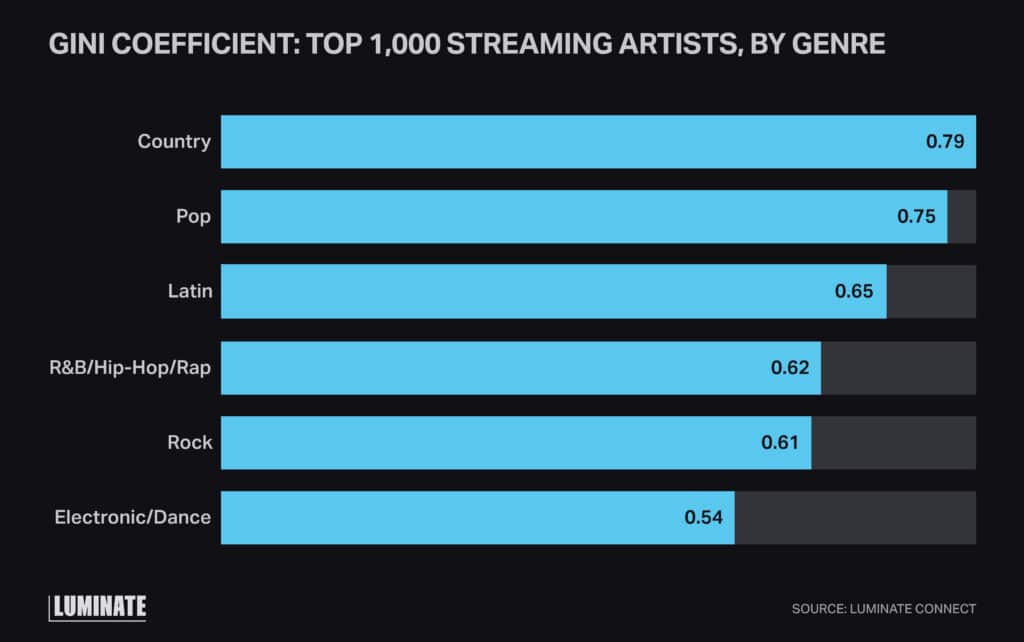
Examining the top 1,000 music artists across a handful of genres in the U.S., as determined by total On-Demand Audio streams (in Q4 2025) on Luminate CONNECT, Country is the most top-heavy genre at 0.79, followed closely by Pop at 0.75, while Latin, Hip-Hop and Rock sit somewhere in the middle. Electronic/Dance has the lowest score of the genres analyzed, at 0.54, indicating the streams are more evenly divided among its top 1,000 artists.
There are undoubtedly a myriad of factors that contribute to a genre’s distributions. In the case of Country, old-school formats, including radio, are still popular and influential — 48% of U.S. Country listeners still discover music on the radio, per Luminate — which may lead to listeners being content with sticking to whatever makes the airwaves over actively seeking out new music.
That finding may explain why top artists get a greater share of streams than in other genres. Similarly, top Pop artists often get the support and resources of the biggest record labels in the world, leading to greater exposure and higher consumption.
But another key factor may be the culture around music discovery within a genre’s fan community.
Genres with listeners who consider themselves first among their friends to discover new music/artists (according to Luminate Music 360 survey data) also tend to have lower Gini coefficients. Nearly half of Electronic/Dance listeners reported being first to discover new music, which may help explain why the genre’s Gini score was low.
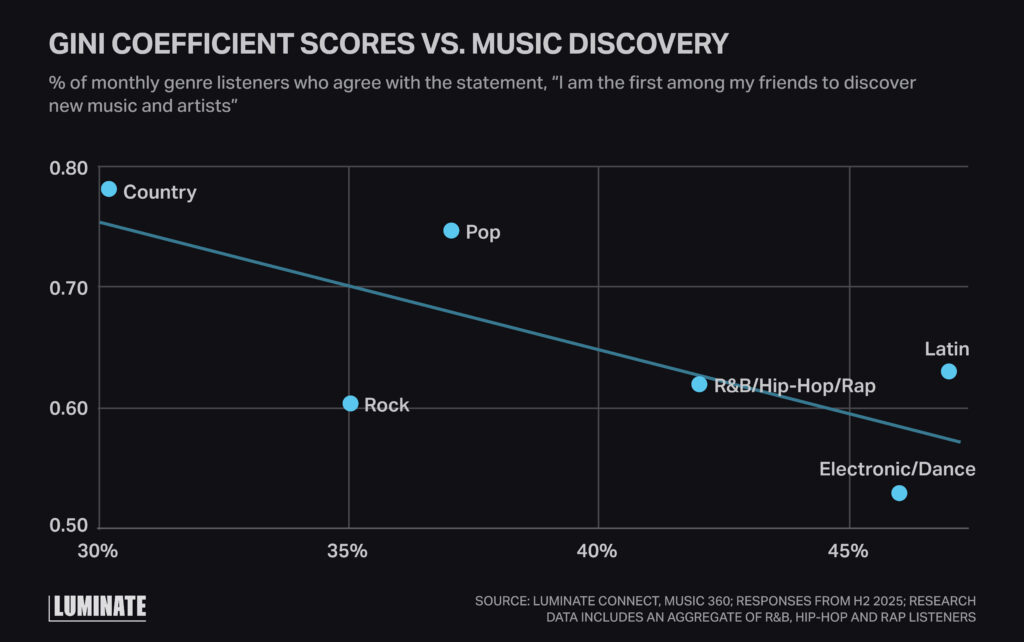
Interestingly, Rock is an outlier here, with listeners having a lower appetite for new artist discovery relative to its Gini score (or, more specifically, lower appetite than we’d expect given its lower “top heaviness”).
That can partially be explained by the distinct makeup of Rock’s various subgenres: Classic Rock listeners exhibit lower interest for new artists, though Indie Rock, Alternative Rock and Metal listeners exhibit a greater appetite for new artists.
While the future of music streaming is always murky, being able to quantify the “pyramid” of songs/artists and the trends within how consumption is spread across tracks can help artists and their teams navigate the music landscape with greater intentionality.
Spotlight is a publication by Luminate Data. Sign up for Luminate’s newsletter to get data-driven insights and case studies delivered to your inbox.