

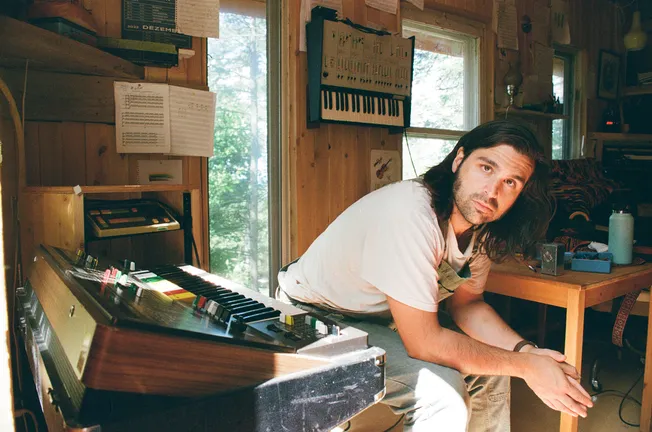
Flore Laurentienne is the project of composer, keyboardist, and synthesist, Mathieu David Gagnon, based in Québec. His music is both physically and inspirationally rooted in the unique landscape of the St. Lawrence riverway, its native plant and animal life, its magnificent transformation from season to season, its lore and meaning-making capacity, and the footprint of the residents who call this place home.
Naturally, the music of Flore Laurentienne has always been both lush and emotive, yet enigmatic and unwilling to be contained within a fixed set of boundaries. His background in fugal, Bachian composition and string performance is met by a modern obsession with the warm, volatile personality of analog synthesizers. The resulting music is lyrical, textural, and sublime.
Mathieu's new album, Volume III, comes out on 10 April, and he'll be touring with his full instrumental ensemble throughout much of the remainder of 2026. I wanted to ask him about how his music interacts with the road from an iterative, compositional standpoint, how he stays healthy on long stretches of tour, and what he's learned along the way.
Here's our conversation. Follow Flore Laurentienne on Bandsintown and catch him live on tour in 2026.
Hypebot: Hi Mathieu, thank you for taking the time to answer a few questions. Congratulations on Volume III! It's an absolutely incredible piece of work. Personally, I think you've managed to find a very unique sound and approach in a musical field that has been heavily exploited in recent years.
Mathieu: "Thank you!! That's really nice to hear."
H: Is the process of composing, recording, and producing a pleasure for you, or stressful and complicated?
M: "Composing and creating is essential to my life balance. It's very liberating for my mind, especially in these troubled times. When it comes time to outline an album, I surround myself with collaborators who can guide me through the process of production and recording."
Where it gets a little stressful is when recording large ensembles. Half of the total budget for the album often goes toward a single day in the studio, involving about twenty musicians. The artistic direction and scores have to be very well-prepared. Every minute counts!"
It's important to surround yourself with excellent musicians, because we usually only need to do one take, or maybe two for good luck!"
H: After all these years, are the songs still inspired by the St. Lawrence River?
M: "The St. Lawrence River is part of my daily life and my earliest memories. I can see it from my studio. And every day, it has a different face. In the morning at sunrise. At the end of the day, when the sun dips into it."
It's also a way to direct my creativity and create a larger-scale work. All the pieces named 'Fleuve' are in the same key and use the same chords, in a different order."
Sometimes I have fun layering them. It gives a different perspective!"
"The St. Lawrence River is part of my daily life and my earliest memories. I can see it from my studio. And every day, it has a different face."
H: Do you compose in the studio or does it happen privately before you enter a recording studio?
M: "It depends on the pieces, but I usually compose in my cabin (a cabin in the woods behind my house) that I call my studio. It's more of a workspace than a real studio. I write sketches that I can then use to plan sessions in a real studio with real musicians."
But sometimes I have a little extra time during a session. I always prepare additional material for improvisation. A few pieces have come out of that!"
H: How does the 'workshop' aspect of touring help to influence the composition process for you?
M: "I consider myself extremely lucky to have an ensemble that follows me around all year. It's a composer's dream to have a string quartet every night. I often take the opportunity to read new material during sound checks. It often opens doors that I wouldn't have opened if I had been alone at my piano."
I've been playing with the same musicians since the beginning. They are largely responsible for the success of the project. They are my motivation to keep writing."
H: How do your songs change, if at all, between the studio and the stage?
M: "They always do! It's rare that we reproduce the studio version exactly. Firstly because it's often impossible due to the number of musicians, but also because I like that kind of challenge."
I try to build my compositions in terms of vocals (often four-part harmonies) and to clearly define the role of each group of instruments. When I talk about roles, I'm generally referring to harmony, sustain, rhythm (drive), the main melody, counter melodies, or even effects/textures."
Once these roles have been clearly defined, it is easier to interchange families or groups of instruments."
I also like to give the musicians constraints. Like playing the drums without ever playing a constant rhythm. I also like to create rhythm without incorporating percussion. Vol. III is different in this respect because, for the first time, there is percussion."
H: What have you learned from spending time on the road?
M: "Not to stay up too late! And to always keep some moments of improvisation in the show. These moments keep the band alert and allow us to create magical moments night after night, which strengthens the sense of belonging."
"Music is a language. It has to be spoken in order to exist."
H: Are tours physically difficult for you? What do you usually do to stay fit or healthy?
M: "Right now, it's harder on the mind than on the body. I need a lot of sleep to be at my best. That's often the hardest thing on tour, getting enough sleep. The second hardest thing is avoiding eating fries every day!"
H: What do you like to do on your days off while on tour?
M: "I like to visit independent record stores. That's often where I discover new albums that fuel my creativity."
H: Do you think touring is essential for artists today?
M: "I think it's essential for the survival of a project, and especially to never stop evolving. Music is a language. It has to be spoken in order to exist."
H: On that note, very well-spoken, my friend. :)
Flore Laurentienne 2026 Tour Dates
APR 09 — Bratislava, Slovakia @ New Cvernovka
APR 10 — Praha, Czech Republic @ Palac Akropolis
APR 11 — London, United Kingdom @ The Elgar Room Brasserie
APR 13 — Berlin, Germany @ Rough Trade Berlin
APR 14 — Bruxelles, Belgium @ Le Botanique
APR 15 — Düdingen, Switzerland @ Bad Bonn
APR 16 — Enghien-les-Bains, France @ Centre des Arts d'Enghien-les-Bains
MAY 16 — Toronto, ON @ TD Music Hall
JUN 26 — Montréal, QC @ Place des Arts - Maison Symphonique
JUN 27 — Ottawa, ON @ Ottawa Jazz Festival 2026
OCT 23 — Otterburn Park, QC @ Les Diffusions Pointe-Valaine
OCT 24 — Sherbrooke, QC @ Théâtre Granada