

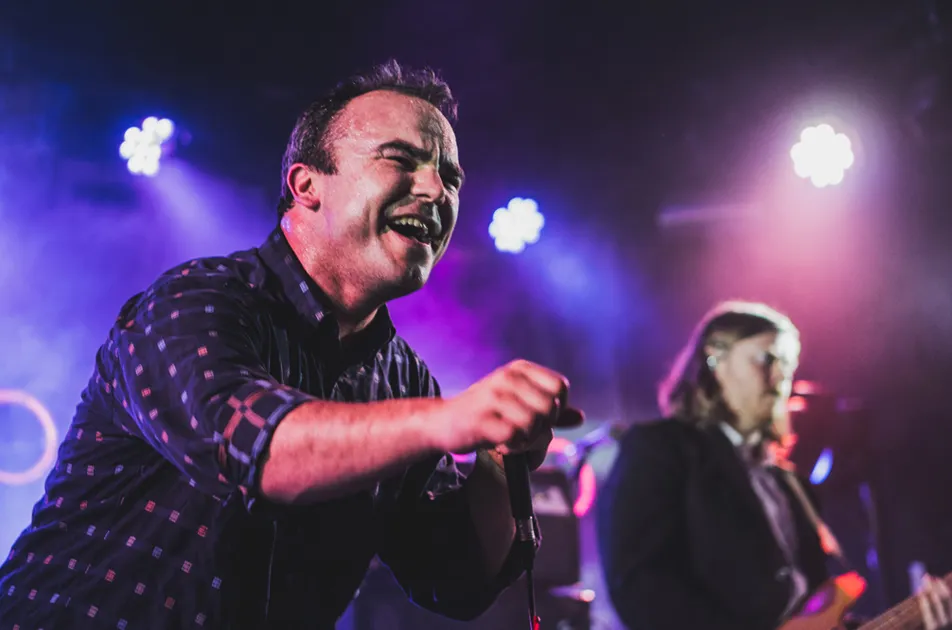
When Future Islands recently announced a tour focused almost entirely within one state — North Carolina — it quietly pointed to an idea that’s been gaining traction across the live music ecosystem, related to something we've previously talked about a few times.
The tour, first reported by Pitchfork, has the band performing two nights each in Wilmington and Asheville, three nights in Carrboro, one night in Greenville, and then a last stop in Baltimore where the band is originally from. Follow Future Islands' live dates on Bandsintown or see their dates below.
This might seem unconventional at first glance. Touring artists typically think in terms of regions or national runs: the Midwest circuit, East Coast sweeps, long cross-country routes, or ambitiously large international stretches.
Not... a single state. (Admittedly, North Carolina boasts a fantastic, richly diverse, and vigorously dedicated live music community.)
But as the realities of touring continue to evolve, some artists are exploring a different approach: going deeper locally instead of wider geographically. And suddenly, something that might have once seemed small-scale starts to look like a pretty smart strategy.
In other words: Local is back, baby. Here's why.
Touring Is Evolving — And Artists Are Adapting
Live music hasn’t slowed down. If anything, audiences are more eager than ever to gather in rooms together. But the way tours are structured is changing.
Artists today are navigating a landscape with more moving parts than ever — rising travel costs, complex logistics, and audiences that often buy tickets closer to show day. None of these factors make touring impossible, of course, but they do encourage artists and their teams to think creatively about how to structure their runs.
We’ve already seen a number of responses to this shift.
Some artists are planting in one city for extended residencies. Others are building tours around festival clusters or concentrating runs within specific regions. Future Islands’ North Carolina-focused tour fits neatly into that evolving mindset: touring smarter by leaning into geography instead of fighting it.
+Read more: "In the New Era of Touring, Artists Are Planting in One City. For Weeks."
The Hidden Advantages of Staying Local
Booking a run of dates close to home — where an artist focuses on one state or region — can unlock a surprising number of benefits.
Lower Travel Friction
Touring logistics become dramatically easier when cities are close together. Shorter drives mean less time on the road and more time focused on the show itself, safer travel, less stress, and (at least, hypothetically), better sleeping conditions. For artists and crews alike, that makes all the difference in running smoother production days and more sustainable long-term schedules.
Stronger Regional Fanbases
Artists often discover that some of their most passionate fans live closer to home than they might expect. Playing multiple cities within a single state allows artists to deepen those relationships, reaching audiences who might not travel far for a show but will absolutely turn out if the band comes to their town. Local media coverage, college radio, and word-of-mouth can amplify that effect.
Familiar Infrastructure
Regional tours also allow artists to work repeatedly with the same promoters, venues, and local teams. That familiarity can make every stop feel more dialed-in (from production all the way to marketing); and in turn help shows run smoothly and help audiences feel like they’re part of something cohesive.
A Touring Model Built for Momentum
What makes localized touring especially interesting right now is how well it aligns with the way music discovery works today. Streaming and social media can help artists build pockets of fans in specific regions long before they ever play there. A concentrated run through those areas allows artists to convert digital attention into real-world momentum.
And once that regional momentum builds, it often becomes the foundation for bigger touring moves later on. In that sense, local touring isn’t a retreat from the road — it’s often the first step toward a much bigger one.
+Read more: "Small Venues in Small Cities: A Playbook for Building Community"
Why “Local” Might Be Having a Moment
The modern music industry often emphasizes global reach. Artists can release music instantly to listeners anywhere in the world. But live music still thrives on something more immediate: shared spaces and community scenes.
Instead of racing across the map, Future Islands is choosing to spend time where the connection already exists — and strengthen it. For independent artists watching closely, there’s an encouraging lesson here.
Touring doesn’t always have to mean covering thousands of miles. Sometimes the smartest move is simply to look around, map out the places where your audience already lives, and start there.
Because right now, the idea that “local is back” could just be a winning strategy.
Future Islands 2026 Tour Dates
MAY 15 — Wilmington, NC @ Greenfield Lake Amphitheater
MAY 16 — Wilmington, NC @ Greenfield Lake Amphitheater
MAY 18 — Carrboro, NC @ Cat’s Cradle
MAY 19 — Carrboro, NC @ Cat’s Cradle
MAY 20 — Carrboro, NC @ Cat’s Cradle
MAY 22 — Asheville, NC @ The Orange Peel
MAY 23 — Asheville, NC @ The Orange Peel
MAY 26 — Greenville, NC @ State Theatre
MAY 28 — Baltimore, MD @ Pier Six Pavilion