

The 10th annual Goldman Sachs Music in the Air report delivers the analysts' first upward revision to long-term music industry revenue forecasts since 2022.
The central takeaway: the music business has completed its transition from a pure volume-and-adoption race into a mature, aggressive monetization era. Rather than relying purely on user growth in developed markets, industry expansion over the coming decade will be propelled by routine subscription price hikes, emerging market penetration, direct-to-consumer (D2C) superfan infrastructure, and consistent spending on live events.
Here is a breakdown of the report's top-line findings plus a deeper dive into what the data says about superfans and live music.
The Macro Picture: Goldman Sachs’ 2026–2035 Global Forecasts
Goldman Sachs projects total global music industry retail revenue (combining recorded music, publishing, and live music) to grow +6.7% year on year in 2026 and expand at a 5.8% compound annual growth rate (CAGR) from 2025 to 2035, reaching $198.1 billion by 2035, up from $112.5 billion in 2025:
- Recorded Music: Retail revenues are projected to grow at a +6.3% Compound annual growth rate through 2035, while rightsholder revenue will grow at a +5.9% CAGR from $31.7 billion in 2025 to $56.1 billion in 2035.
- Live Music: Projected to grow at a +5.7% CAGR, expanding from $37.4 billion in 2025 to nearly $65 billion by 2035.
- Music Publishing: Forecast to grow at a +4.8% CAGR over the ten-year period, generating $12.1 billion in incremental revenue.
- Subscription Streaming: Rightsholder subscription streaming revenue is set to climb at a +7.1% CAGR from $17 billion in 2025 to $33 billion in 2035, supported by paid subscribers expanding from 837 million to 1.525 billion.
- Routine Streaming Price Hikes: The report notes that music DSPs have successfully broken the historic $9.99 price ceiling and established pricing power with minimal churn. Goldman Sachs forecasts DSPs will now implement price increases on a predictable 12- to 24-month cadence across individual and family tiers.
- Generative AI Opportunity: Goldman models AI as a net near-term positive for DSPs and premier rights holders, projecting a $3.3 billion base-case monetization uplift (a ~10% revenue lift to subscription streaming) by 2035 through licensed creation tools, remix add-ons, and forensic royalty recovery.
Superfans & D2C: The High-Margin Frontier
In a dedicated deep dive section titled The Emerging Direct-to-Consumer Opportunity, Goldman Sachs identifies D2C platforms and artist-owned superfan relationships as the next structural revenue wave. The report argues that emerging D2C channels are actively fulfilling the monetization promises that streaming DSP "super-premium" tiers have struggled to execute.
Superfan Spending Is Underestimated
Goldman Sachs now says that its historic assumption - that superfans spend roughly 2x the amount of an average listener - is too conservative.
Close to 50% of fans voluntarily pay above the artist-set minimum price on pay-what-you-want direct storefronts when given the choice,.
Direct To Consumer: Four Integrated Pillars
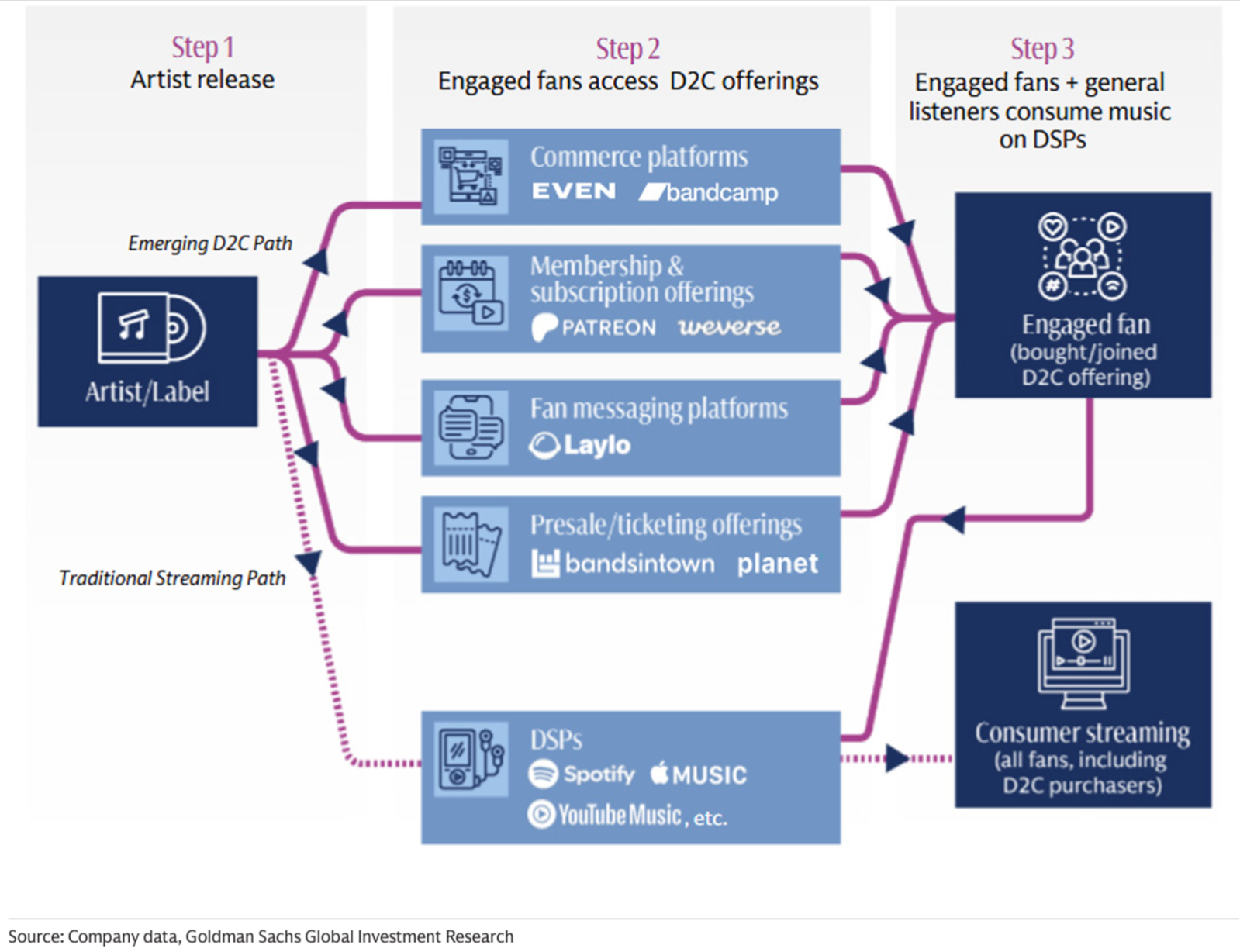
The report maps out an integrated Direct To Consumer (D2C) architecture operating across four pillars.
- Commerce & Music Storefronts (EVEN, Bandcamp): EVEN enables pay-what-you-want digital drops, vinyl pre-orders, and fan access windows before streaming release dates. These sales report directly to Luminate for Billboard chart eligibility. J. Cole leveraged EVEN for the 10th anniversary of "2014 Forest Hills Drive," propelling a decade-old catalog record back into the Billboard Top 15. The report also highlights Bandcamp which pay an average of 82% of fan spend directly to artists and labels.
- Community Memberships (Patreon, Weverse, Substack): Subscription platforms that capture recurring monthly revenue in exchange for exclusive content and direct community access.
- Direct Fan Messaging (Laylo): SMS and direct-to-consumer messaging tools that bypass social media algorithms. Laylo has generated more than $1 billion in ticket, merch, and content sales across 250 million fan interactions for artists like Sabrina Carpenter and Nicki Minaj.
- Direct-to-Fan Presales (Planet, Bandsintown): Presale and ticketing offerings round out the ecosystem, giving artists a way to route ticket access directly to their most engaged fans. The report features Bandsintown, which offers artists a free D2F presale tool: "Artists list a presale directly on their Bandsintown page, fans opt in, and Bandsintown automatically alerts fans who signed up with the ticket link and presale code shortly before the presale opens." Goldman Sachs also cites Planet which issues fans a digital wallet pass that captures presale sign-ups, RSVPs, and in-venue engagement, allowing artist teams to identify their most committed fans.
D2C Release Windows Are Additive, Not Cannibalistic
Importantly, Goldman Sachs found that D2C/D2F release windows do not cannibalize streaming royalties.
Artists who run direct-to-fan sales windows ahead of general DSP drops capture high-margin upfront revenue without experiencing any drop in subsequent streaming performance. The D2C sector is forecast to expand from tens of millions in industry revenue today to hundreds of millions annually over the next decade.
Major labels are reacting by acquiring stakes and embedding D2C. UMG has established partnerships and investments with EVEN, Stationhead, and HYBE’s Weverse, while Sony Music and WMG have created dedicated internal D2C divisions.
Live Music: The Experiential Engine That Beats Recessions
Live entertainment remains one of media's strongest growth sectors. Following a slight pause in 2025 due to difficult year-over-year comps against Taylor Swift’s historic Eras Tour, live music revenue is forecast to accelerate to +6.0% YoY growth in 2026, delivering a +6.0% CAGR through 2030 and +5.0% through 2035.
Global Live Music Revenue Projection
• 2025: $37.4 Billion (Actual/Base)
• 2026: $39.6 Billion (+6.0% YoY)
• 2030: $49.8 Billion (+6.0% 5-Yr CAGR)
• 2035: $65.0+ Billion (+5.0% 5-Yr CAGR)
Insatiable Millennial & Gen Z Demand For Live
Live music’s resilience is rooted in structural demographic demand:
- Generation Y & Z Spending Power: Millennials and Gen Z make up 43% of the US population and heavily prioritize real-world experiences over material possessions.
- Concerts as the #1 Financial Priority: A 2025 CashApp study cited in the report reveals that concerts rank as the number one spending priority for Gen Z—ranking above vacations, buying designer apparel, investing in stocks, or saving for a house.
- Resale & Premium Tolerance: 75% of Gen Z music fans surveyed are willing to pay inflated ticket resale prices to see their favorite artists, spending 23% more per month on concert attendance than the average US listener.
- Eventbrite Data: 79% of young adults (ages 18–35) report plans to attend more live events in 2026 than in prior years.
Proven Recession Resilience
Goldman’s macroeconomic analysis reveals that live music is historically non-cyclical compared to broader consumer spending:
- Spending on live music in the US has grown in 31 of the past 35 years, persisting through three major economic recessions and the pandemic.
- During US recession years (excluding COVID), live entertainment spending grew at an average rate of +7.3%, more than double the broader personal consumption expenditure (PCE) growth rate of +3.2%.
- In a 2025 Live Nation consumer survey, 91% of respondents ranked live concerts in their top spending preferences, while only 12% stated they would cut concerts first if forced to trim discretionary budgets.
Expanding Venue Pipelines and Pricing
To meet artist supply and touring demand, venue infrastructure is expanding at record scale. Live Nation’s Venue Nation pipeline alone currently tracks over 768,000 seats of announced new venue capacity across arenas, amphitheaters, and stadiums globally.
Pricing trends reinforce this growth: average ticket prices for the Top 100 tours worldwide have increased +37% since 2019. Stadiums and venues with 30,000+ capacity captured the steepest price gains, with average ticket prices leaping +29% between 2023 and 2025.
Read the full Goldman Sachs Music in the Air report here.
Hypebot's Bottom Line
Goldman Sachs’ 2026 report confirms what working artists, managers, and indie labels have felt on the ground for the past three years: streaming volume alone will no longer save the music business.
With subscriber growth maturing in Western markets, the music industry's real financial power has migrated to two poles:
- The physical stage: Live concerts remain an untouchable, recession-proof juggernaut where young fans willingly divert their savings to stand in a room together.
- Direct fan ownership: Capturing the top 5% to 10% of your audience via D2C commerce, SMS channels, and exclusive drops is now a recognized pillar of corporate music valuation.
For independent artists and labels, the mandate is clear: do not treat DSPs as your final monetization destination. Use streaming platforms for what they do best - algorithmic discovery and passive reach - while actively funneling your true listeners into owned platforms like Laylo, EVEN, and Bandsintown.
Get the latest Live Music & Industry News updated continuously from across the web under the Hypebot Industry News tab here.