

____________________________
Guest post by Gillian Robins, David Choi and Jason Joven of ChartmetricWith a steadily growing following, brash yet introspective “emo rap” artists such as Juice WRLD or Lil Uzi Vert could be seen as one of music’s newer trends. But the youthful malaise and diversion from the mainstream is timeless: they echo the spirit of Sid Vicious and Kurt Cobain more than they do today’s Jay-Z or Cardi B.
Unless you’ve been a decades-long rap fan, it’s tempting to say that their emotionally-raw and vulnerable rap lyrics are a new thing. But references to Notorious B.I.G.’s 1994 “Suicidal Thoughts”, Tupac’s or Eminem’s frequent themes of dark introspection in the 1990s/2000s, or large swaths of Kid Cudi’s work in the late 2000s/early 2010s would surely refute that idea.
But what does seem to be unprecedented is the high-profile commercial success of several male rappers in a machismo-laden genre that don’t just dip their toes in such taboo topics such as depression, anxiety, and suicide: it’s their signature.
Emo rap, SoundCloud rap. It has several names. Its artists typically make beats with software and upload directly to sites like SoundCloud or YouTube. Many of them draw influence from early ’00s punk and alternative rock bands- Foo Fighters to Chief Keef and Kid Cudi (Chicagoland’s Juice WRLD), as well as Nirvana, Papa Roach and the Fray (XXXTentacion). Some are completely independent artists, some with a label. All are empowered with social media reach.
“I’m in pain, wanna put ten shots in my brain / I’ve been trippin’ ‘bout some things, can’t change / Suicidal, same time I’m tame / Picture this, in bed, get a phone call / Girl that you f*cked with killed herself” — Jocelyn Flores by XXXTentacion
With such non-mainstream sounds and dark themes, it’s less likely that “emo rap” will ever eclipse the power of wedding-friendly Ed Sheeran ballads or clear-the-dance-floor Bruno Mars party joints…so searching for who has the most followers/streams/views might not be the best way to gauge such content.
Methodology
In the modern music business, professionals are deluged with key performance indicators (KPIs) like Spotify spins, Apple Music playlist placements, Instagram followers, YouTube views…the list never ends. Most of the time, it’s just a “who’s got the most” game.
A major focus of Chartmetric is looking for Music Analytics 2.0…or what we believe will be the next level of our industry’s business intelligence. We believe the use of relative metrics like listener to follower ratios, “event decay” or less familiar data sources like Wikipedia help get to what is really the most bankable of variables: curiosity/love of the artist and true fan engagement with their content. With that, the business will follow.
Of course, these are target variables that will (likely) never be directly measurable, so we look to second-level, proxy variables or unorthodox data sources like the above. We’d like to use emo rap to explore two more of these uncommon data sources: Google Trends and Genius lyrics.
We will focus on the most notorious artist in today’s pop zeitgeist: XXXTentacion (subsequently referred to as “X”).
In case you are not familiar with his work, his credentials: “17” album debuted #2 Billboard Top 200 Albums chart (Aug 2017), “?” album- debuted #1 Billboard Top 200 Albums chart (March 2018). His single “Sad!” peaked at #17 on the Billboard Top 100 before reaching #1 posthumously after his death (June 2018), breaking Spotify’s record for most streams in a single day (previously held by Taylor Swift’s “Look What You Made Me Do”) with 10.4M spins on June 19, 2018.
Much has been written about X’s short life and controversies. We will focus on how his fans loved him and his work with these two data sources.
Google Trends → Public effects
When dealing with difficult subjects such as mental health, frequently family and friends are left out of the conversation. Ironically, many of our deepest, darkest secrets only surface in the air-conditioned servers of the world’s most powerful search engine and music streaming platforms.
Mental health- a topic steadily becoming less “taboo”- seems to finally be on the pop culture table for open discussion. In looking at Google Trends, the idea is to understand in a data-driven way how an artist can affect culture: how do artists advance our collective processing of difficult topics?
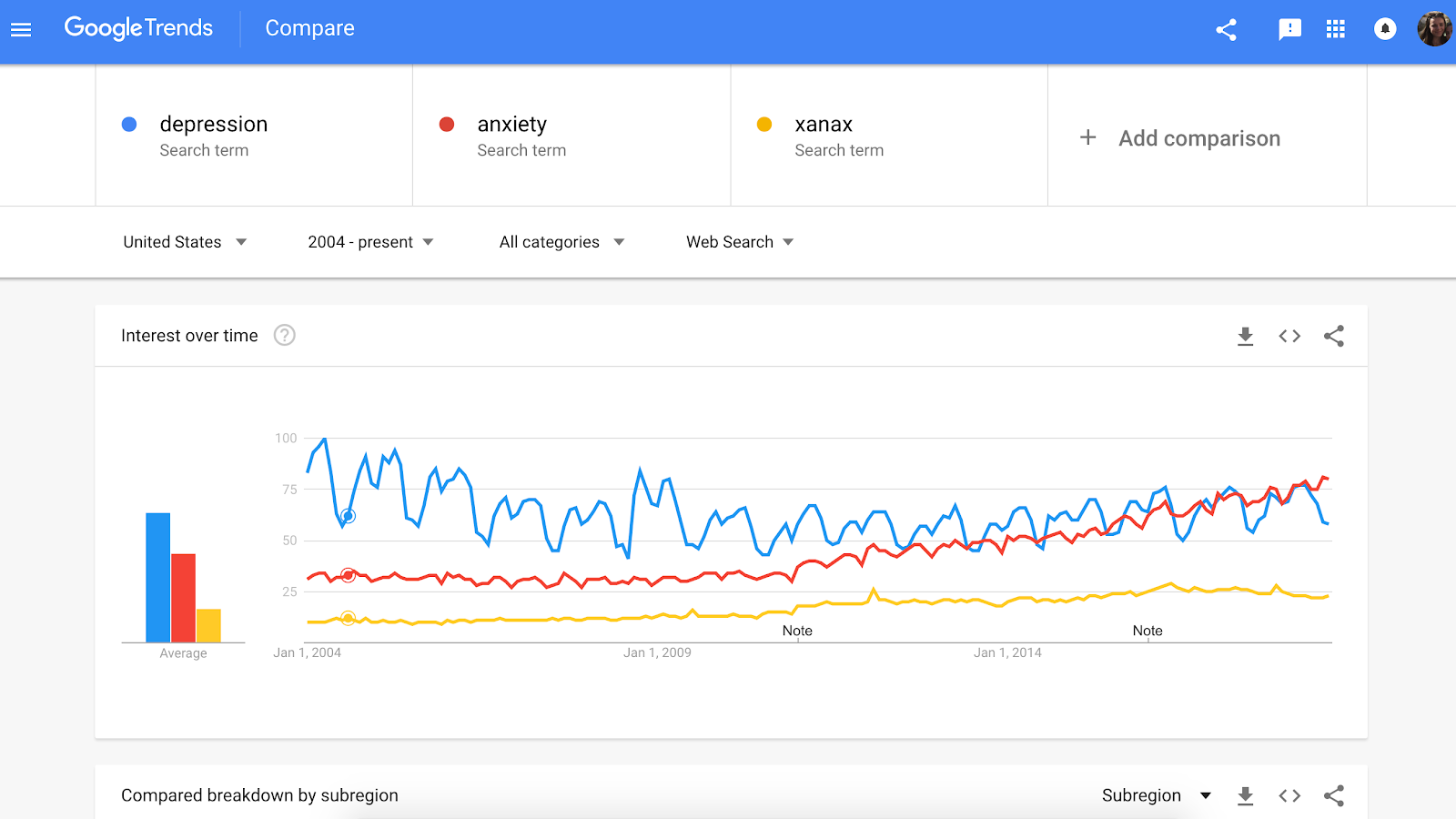
To begin a dive into Google Trends, we compared the queries for the keywords “depression”, “anxiety” and “Xanax”. Decades old but as of late popularized by emo rap, Xanax is a drug frequently prescribed by doctors for anxiety. The Pudding determined that it was 47 times more likely to hear this word in a hip hop song than in any other genre.For every time period / geographic area searched, Google Trends identifies the most popular search point of your query and establishes that as “100”. The number is relative in nature (it’s meaningless alone). It indicates peak search interest and then calculates all other search frequency relative to that highest point on the chart. This can be done with one or several search terms.

Genius → Lyrical Resonance
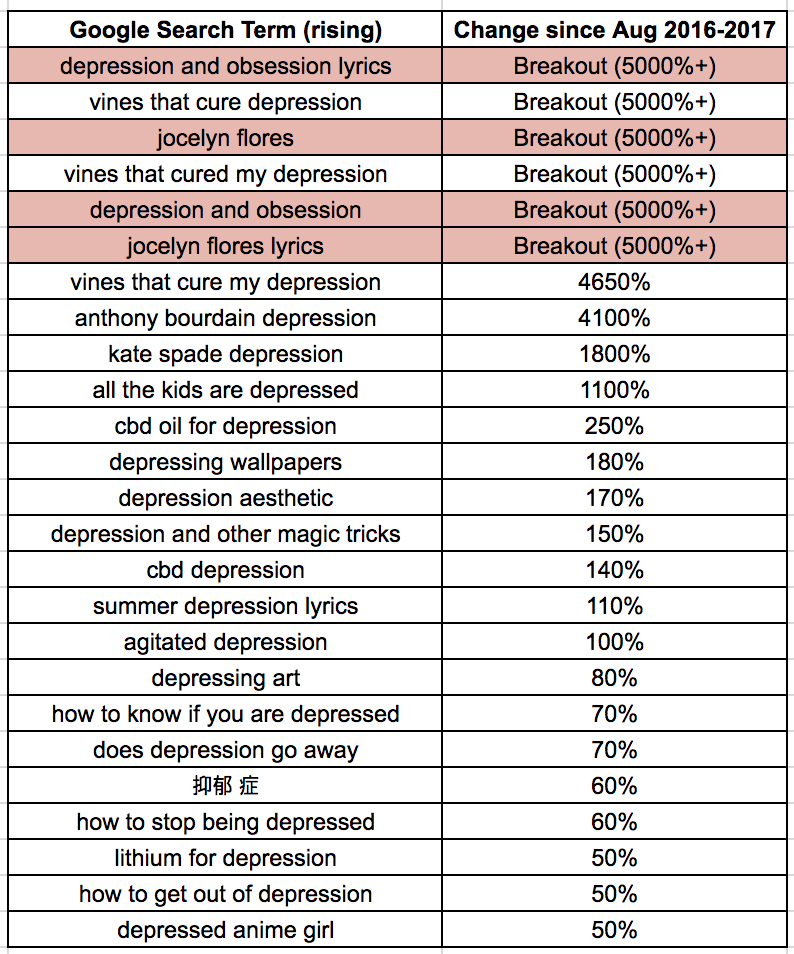
You may have noticed that both of XXXTentacion’s songs listed above were queried by “title” and then “title” + “lyrics”. This is where Brooklyn-based media company Genius comes into the picture as our second source of relevant data.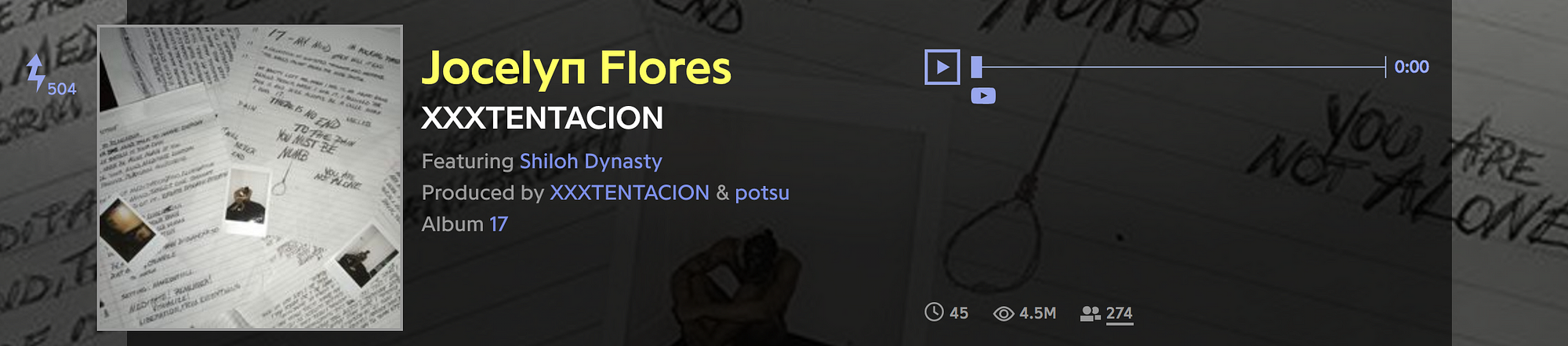
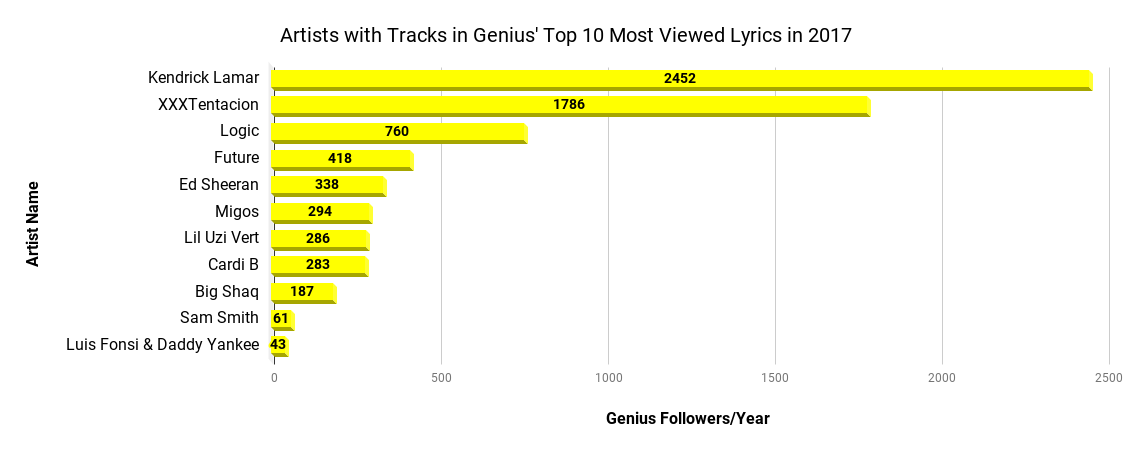
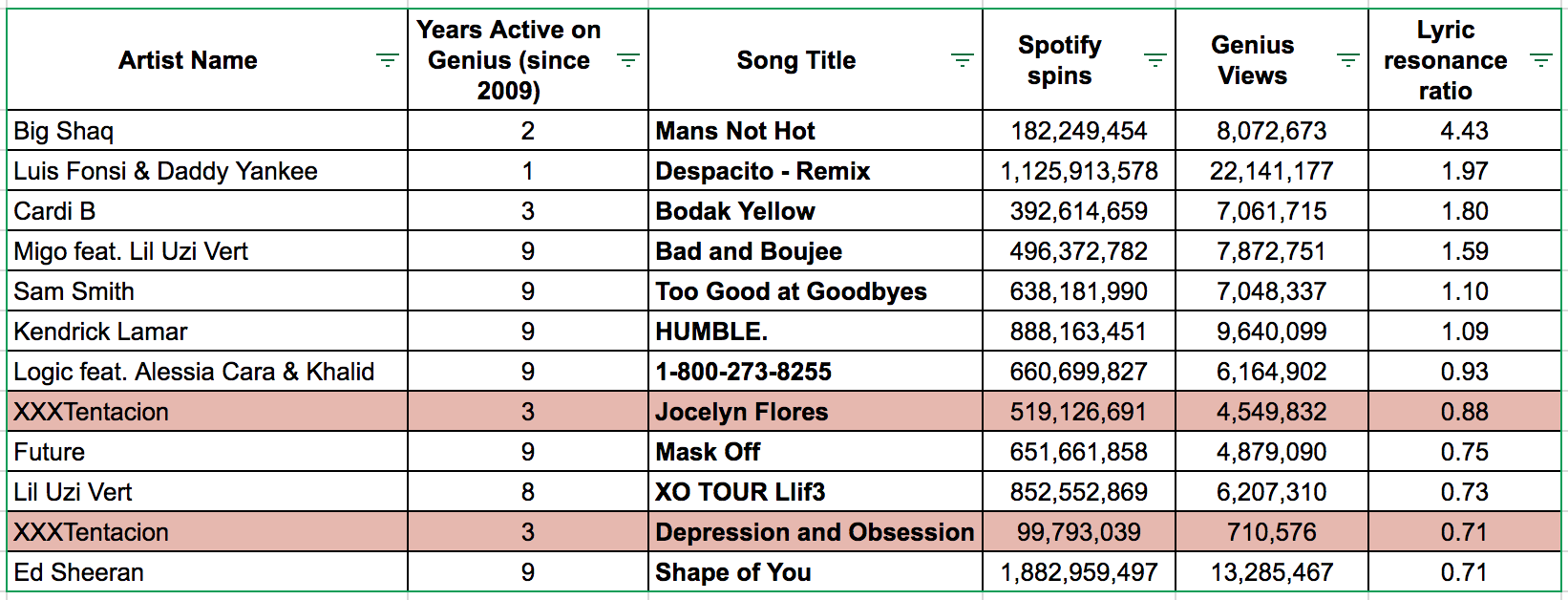
In an effort to understand how much Genius/Spotify users are interested in a certain track, we experimented with a “lyric resonance” ratio. This is simply a track’s Genius page views divided by its Spotify spins multiplied by 100 (for readability). It’s an imperfect equation that likely also rewards popular songs with exceedingly incomprehensible lyrics or non-English language content.
X’s two tracks surprisingly don’t do well in this grouping. Both beating only Ed Sheeran’s “Shape of You”, and one track beating out fellow “emo” rappers Future and Lil Uzi Vert, they are both overcome by the rest of the dataset. However, for such a relatively junior artist to be able to stand toe-to-toe in lyrics engagement in this grouping is still worth noting.
Most surprisingly, British comedian act Big Shaq stands tall above all the A-list musicians with a 4.43 lyric resonance, with the #2 track being the Spanglish juggernaut “Despacito – Remix” by Luis Fonsi, Daddy Yankee and Justin Bieber at 1.97.
There’s a lot to think about here: how should one measure Big Shaq’s novelty “Mans Not Hot” track against a dark themed track like X’s “Jocelyn Flores”? Does the Spanish nature of “Despacito — Remix” on an English-centric website like Genius make it more of a translation exercise, or are fans really engaged with the sensual themes of the song? Does Logic’s “1–800–273–8255” theme of depression and suicide, which is in the ballpark of X’s work here, get a boost due to Logic’s more mainstream-friendly persona and MTV/Grammy visibility?
Artists Move Culture.
Fan engagement is a complex target variable, and it happens at both surface and deep levels. Club hits and cocktail party music may be more easily measured in simpler metrics, but for more intimate and dark material such as “emo rap”, we may have to be more creative in our approaches such as utilizing Google Trends and Genius lyrics pages.
Our most progressive- and frequently the least liked- artists push the edge, make us uncomfortable, and advance our public conversations through their work. Their content can be as complex as it is revolting, as resonant as it can be dangerous…but it is culture nonetheless, and our business must understand it to best serve the fans. We’ll continue to experiment with new sources of pop culture data to most accurately measure that at scale.
If you’re looking for someone to talk to, don’t hesitate to contact the National Suicide Prevention Lifeline at 1–800–273-8255, or text “home” to the Crisis Text Line at 741741 in the US.