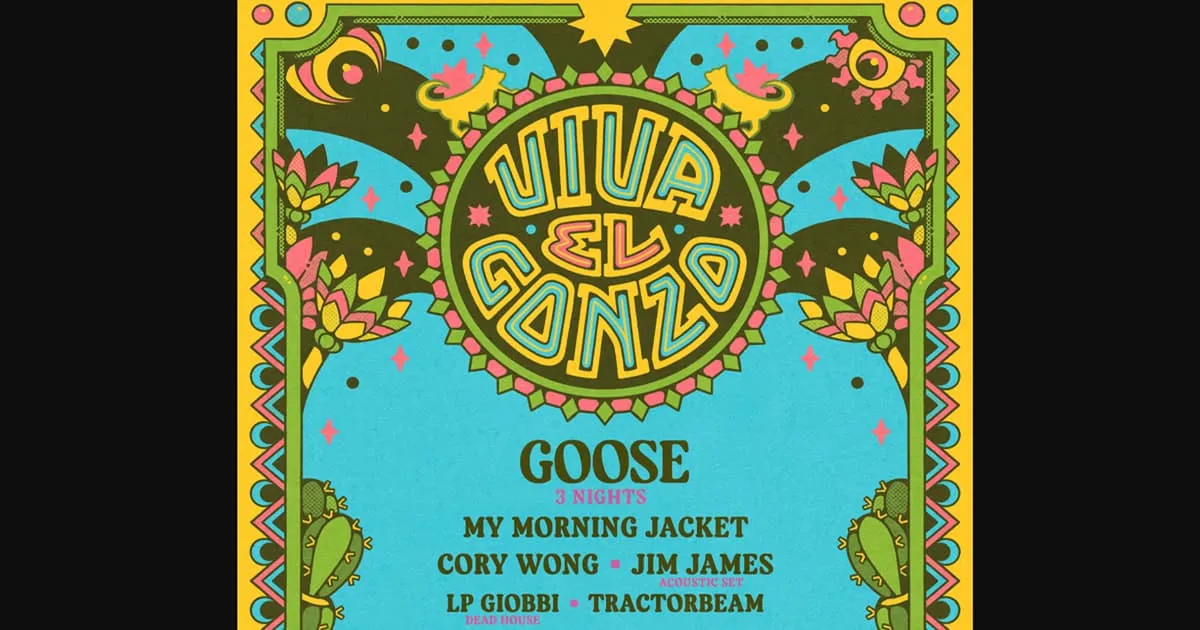
Goose have announced the return edition of Viva El Gonzo, their destination festival emanating from the slice of paradise that is San José del Cabo, Mexico. Set for May 7th through 9th, 2026, the fest is led by the multifaceted rockers performing two unique sets over three consecutive nights.
This year’s lineup includes My Morning Jacket, Cory Wong, LP Giobbi, an acoustic Jim James set, Tractorbeam, The California Honeydrops, and Pigeons Playing Ping Pong, among many others artists. Check out the full lineup and grab ticket packages for Viva El Gonzo here.
View the rest of Goose’s 2026 tour dates via Bandsintown.
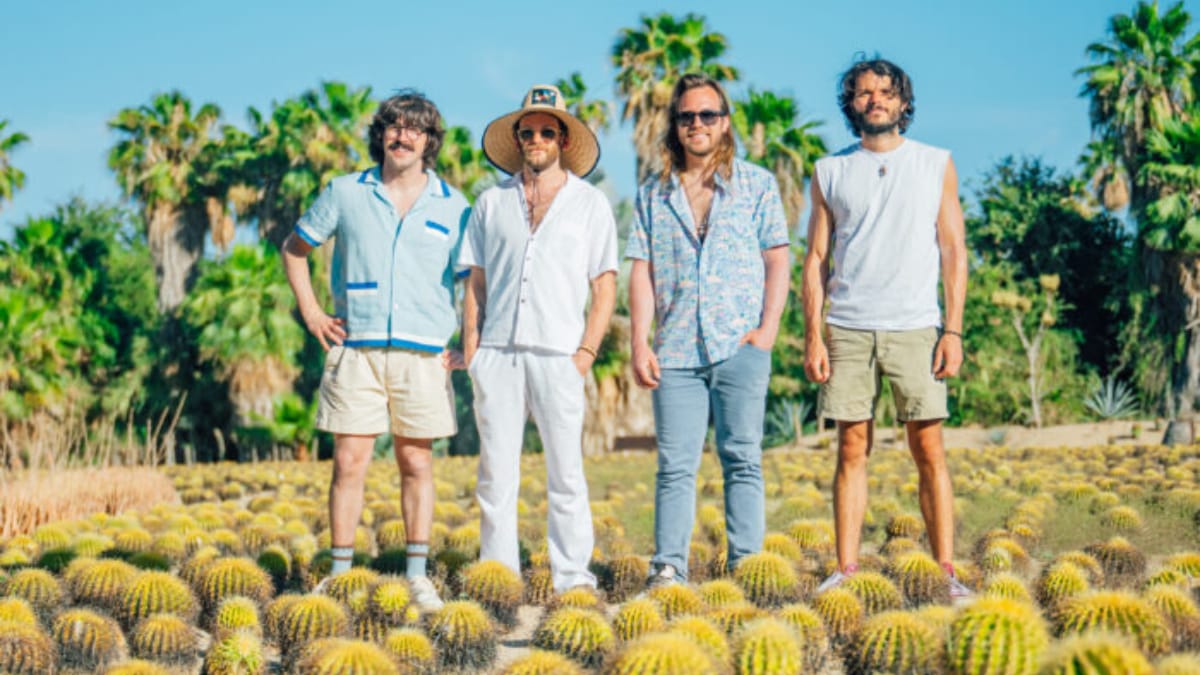
This festival continues a growing legacy of “artist-curated” festivals that began to reshape the largescale music event landscape as far back as the 1990s. Before then, rock festivals were usually industry-produced events (ie: Woodstock, Monterey, Isle of Wight). These weren’t band-curated, but they set the stage for what came later.
Let’s take a closer look at the major milestones of artist-curated music festivals here.
A Brief History of Band-Curated Festivals
The Jam Band Blueprint (Mid-1990s)
The modern idea of a band-curated music festival begins most clearly with Phish in the mid-1990s. While large music festivals had existed for decades, The Clifford Ball in 1996 marked a shift: a single band staging a multi-day, destination event centered almost entirely around its own music, fanbase, and culture. Held at a decommissioned Air Force base in upstate New York, the festival featured multiple extended Phish sets across two days, on-site camping, art installations, and an intentionally self-contained environment.
Crucially, fans weren’t just attending a concert — they were entering a temporary world built by the band.
Phish doubled down on this model throughout the late ’90s and early 2000s with festivals like The Great Went, Lemonwheel, Camp Oswego, and the now-legendary Big Cypress New Year’s event, where the band played from midnight until sunrise. These gatherings established core principles that still define artist-curated festivals today: creative autonomy, community immersion, and an experience that rewards deep fandom.
Long before “experiential festivals” became industry buzzwords, Phish demonstrated that artist-driven curation could be both culturally influential and commercially viable. Other jam bands of this era carried the torch forward, like The String Cheese Incident’s Hula Festival, The Disco Biscuits’ Camp Bisco, and moe.’s moe.down Festival.
One thing worth mentioning is that at most of Phish’s festivals, they were the only band performing all weekend long. Whereas at the other festivals that took inspiration from these early events featured many curated artist performances, including the next one on our list.
Community and Cultural Identity: The Roots Picnic (2008–Present)
While jam bands were continually reshaping the summer festival landscape in outdoorsy locations around North America, Philadelphia-based hip-hop group, The Roots, decided to enter this space when they launched The Roots Picnic in 2008. Curated by The Roots themselves, the festival was explicitly grounded in community, musicianship, and cultural continuity. From the outset, it blended hip-hop, R&B, soul, jazz, comedy, and local food culture — reflecting the band’s long-standing role as musical connectors rather than genre purists.
The Roots Picnic reframed what an artist-curated festival could look like in an urban setting. It wasn’t a destination camping trip, but a cultural homecoming — an annual gathering that felt deeply tied to place and identity. Over time, it grew into one of the most respected music festivals in the U.S., while still retaining the feeling of a band inviting fans into a shared space. Its success helped validate artist curation as a tool for cultural stewardship, not just fan service.
From Jam to Indie: Wilco’s Solid Sound (2010–Present)
By the late 2000s, the band-curated festival concept began migrating, this time towards indie rock culture. Wilco’s Solid Sound Festival, first held in 2010 at MASS MoCA in North Adams, Massachusetts, represented a quieter but equally important evolution of the format. Rather than building a massive outdoor campground experience, Wilco leaned into context, intimacy, and visual arts. The festival combined multiple Wilco performances with a carefully curated lineup of artists, comedy acts, film screenings, and conversations — all staged within the museum’s surrounding galleries and grounds.
Solid Sound stood out because it treated curation as an extension of artistic taste rather than spectacle. Wilco positioned themselves not as headliners towering above the lineup, but as hosts inviting fans into their broader cultural world. Over the years, Solid Sound has become a recurring, beloved event that emphasizes discovery, collaboration, and interdisciplinary programming. Its longevity helped normalize the idea that artist-curated festivals didn’t need to be enormous to be meaningful — and that indie and alternative bands could build sustainable, recurring festivals rooted in sensibility rather than scale.
World-Building as Festival: Camp Flog Gnaw Carnival (2012–Present)
If Phish pioneered immersion and Wilco refined taste-driven curation, Tyler, the Creator’s Camp Flog Gnaw Carnival turned the artist-curated festival into full-scale world-building. Launched in 2012, Camp Flog Gnaw combined music with carnival rides, games, art installations, surprise guests, and a playful sense of chaos that mirrored Tyler’s creative persona. The festival wasn’t just curated — it was authored.
Camp Flog Gnaw demonstrated how festivals could function as physical manifestations of an artist’s brand and imagination. Tyler positioned himself less as a traditional headliner and more as a ringmaster, hosting a lineup that reflected his personal tastes rather than strict genre logic. In doing so, he influenced a generation of artists to think of festivals not just as events, but as cultural extensions of albums, fashion, and creative universes.
Scale, Spectacle, and Responsibility: Astroworld Festival (2018–2021)
Travis Scott’s Astroworld Festival represented the apex — and breaking point — of the hyper-branded artist festival era. Named after his album and designed as a massive sensory spectacle, Astroworld leaned heavily into theme, scale, and immersive visuals. Travis Scott’s role was central: he wasn’t just the performer, but the symbolic core of the event’s identity, and for several years this was seen as the pinnacle of success in the large-scale music event industry.
Yet, on November 5, 2021, a fatal crowd crush occurred during the festival. Eight people were pronounced dead on the day of the incident, and two more died in the hospital in the following days. The county medical examiner’s office declared the cause of death to be compressive asphyxiation while the manner of death was ruled an accident. Yet numerous lawsuits were filed against Scott, Live Nation, and other parties involved, with allegations of negligence and failure to ensure the safety of attendees.
Despite that a 2023 Texas grand jury declined to indict Scott or anyone associated with the concert, Astroworld became a defining moment in festival history, prompting industry-wide reassessments of crowd safety, artist responsibility, and the risks of scaling artist-centric events too rapidly. In the broader timeline of band- and artist-curated festivals, Astroworld serves as a sobering reminder that creative control and cultural power must be matched with operational rigor and care for audiences.
Festivals With Rotating Guest Curators
As the idea of artist curation matured, some festivals moved toward a hybrid model — maintaining a consistent festival framework while inviting different artists to curate the lineup each year. One of the most influential examples is Le Guess Who? in the Netherlands. Each edition invites musicians to act as guest curators, shaping stages or entire lineups around their personal influences and creative interests. This approach shifts the focus from a single band’s universe to a rotating set of artistic perspectives, turning the festival itself into a platform for curatorial expression.
Other festivals have adopted similar models, positioning curation as a collaborative, evolving process rather than a fixed identity. These events demonstrate how the core insight of band-curated festivals — that artists can be trusted as tastemakers and cultural architects — has expanded beyond individual fandoms into a broader festival philosophy.
The New Torchbearers?
Goose’s Viva El Gonzo positions the band as the next generation inheritors of this tradition. Announced as a multi-day, destination event, Viva El Gonzo draws directly from jam-band DNA while incorporating lessons from contemporary artist-curated festivals — tighter curation, intentional guest selection, and a focus on shared experience over sheer scale. In many ways, Goose’s festival feels like a modern synthesis of everything that came before it.
Goose 2026 Live Dates
MAR 28 — Athens, GA @ Jam in the Streets
APR 10 — Asheville, NC @ Explore Asheville Convention & Visitors Bureau
APR 11 — Birmingham, AL @ Coca-Cola Amphitheater
APR 14 — Fort Lauderdale, FL @ FTL War Memorial
APR 15 — Fort Lauderdale, FL @ FTL War Memorial
APR 17 — Clearwater, FL @ The BayCare Sound
APR 18 — St. Augustine, FL @ St. Augustine Amphitheatre
APR 19 — St. Augustine, FL @ St. Augustine Amphitheatre
APR 21 — New Orleans, LA @ Saenger Theatre
APR 22 — New Orleans, LA @ Saenger Theatre
APR 23 — Houston, TX @ Bayou Music Center
APR 24 — Austin, TX @ Moody Center
APR 25 — Irving, TX @ The Pavilion At Toyota Music Factory
May 07-09 — San José del Cabo, Mexico @ Viva El Gonzo 2026
MAY 22 — London, United Kingdom @ Electric Brixton
MAY23 — London, United Kingdom @ Electric Brixton
MAY 25 — Brussels, Belgium @ La Madeleine
MAY 27 — Amsterdam, Netherlands @ Melkweg
MAY 28 — Amsterdam, Netherlands @ Melkweg
MAY 30 — Köln, Germany @ Bürgerhaus Stollwerck
JUN 01 — Paris, France @ Élysée Montmartre
JUN 03 — Berlin, Germany @ Festsaal Kreuzberg
JUN 04-06 — Aarhus, Denmark @ NorthSide 2026