

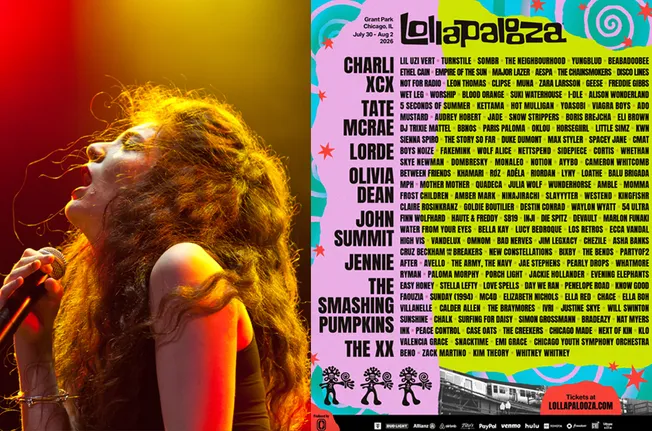
This week, the official lineup of Lollapalooza's 2026 edition was revealed.
As expected, it's a total barn burner this time around. The now-rooted Chicago live festival will take place across four nights, and feature headliners Charli XCX, Olivia Dean, Tate McCrae, Lorde, John Summit, Jennie, The XX, and The Smashing Pumpkins. And high-octane live touring acts like Turnstile, Lil Uzi Vert, Freddie Gibbs, Wet Leg, Geese, The Chainsmokers, beabadoobee, Whitney Whitney, Ethel Cain, and Blood Orange, will also be gracing the various stages.
The big question is: with this lineup in place, how will be define this phase in the long, unfolding narrative of the Lollapalooza drama machine?

Because, here's the thing.
Since its launch in 1991, Lollapalooza has dually functioned as both a music festival and a cultural barometer — its many shifting formats, multitudes of genres, and identity as a cultural signifier of our times, have always moved alongside the broader evolution of live music and alternative youth culture itself.
But that doesn't mean Lollapalooza has been without its missteps.
What began as a scrappy farewell tour for an Alt Rock band has since become a global, multi-continent institution. But more importantly, each phase of Lollapalooza’s life tells us something about what audiences wanted, what artists represented, and how the business of live music adapted in response. To trace Lollapalooza’s history is to trace the last 35 years of live music culture — one muddy stage, controversial booking, and viral headline at a time.
+Read more: "Festival Curator Brad Sweet on Raising $700k in Fan-Powered Ownership"
1991–1997: a Traveling Counterculture That Broke All the Rules
When Perry Farrell launched Lollapalooza as a farewell tour for Jane's Addiction, the idea wasn’t to build a festival empire spanning decades. It was to create a moving ecosystem — part concert, part cultural gathering — where genres collided and subcultures coexisted. And frankly, to provide a worthwhile excuse for Farrell to hang out with his best buds on the road for one final middle finger in the air to the establishment.
That first tour set the tone immediately.
Nine Inch Nails’ now-legendary mud-covered performance became a visual shorthand for the rawness of the era, while Ice-T’s band Body Count ignited national controversy with “Cop Killer,” forcing conversations about censorship, politics, and the role of artists in public discourse.
This version of Lollapalooza (between 1991-1997) was a touring event. It briefly took to the road in 2003, but it wasn't until 2005 when the festival found its semi-permanent home in Chicago.
It also reflected a moment when “Alternative” wasn’t a genre, but a worldview pushed into the mainstream by hordes of young, obsessed music fans with money to spend and record labels' ears. The touring format itself reinforced that ethos: decentralized, unpredictable, and intentionally outside the traditional concert industry model.
1992–1996: Alternative Becomes Mainstream, But Begins to Fracture
As the ‘90s progressed, Lollapalooza became the epicenter of Alternative Rock’s commercial peak — and its growing pains. Perhaps the momentum of its own critical mass had started to chip away at the Alt scene's foundations.
Rumors of Nirvana headlining in 1992 (complete with talk of Kurt Cobain appearing in a wheelchair) became part of the festival’s lore and mythology, even though the performance never happened. Almost as if what didn't happen was more heavily talked about than what did.
And their absence itself spoke volumes: Lollapalooza was now big enough that even its “what-ifs” carried cultural weight.
By 1994, The Smashing Pumpkins were delivering era-defining performances to massive crowds, signaling that Alternative Rock had fully crossed into the mainstream. But with that visibility came volatility. Courtney Love’s mid-set confrontation with the audience during Hole's 1995 set captured the tension between artist and crowd, underground credibility and mainstream attention. The band threw their instruments into the crowd. It got intense.
Lollapalooza in this era mirrored the arc of alternative music itself: explosive growth, followed quickly by fragmentation and identity crisis. Egos were outsized, audiences took that as a green light to lean into chaos and catharsis too.
1996–2004: Identity Crisis, Commercial Pressure, and Brief Collapse
By the late ‘90s, the cultural center of gravity had shifted — and Lollapalooza struggled to keep up. The audiences had moved on.
Booking Metallica in 1996 was a turning point. while a move like this did offend people of a certain allegiance to the ethos of the festival, it also expanded the event's scope like a survival mechanism, which allowed it to continue on.
But the annals of history sometimes define this as the mark of an identity loss. Attendance began to decline as Alternative Rock lost its dominance on MTV and the airwaves, and audiences fragmented across emerging genres. A unifying community was no longer easily accessible for a festival that barely had to do anything at all to attract a wide spectator base.
Also, the touring model that once defined Lollapalooza became a liability. Rising costs, inconsistent ticket sales, and a lack of clear cultural direction culminated in a full cancellation in 2004.
It looked, for a moment, like Lollapalooza might simply become a relic of the ‘90s — a festival that couldn’t survive the very changes it helped create in society.
+Read more: "Book More Women: The Data-Driven Initiative Pushing Music Festivals Toward Gender Equity"
2005–2010s: Reinvention in Chicago and the Rise of the Modern Festival Economy
Instead, Lollapalooza reinvented itself — and, in doing so, helped define the modern festival model, leading to now-iconic moments that remain cultural watermarks.
By planting itself permanently in Grant Park in 2005, the festival shifted from a traveling counterculture experiment to a destination event. This wasn’t just a logistical change; it reflected a broader industry transformation toward large-scale, city-based festivals that drive tourism, sponsorship, and multi-day experiences.
The bookings followed suit. Daft Punk’s 2007 pyramid set helped legitimize EDM as a headline festival genre. Early appearances from Lady Gaga on a small side-stage demonstrated Lollapalooza’s growing role as a predictor of future stardom. And Chance the Rapper’s powerful, resonant homecoming set in 2013 underscored a new priority: local connection within a global framework.
This era marked the full convergence of music, branding, and experience. In case you didn't think so before, it was now clear how Lollapalooza had been actively shaping how festivals operated alongside youth culture for years.
2010s–Now: The Genre-Free Era and the Age of Virality
In its current form, Lollapalooza embodies the fully hybridized state of modern music culture. Less a detailed view of what genres are selling tickets and records at any given time, and more now a referendum on which specific artists are dazzling live stages across the globe.
Who is entertaining you via the screen or stage?
Lineups now move seamlessly between Pop, Hip-Hop, EDM, Rock, and everything in between. Ariana Grande and Billie Eilish headline alongside acts that would have once been siloed into entirely different festivals. Childish Gambino’s emotionally-charged performances blur the line between concert and performance art, reflecting an audience expectation for something more immersive and narrative-driven.
At the same time, the festival experience itself has become inseparable from the internet. Viral crowd surges, gate-crashing incidents, and social media-driven hype cycles highlight both the scale of demand and the challenges of managing it.
Lollapalooza today almost functions like a massive content engine, a global brand, and a reflection of how music consumption has become as much visual and social as it is auditory. It has proven that it has longevity, as well as adaptability, in order to remain not just relevant but important.
Every major shift in its format — from touring caravan to destination festival, from Alt-Rock showcase to genre-agnostic spectacle — has mirrored a larger transformation in the live music business. Along the way, it has helped normalize ideas that now define the industry: multi-genre lineups, experiential branding, global expansion, and the fusion of live performance with digital culture.
Lollapalooza 2026
MAR 13-15 — Santiago, Chile @ Parque O'Higgins
MAR 13-15 — Buenos Aires, Argentina @ Hippodromo de San Isidro
MAR 20-22 — São Paulo, Brazil @ Autódromo de Interlagos
JUL 30–AUG 2 — Chicago, IL @ Grant Park