

“Artists can’t make money anymore!” “Streaming is killing the industry!” “Nobody buys music!”
If you’ve clicked on this, I’m already pretty sure you’re industry-savvy enough to see these claims frequently.
Are they true? Not so much. Apologies for ruining a perfectly good panic story.
I would rather believe that yes, the music industry has changed, and maybe the industry hasn’t finished rebounding from a low point circa-2014. But the money consumers spend on music has not disappeared — it just flows differently now, and to different people.
Yes, there’s a huge change in that consumers pay a streaming fee instead of “buying” music now. All of us with a subscription have bought an admission ticket to just about everything we can think of playing.
In this article, let’s take a look at where our music money goes, historically and today.
Since I am myself an artist and composer (and an author for hire, by the way), my vantage point is going to naturally align with other artists. Something important to remember is that there are more artists now than before. With first-class production tools available in a spare bedroom, there are so many unsigned artists making various types of livings in music. [cough], like me for instance – with no record deal in 1999, I wouldn’t have had a prayer or a clue how to get my music into a film, whereas I can make inroads in 2026.
Industry Health Overall
First, the bad news. The industry’s bounce back isn’t quite what it seems.
We can all agree that 1999 or thereabout is the inflation-adjusted high point of the recorded music industry. Or to put it another way, the pre-Napster era. The onset of downloading really took a bite out of everybody’s pockets: artists, record companies, labels, etc. The nadir for earnings is pretty recognized as somewhere between 2010 and 2014.
Ever since then, the overall money in the industry has come back. You can see slightly different figures, but according to this article from Musically, global recorded music revenue in these key years was:
1999: ≈ $22.2 billion. 2014: ≈ $14.0 billion. 2023: ≈ $28.6 billion
Doesn’t that look like good news? Better than ever, right?
Not so fast, music industry. That 1999 amount would be $40.2 billion in 2023 dollars. So, let’s keep inflation in mind when we make year-to-year, apples-to-oranges comparisons.
We can see the reality in an inflation-adjusted U.S. music revenue comparison; 1978 through 2024 looks like this:
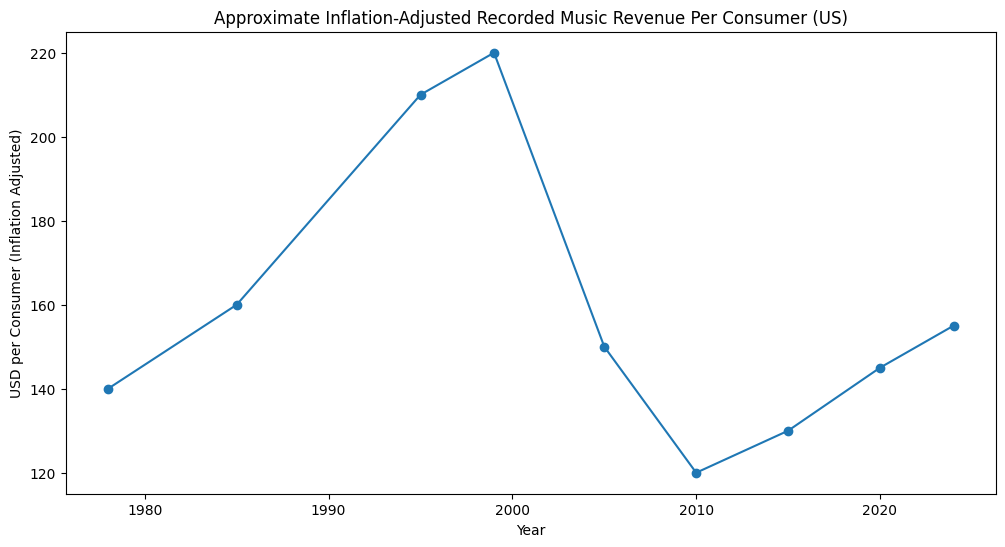
But revenue only tells part of the story. The bigger shift isn’t how much we spend, it’s how we spend it and where it now goes.
+Read more: "UK Music Spending Climbs in 2025 — But Artists Still Face Tough Realities"
Historical Context and Revenue Evolution
There’s quite an evolution in music-buying formats over the years. I’ll list approximate years of early popularity: Wax cylinders around 1895, shellac 78’s around 1910, vinyl/LPs around 1948, 8-track tape 1965, cassettes maybe 1974, CD’s popularity in 1983, then digital downloads in 1999, and streaming really about 2010.
Generally, over the years the differences in fan spending were pretty easy to understand. How everybody played their music over the years changed, but ever since wax cylinders were around, a fan could “buy” music. For the record (no pun intended), THAT was the paradigm shift that will never be equaled: going from live music or sheet music to actually being able to play a recording.
Take that, disruptors!
Anyway, the music industry propped itself up a bit by changing formats — so many people in the 1980s and 1990s bought CDs that they already owned as LPs. In fact, it’s not unusual for consumers over 30 years old today to have bought an album as a record, an 8-track, a cassette, a CD and in maybe more than one streaming service. OK, maybe not an 8-track.
The second-biggest paradigm shift in music all-time is recent. It’s when we all went from buying a song or album to paying a license to stream. It’s like going from the A-through-E tickets at Disneyland to just hopping on any ride with a park pass.
Superfans and collectors spent more money back in the day, while casual fans maybe bought a couple of records per year. Now that’s flattened out, huge music fans and casual ones both pay for pretty much the same subscription now (e.g., Spotify Premium or Apple Music).
That means today there is a lot more music consumed, but less revenue per artist per listener.
Who’s Actually Making Money
While we’ve shown that overall money spent in the music industry is a little bit down over the past 25 years — and certainly not as much as some panicky voices are claiming — the changes really seem to be where the money is going.
The flow in 1999 was basically from: Consumer → Retail → Label → Artist.
More recently in 2026, it’s more like: Consumer → Platform → Rights Holders → Artist.
I was going to write a detailed breakdown of music stakeholders’ piece of the pie in key years. But then I figured it might put one of us (you or me) to sleep. How about a graph instead (you’re welcome):
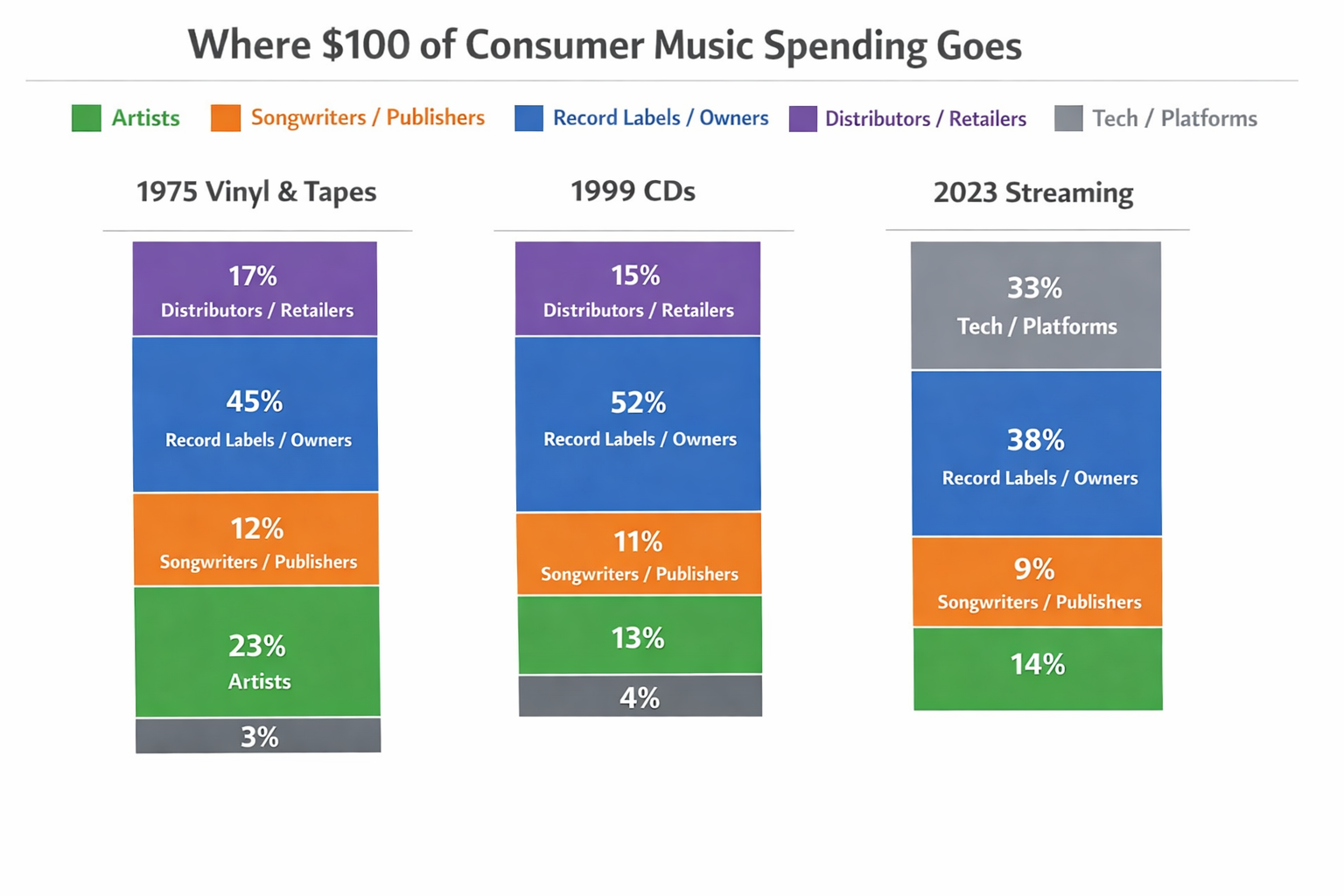
If you’re worried about record labels losing a slice of the pie, don’t shed a tear for them so much. Labels now often participate across income streams via 360 deals with touring, merch, brand deals, publishing, etc. — so, there’s still plenty of water for them at the giant trough.
What’s the big new element in our modern era? Tech companies and streaming platforms. Revenue is concentrated with tech/platform owners and labels, while artists and songwriters get a smaller relative slice.
Is that alarming for those of us who have lived and breathed music for their lifetimes? I think so.
It’s easy to dismiss the streamers completely as “tech bros” which is simplistic; there are a lot of people working in those platforms who love music too. But the people making the real money at the top are not in the music business. They’re in the money business and to them music is “content.” If they could sell widgets more effectively, they’d be selling widgets.
Is it time for an overly simplified Winners & Losers proclamation? Yes, it is.
Winners:
- Platforms
- Catalog owners
- Top 1% artists
Meh:
- Mid-tier artists
Losers:
- Unit-sale dependent artists
- Retail distribution
Lots of us artists can show royalty reports like ASCAP statements showing how one of your songs getting 10,000 plays on Amazon Music will get you $0.40.
When I talk about music and royalties, I frequently bring up David Lowery, lead singer and songwriter for Cracker and Camper Van Beethoven and also a senior lecturer in the Music Business Program at the University of Georgia. If you want a smart voice in your head about how this all works and what certain pieces of news mean, follow Lowery or seek him out.
Some telling quotes from David Lowery about changing revenue streams:
- “My song got played on Pandora 1 million times and all I got was $16.89, less than what I make from a single T-shirt sale.”
- “Streaming flattens and commoditizes the spin. So, you just have one price for every spin of a song… whether it’s some kind of avant-garde classical work or a Miley Cyrus song. That… will push out any sort of niche or… music.”
- “There will be no middle class or niche ensemble music unless streaming revenues increase.”
Change In How Artists Make A Buck
Do you want to know why classic rock bands started hitting the road again? Their music royalties and sales fell off. Do you think Donald Fagen would have ever gotten back on stage in front of all of us slobs if he didn’t suddenly need the money he was losing in the new music economy?!
Take a look at this graphic showing where artist money comes from:
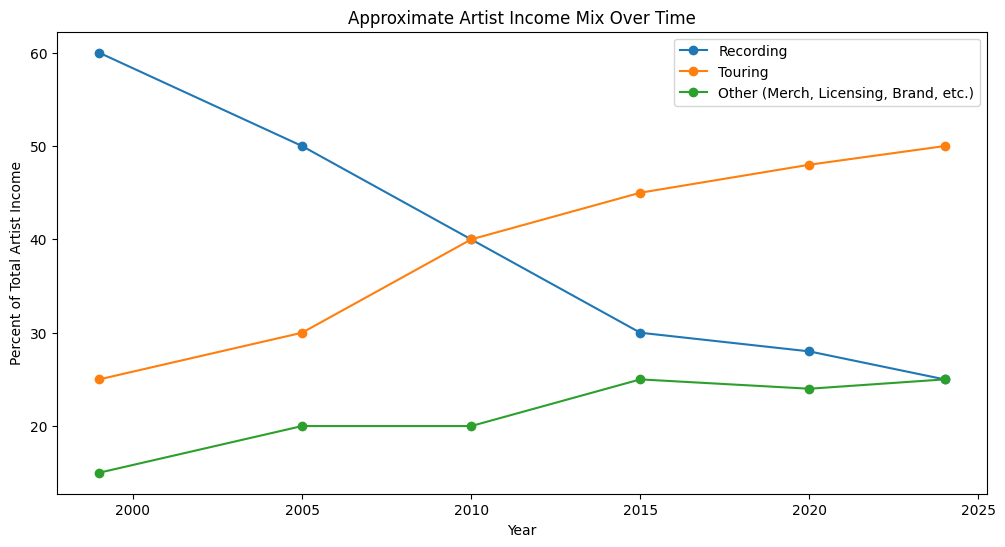
That falling blue line brings home what I’ve been talking about. You can also see how much merch and licensing has gone up. But a lot of that is for the larger acts who can enter into creative and lucrative brand partnerships. If you’re not at an advertiser-friendly level in your career, you’d better get off your ass and out on the road.
A.I. and the Future
This is a 2026 article, so I’m almost legally obligated to discuss A.I. although I’d love to avoid going down that rabbit hole. A.I. also a trap for industry analysis because it’s changing so damn fast. Whatever I say in February 2026 could be totally outdated by July.
A.I. creating music is threatening to musicians for sure, even pro-A.I. Pollyanna's have to admit that. If the rights of the human works that A.I. is “modeling” (or “stealing from” if you like) — if those original creators start getting paid, it’s going to be at a lower rate than when a songwriter and artist made music and got paid straight up without A.I.
But we shouldn’t view this as a zero-sum game. Every dollar that goes to A.I. doesn’t mean it’s a dollar that an artist didn’t get. One thing about A.I. volatility is that we don’t even know if A.I. will somehow create new tiers of revenue for artists and the industry in general. Some of us could end up training A.I., interpreting A.I. and using A.I. in still basically “human” work.
And creatively, if I write and record a song with an A.I. drum track instead of a loop from a royalty-free library, then what’s really the difference?
Again, it’s so hard to imagine the landscape 5 years from now. Anybody who sounds really certain about what’s going to happen should seem a little suspect. That said, most artists like me fear that the need for songwriting, film and TV score, and cues will increasingly be filled by A.I. — and the revenue along with it.
What Have We Learned?
Zooming out in general about the movements in the industry, many artists think revenue is vanishing, while the reality shows more nuanced flows.
So, are the rich getting richer? If by “rich” you mean “tech platforms” then yes, they’re getting richer.
All of us in the industry in whatever form don’t need to panic that there’s no money in music anymore. There’s still money, just in different places. Despite the way it might feel to some of us, music money is still flowing, but it’s flowing down different rivers and streams than it did before.
But I will leave you with the one question I wish all of us in the industry asked a little more: Are fans happier now?
Charlie Recksieck is a musician, composer, and writer-for-hire focused on music, culture, and the realities of today’s creative economy. As a songwriter, he’s been called “the stupid man’s Randy Newman,” which he considers a fair warning label. Check out Charlie's music at The Bigfellas.