

Except from The Label Machine by Nick Sadler
We're excited to share a chapter from the newly republished second edition of The Label Machine: Build Your Music Career With The Record Label Model, a go-to resource guide for artists and nearly everyone working in independent music publishing today.
In it, artist, indie label owner, and author Nick Sadler reveals how to build a profitable career using the tools available at our fingertips in the post-COVID era and beyond, from conquering social media and mastering the digital landscape to embracing authentic fan connection and simply learning how to persevere. It's a must-read for anyone hoping to navigate the increasingly complex yet advantageous landscape that is the modern music business.
Here, we have excerpted the chapter titled, "Budgets."
Budgets
How much will it cost to start and run a record label? There are unavoidable costs, plus optional investments, primarily marketing expenses like paid advertising, music videos, or external PR.
For reference, we started Never Say Die with approximately £5,000/$7,000. Our first seven releases were on vinyl, requiring steep physical manufacturing costs. Digital releases are much cheaper!
Your biggest investment is setting up your label’s first release and infrastructure. When revenue returns, you can reinvest it into operational costs.
Many artist-based labels fund releases incrementally, using income from live shows, merchandise, or day jobs. Regardless of your approach, you must control and understand the label’s finances and have a clear investment plan.
To determine your investment needs, understand the different expenses: startup costs, label expenses, and release expenses.
Label Expenses & Release Expenses
Label expenses are the essentials to set up and run your record label. These are non-recoupable expenses paid out of the label’s profit share.
What is the difference between recoupable and non-recoupable expenses?
A recoupable expense directly relates to releasing a song, artwork, PR, remix fees. These are release expenses. A non-recoupable expense is not directly related to releasing songs, company formation fees, office rent, website hosting, employee wages. These are label expenses.
Label Accounting Basics
When signing an artist, you agree to a Royalty Income split (specified in the contract), typically a 50/50 Net Profit deal for independent labels.
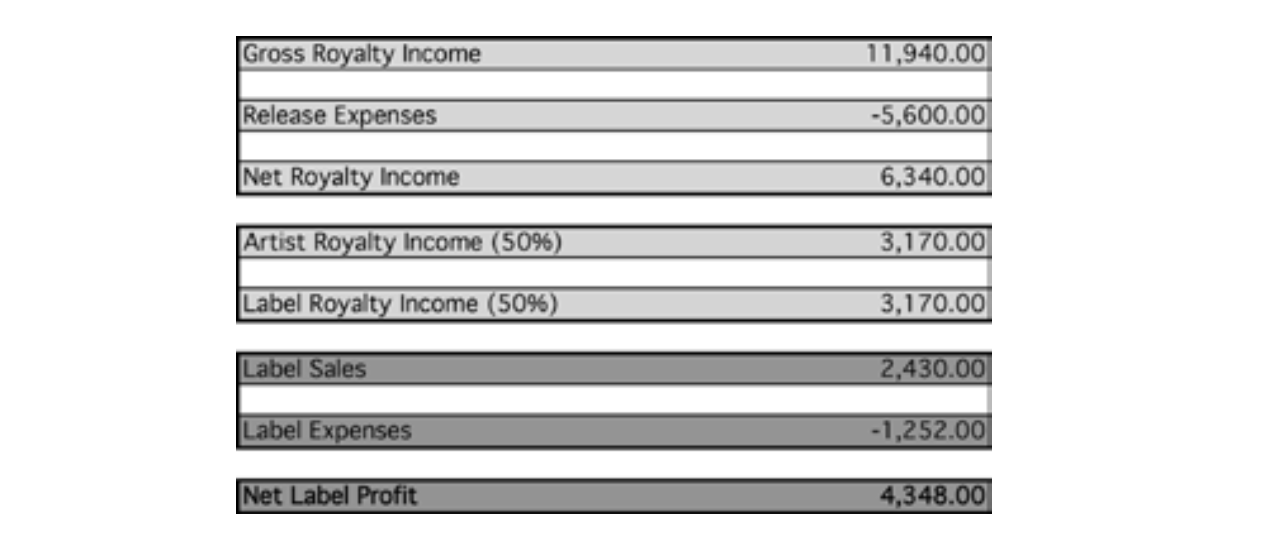
Before deducting recoupable expenses, this is called Gross Royalty Income. After deductions, it’s Net Royalty Income.
Gross Royalty Income – Release Expenses = Net Royalty Income
You then split the Net Royalty Income between artist and label as agreed, for example, 50%/50%.
$100 Net Royalty Income = $50 Artist Royalty Income + $50 Label Royalty Income.
You send the artist their share, and the Label Royalty Income is yours.
To calculate label profit, add any other sales income (like merchandise) and deduct non-recoupable Label Expenses.
Label Royalty Income + Other Label Sales – Label Expenses = Net Label Profit.
Here is an example as illustrated by a record label’s profit and loss summary.
Label Expenses
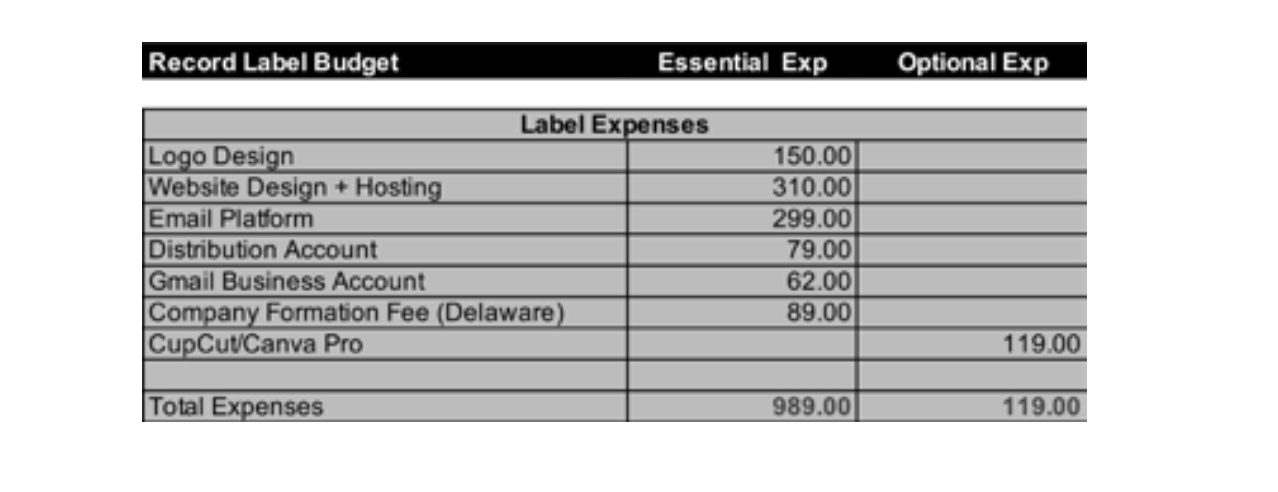
Let’s break down some common label expenses for the first year
of operation.
Logo Design
This price varies depending on what you choose in the Designing the Logo section. For the budget, we will use the budget amount for a freelance designer of $150.
Website Design and Hosting
Like the logo design, this will depend on what you decide to use in the Choosing a Website section; for the budget, we will use the budget amount for the annual fee of $310 for a website-in-a-box option.
Email Platform
This is the annual fee for a professional email provider to manage your email subscribers. We have chosen to use the Marketing Machine platform, which as a member has a $299 annual fee and includes access to all other marketing tools too.
Distribution Account
This is the annual fee for setting up a label account with Distrokid, but if you get distribution with a platform that works onpercentages, such as The Label Machine’s distribution, this can be omitted as it will be deducted from your label’s gross income before it reaches you.
Google Workspace
I recommend using Google Workspace for your business. It gives you access to a suite of business applications for document and spreadsheet processing and the ability for Gmail to host your business email address securely.
Company Formation Fee
This is the service fee to incorporate your record label as an official business. This will depend on which country and state you are based in, and I have used the fee expense for forming a company in Delaware, USA.
Canva
Useful for editing images and formatting for social media. Many tutorials are available on YouTube for both Canva and other tools.
CapCut
CapCut is a user-friendly video editing app ideal for record labels to quickly create engaging, music-driven promotional content optimized for social media. Both Canva and CapCut are an optional expense, however, so we have placed it in the optional costs section.
Other Business Expenses
Other non-recoupable business expenses worth considering are office space rental, travel, employee wages, and business rates. These aren’t included in the budget template as they vary by location and are often unnecessary until you’re established.
Release Expenses
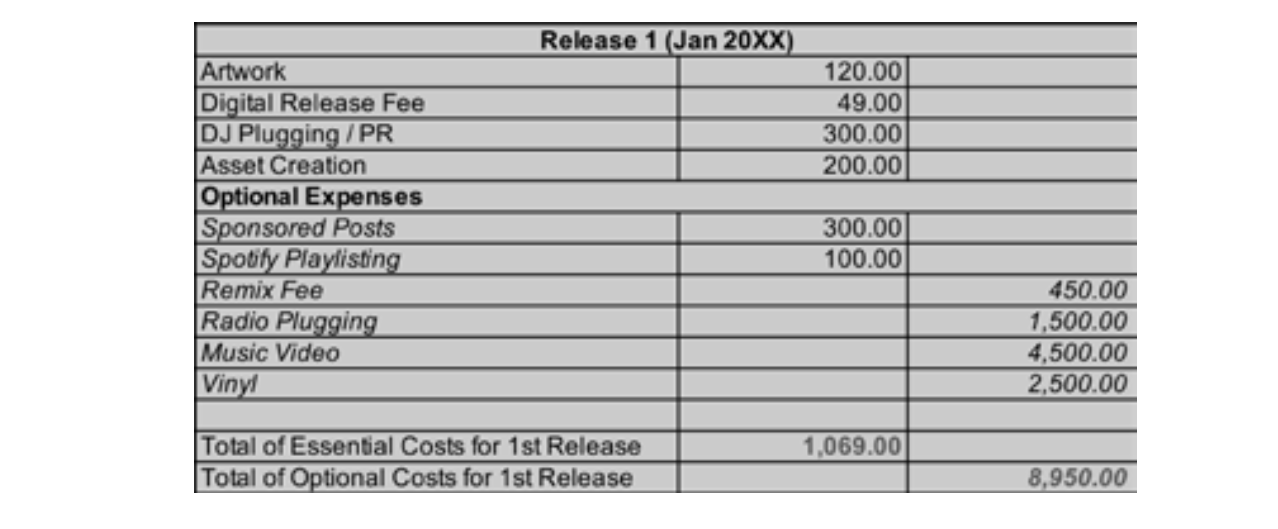
These expenses directly relate to releasing singles, EPs, or albums. This list covers essential and optional expenses but isn’t exhaustive. If you have any other costs, insert a new line into your budget and add to the expenses.
Artwork
The second most important creative asset after the music. If there’s one place to spend more, it’s here. Budget example: $120 via designcrowd.com or Fiverr. Alternatively, AI-powered design tools can create artwork at lower costs. If you use a designer for multiple releases, negotiate a bundle deal, five pieces for $100 each provides artwork continuity for $500.
Digital Release Fee
If you use a self-distribution model, which will be likely if you’re just starting, then most platforms will charge a fee to upload or have the music available on all platforms for eternity.
If you have completed the Choosing a Distributor section, enter the digital release cost here. For the purpose of the template, I will use the Distrokid ‘Leave a legacy’ fee as we have chosen them as the distributor in the label expenses sections.
DJ Plugging/PR
This expense can vary depending on your approach and the type of music you are releasing. In-house PR (by which I mean you or a member of your team will do the PR) costs less than agencies but still requires services like Submit Hub or Groover.
For electronic club music, specialist companies with DJ databases can distribute your music and collect feedback. These services start at $250-$500, but they review your music first and may decline if it’s not suitable.
For our first release, we’ll budget $300 for an independent PR agency to help reach radio and tastemakers.
Digital Asset Creation
This expense refers to creating marketing assets like teasers, lyric videos, or promo interviews. Budget example: $200 for a lyric video from a fiverr.com freelancer.
Promoted Posts
Essential for reaching fans on social platforms, even with large followings, so make sure you have included a budget for this. For this example, we will use $300 to create Facebook and Instagram promoted posts.
Optional Release Expenses
These are expenses that will vary depending on each single, EP, or album you release. The general rule of thumb is that the bigger the track and artist, the more you will spend here. If the track has a commercial pop edge and the artist is a rising star, you may want to get an established radio plugger onboard to promote to radio stations. Or, if you have a track that’s been picked up by a big YouTube channel, you may want to make a music video to help drive views.
Spotify Playlisting Service
A reputable Spotify playlisting service can give valuable momentum during the crucial initial release period, helping new artists get their streaming numbers above 1000. It’s arguably the most essential optional expense, one that many labels choose to include in their budget.
A single placement on a prominent playlist can rapidly exceed one million plays, translating into earnings of approximately $4,000 to $5,000 (Spotify’s current average payout per stream ranges between $0.004 and $0.005).
There is a handy tool called Streaming Royalty Calculator that is fairly accurate if you want to calculate streaming royalties: streamingroyaltycalculator.com
Investing in an experienced Spotify playlisting service can thus prove financially rewarding; for example, a $2,000 plugging fee might quickly pay off if the promoted track gains significant traction on playlists. At the $100 tier, expect approximately 2,000-3,000 plays, whilst the $300 tier delivers 7,000-10,000 plays.
Trusted Playlist Promotion Companies
Here’s a list of reliable Spotify playlist promotion companies, with personal insights to help gauge what might work best for your goals.
Indie Music Academy
Led by Ryan Waczek, an impressive choice who genuinely delivers results. I’ve met Ryan personally and can vouch for his effectiveness.
- Excels at finding playlists ranking well in search results
- Identifies playlists with authentic engagement, ensuring no bots
- Offers educational resources for artists to boost playlisting chances independently
Playlist Push
One of the original playlist promotion companies, maintaining a solid reputation.
- Works with 900+ independent playlist creators, reaching over 25 million listeners
- Reasonably priced with campaigns starting around £200, average spend about £450
- Extensive curator network ideal for artists seeking broad audience reach
YouGrow Promo
Consistent performer with excellent Spotify campaigns. Their CEO runs a tight ship with excellent customer service and responsiveness.
- Campaigns start at just £79, offering excellent value
- Feedback shows genuine, non-bot engagement
- Provides refunds or campaign transfers if placements aren’t achieved
Playlist Promotion
Focuses solely on playlisting, recently expanding into YouTube promotion.
- Unique application process ensures artist-curator fit
- Approach indicates quality-focused rather than solely profit-driven
Daily Playlists
A must-use service as it’s free! Met their team at ADE Music Conference and they are fantastic to work with.
- Paid option allows genre-specific submissions and back-catalogue uploads
- Artists report significant stream increases, with successful use across all genres.
You can get a list of reputable playlisting services in the Book Resources tab on The Label Machine website.
Remix Fees
If you plan to have remix tracks on a release, you must add this to the budget. If you are an electronic record label, once you are more established, you can have fellow label artists remix each other as favours, so this might not always need to be factored in as an expense. But if you want producers beyond your contact list to remix your work, then you’ll have to pay a remix fee. Fees will be anything from $400 for new rising talent to $5000 for an established, well-known producer.
Radio Plugging
Radio plugging involves promoting a track to radio stations with the primary goal of securing airplay, ideally achieving B-list rotation and eventually progressing to A-list rotation. Successfully entering these rotations significantly boosts exposure and can propel the track toward chart positions, such as the Top 40.
Radio pluggers usually charge a flat fee for their service, usually starting around $1500, supplemented by bonuses triggered if the track reaches certain milestones, like securing B-list rotation, moving onto A-list rotation, or achieving prime-time
drive-show plays.
Music Video
Great for making a statement and providing additional content like behind-the-scenes material. Professional videos still start around $4,000 but consider leveraging user-generated content platforms like TikTok to reduce costs while boosting viral potential.
Vinyl Costs
For physical releases, work with a manufacturer near your location to minimize shipping costs. Rising material costs may slightly increase manufacturing expenses, budget example: $2,500 for 500 vinyl records via discmanufacturingservices.com.
Professional mastering is required for vinyl pressings alongside digital versions, budget example: $150.
Recording, Mixing, and Mastering Expenses
As I’m focusing on the business side of running an indie record label, I have not included music production costs such as studio recording costs or mixing engineer expenses.
These days a lot of indie music is produced in home studios or smaller studios where the artists have taken care of the mixing, mastering and production costs themselves. This is also true for electronic music, and almost all electronic artists mix and master their own tracks.
Suppose the recording agreement with your artist includes covering the recording, mixing and mastering costs as part of the release. In that case, you will need to insert extra lines in the releases section of expenses, as these are costs that are recoupable from music royalties.
For this example, as I’m pressing vinyl, I’ll have the release mastered by a professional engineer to get both a vinyl and digital master of the track for $150.
Note: If you’re already engaged in the music industry or in your local music scene, I highly recommend that when starting a label you use all the contacts at your disposal and pull in favours where possible to keep costs down. Somewhere along the line, you’ll be able to return the favour in kind. And always look to incorporate AI-driven tools across areas such as mastering (LANDR), and design (Canva) to keep costs down when you can.
Cash Flow
As you make sales, you can start tracking your cash flow. When you are starting out, you will have to forecast the royalties of the label. The following table is an example of a cash flow example for the first year of a record label, starting with the first release in January. It included four release and merch sales from September, as well as the revenue from an event in December.
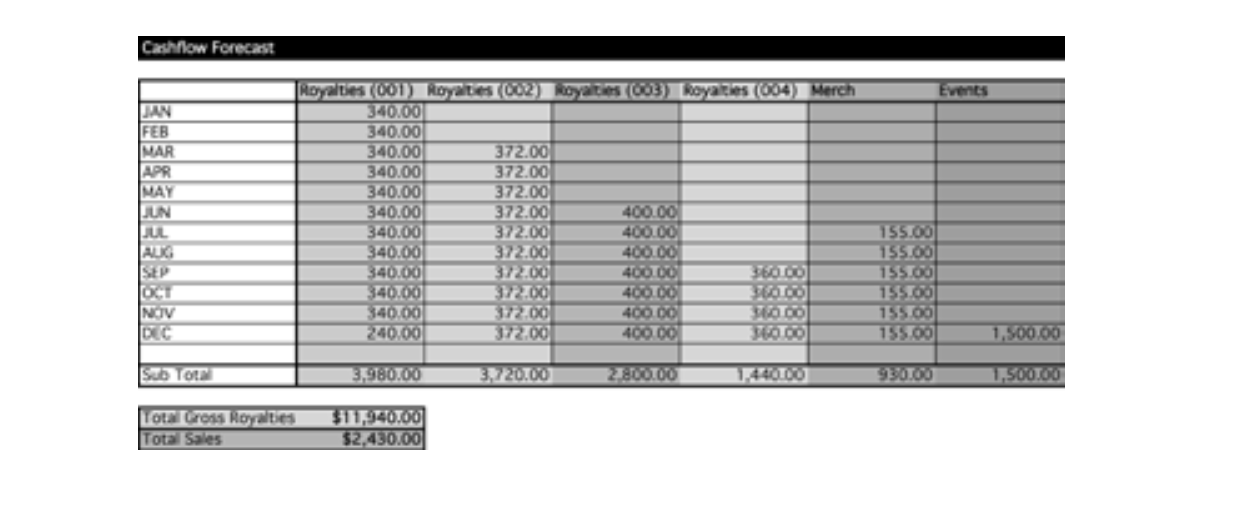
This really is a guide for your first year, and I’ve used an average of the last few labels I have set up. It’s to give an idea of what you can expect. As you make sales, you’ll need to update this to get a better picture to forecast your finances.
Check your finances after one month and revise your yearly projection accordingly. Do so again after the first quarter, and again after 6 months. I have been very conservative with the cash flow and these numbers as it’s better to budget with realistic expectations.
For simplicity, I have based this budget on four releases a year, which is a good start if you are entirely new to running a label. However, once established after the first year, many labels will put out 15-20 releases a year, which is when you can expect to start making a good income.
Budget Template
I have created a budget template in a 12-month calendar cycle and included tabs to estimate your cash flow and calculate your profit and loss. The whole budget is dynamic, and changing expenses and cash flow will automatically update your profit and loss and summary tables.
You can download a copy of the budget from the Book Resources tab on The Label Machine website. While these budget examples should only act as a guide for your own label’s set-up, they should still provide you with a clearer understanding of the costs involved in setting up your own label and budgeting for your first release.