


The debate over consent decrees and compulsory licenses is heating up, raising questions about creators’ rights to control their own music…
Consent Decrees and Compulsory Licenses: The Right to Say No
by Chris Castle via Music Tech Solutions [This post first appeared on Artist Rights Institute’s Artist Rights Watch blog]
“I remember you, you’re the one who made my dreams come true…”
written by Johnny Mercer
Careful What You Wish For
Remember the sales pitch for how wonderful the Music Modernization Act was going to be? An even broader compulsory mechanical license for songwriters combined with yet another safe harbor for music users (with new and improved retroactivity) was going to solve all our problems. A solution for unlicensed songs, black box, unpaid royalties, a stop for “inefficient” litigation. The new musical works database would succeed where all other efforts had failed, not to worry and now back to sleep. Good thing it didn’t make the already complex music licensing regime even more convoluted.
There is, of course, a very simple way to clean up at least some complexities in the music licensing system. Digital services don’t use a track if they don’t clear the publishing. Radio stations certainly can block tracks when they blacklist a particular song. That would, of course, require not just accepting responsibility for licensing but also for doing an effective job of licensing so the platform did not get sued. The whole point of the civil law system is to encourage honest behavior and to empower individuals to unleash hell. Don’t mistake “holding up” a license for standing up and fighting back. Those noisy smallfolk may get in the way but that doesn’t mean they’re wrong.
Who Made Them Special?
It doesn’t seem like it’s working out quite as advertised. We were told before the MMA that you just can’t ask the digital services to actually confirm they have the rights to sell their products. Why do we ask it of other commercial actors in complex rights situations but not digital services? We ask grocers, car dealers, doctors, bankers or even lawyers to know who they are dealing with and make sure they are doing so lawfully. As Justice Thomas wrote in a recent Supreme Court case, [i]n the platforms’ world, they are fully responsible for their websites when it results in constitutional protections, but the moment that responsibility could lead to liability, they can disclaim any obligations and enjoy greater protections from suit than nearly any other industry.”
If a car dealer sold a hot Ford or Ferrari, could the dealer tell the prosecutors that compliance was just too hard? If a pharmacy sold counterfeit insulin could they ask for a safe harbor? If a vaccine manufacturer ….no wait.
But no, we were told that digital services were special and that we needed to give them an even broader compulsory license and an even broader safe harbor than Section 230, DMCA and the natural safe harbor from being the richest companies in commercial history. (And there’s a connection between safe harbors and them being rich while we get a royalty that starts 3 or 5 decimal places to the right.).
After the Spotify bundling debacle, all of a sudden a broader and deeper compulsory license doesn’t look so hot. Plus it now appears that Spotify is to be singled out in the coming Phonorecords V proceeding which will be starting in a matter of months. That may not be a dog whistle to the lawyers, but it sure sounds like the meter going down. This may be a test of the antitrust exemption for what sure seems to me to be a concerted refusal to deal, but then I’m just a country lawyer and I’m not as smart as the city fellers. (All the more reason for songwriters and labels to make another separate peace on physical like Phonorecords IV and do it quickly.)
Abandoning The Right to Say No
In other words, it looks like it’s going to be making something extremely complicated with side issues galore when it really comes down to a simple issue: The right to say no. Unfortunately, the compulsory license and the ASCAP and BMI antitrust consent decrees exist for a single reason which is to take away that right to say no. But that was what they wanted and now they’ve got it.
How does the other side perceive their cherished ability to hide behind the government’s boot on our throats? A “friend of the court” brief in the current appeal of the BMI v. NACPA rate court case under the BMI antitrust consent decree gives us some insight. These briefs (also called “amicus briefs”) are sometimes filed in court cases, especially appellate cases, by entities who are not parties to the litigation but who may be affected by the outcome and who are trying to influence the court’s decision. The briefs are often filed by trade associations, giving the members of those associations plausible deniability as to their own intentions.
The “friends” or “amici” often want to point out to the members of the court potential unintended consequences or broader effects of a pending judicial decision resolving the particular controversy. It is common for groups of amici to band together, thus giving the court the benefit of the thinking of companies with (or representing) an interest in how the court rules. These briefs also give some insight into what the other side is thinking.
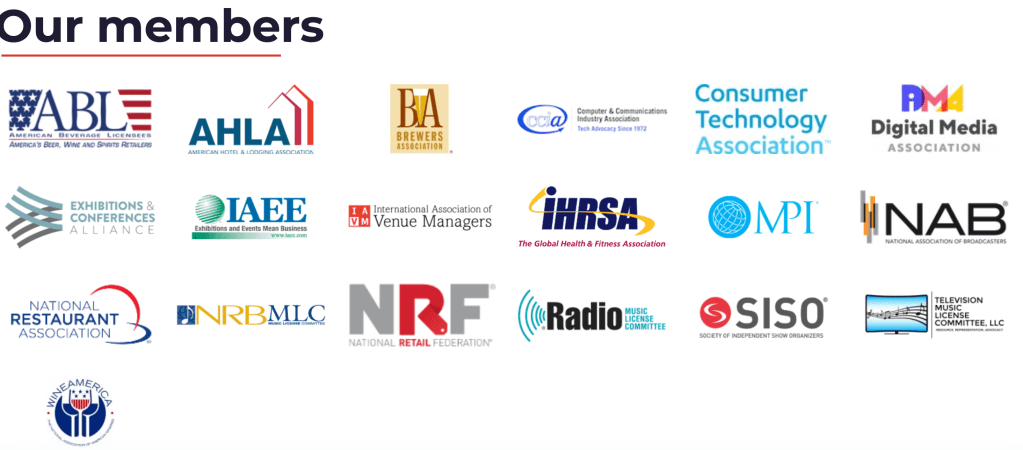
The joint amicus brief that caught my eye in the BMI v. NACPA BMI rate court case was a brief filed by a number of amici including the National Association of Broadcasters (NAB) and the Digital Media Association (DiMA). That alliance caught my eye. Three guesses why.
The core logical flaw of the argument by these amici is that they omit the solution of saying no. They want the court to believe that using music is all too complicated. For example:
The [BMI rate court’s] decision here is wrong. It set a rate for BMI using as “benchmarks” rates obtained by two very different performing rights organizations, SESAC and GMR, in very different economic circumstances than pertain to the marketplace governing BMI and ASCAP licensing.
What’s the principal difference between rates paid to BMI (and ASCAP) and rates paid to SESAC and GMR? The biggest difference identified by the trade association “friends” representing companies that together have market capitalizations in the $3 trillion range is that songwriters represented by SESAC and GMR are free to negotiate. And we can’t have that, now, can we? Here’s the explanation from the “friends”:
BMI and ASCAP, which together control over 90% of all public performance rights in musical works…are subject to consent decrees intended to protect entities like amici from the anticompetitive abuses that come with the aggregation of vast numbers of copyrights in the hands of a single licensing entity….As amici have experienced firsthand [oh, my, first hand? Poor babies!], SESAC and GMR are not subject to the same constraints on anticompetitive conduct as BMI and ASCAP, and amici enjoy none of the consent decrees’ protections when they negotiate—as they must—with SESAC and GMR.
Although SESAC and GMR have smaller repertories than BMI and ASCAP do (partially because they are invitation-only organizations, unlike BMI and ASCAP), each nonetheless controls the rights to multiple thousands of musical compositions, including works of writers as iconic as those who populate the ranks of BMI and ASCAP (such as Adele and Bob Dylan who are licensed by SESAC, and Bruce Springsteen and John Lennon who are licensed by GMR).
Friends Don’t Let Friends Change One-Way Streets
So what the friends argue is that the BMI rate court should not have taken into account the rates negotiated by SESAC and GMR at arms length when setting the consent decree rate for BMI. In other words, when setting what is effectively a government-mandated rate, the BMI rate court should not have considered a willing buyer/willing seller negotiated rate because that was mixing apples and rotten apples. Which those poor babies know “first hand”–they, too, have been bullied by those “iconic” writers who fancy themselves worth more to music users than the other 90%. Oh, the arrogance!
And here is the fallacious conclusion of the false choice:
Industry reality thus makes it a necessity for amici to obtain blanket licenses from SESAC and GMR as well as BMI and ASCAP. This is particularly the case because music rights are often fragmented, with multiple PROs controlling interests in a single song. Adding to the problem, composition ownership information is opaque and inaccurate. Amici thus face, on the one hand, the threat of crippling copyright infringement liability if they do not obtain SESAC and GMR licenses and, on the other, supra-competitive prices that SESAC and GMR invariably charge when they do. As a result, they find themselves wedged between a rock and a hard place.
This is the essence of the false choice that keeps coming up in these relationships. The underlying fallacy is that in order to use the music, the richest companies in commercial history must negotiate with SESAC and GMR (especially GMR if you ask me) and those pesky, albeit iconic, songwriters who allow these PROs to represent them. SESAC and GMR are not compelled by the government to bend the knee. If songwriters are allowed to keep going down that road outside the government’s boot, God knows where that might end up. They might get it in their heads that they’re actually worth something. We can’t have that, now can we?
And worse yet, if the government’s rate courts start using these freely negotiated terms to set compulsory rates, the one way street might change direction. And we can’t have that, either. But isn’t the essence of a compulsory license that the government is supposed to approximate what a willing buyer would pay a willing seller for the licensed rights? So aren’t the SESAC and GMR rates for the same use exactly the kind of benchmark the government should use when setting rates for everyone else?
Saying the Quiet Part Out Loud
This drives them wild, of course. They actually say the quiet part out loud:
[T]he impact of [SESAC and GMR’s] supra-competitive [free market] licensing practices on licensees has been cabined before the decision below, in large part because (a) the actual prices, while inflated, are not so high as to be ruinous to licensees given the comparatively smaller repertories involved; and (b) no rate court until now had relied on SESAC or GMR rates in setting rates for the much larger BMI and ASCAP repertories. In relying on SESAC and GMR’s rates, the district court turned a long-standing consent decree designed to protect music users on its head. The BMI consent decree was designed to stop BMI, a music-rights aggregator with monopoly power, from abusing that power. But [BMI Rate Court] Judge Stanton’s decision effectively endorsed those abuses by setting a rate that BMI could never get in a competitive marketplace, even though that is the governing standard for BMI (and ASCAP) rate-setting cases.
And there’s the false choice again. If you can’t afford Le Bernadin, no one is forcing you to dine there. All these music users can just say no. They don’t want to. What they want is to get the music on the cheap. And, frankly, take a lazy approach to licensing. Yet the amici acknowledge that the court is bound to use a rate from a competitive marketplace as the “governing standard” in setting consent decree rates.
Here’s the rub. Until SESAC and especially GMR came along there effectively had never been a competitive performance royalty rate so the “governing standard” was essentially iterative and therefore meaningless. All these companies represented by amici got the government discount in rate court because of their lobbying power. As Senator John Kennedy told Mark Zuckerberg, tech companies are like countries and they get whatever they want in Washington–the primary reason artists have never been paid for broadcast radio performances of their recordings. And a recession is when Google lays off 25 Members of Congress.
While these music users are supposed to negotiate before going to rate court, those negotiations are just inconveniences so they could get to rate court and start running up legal fees. And shocker–when they have to negotiate with GMR and cannot go to rate court, they end up paying more. Just FYI, there’s also gambling in Rick’s American Bar.
The False Choices
So false choice number 1: The users don’t have to use music they can’t afford. False choice number 2: When songwriters cannot step away from the table and refuse to license, it’s the government that imposes a lower rate particularly when staying in rate court costs a fortune.
The government doesn’t protect the user from anticompetitive behavior, it protects the user from a competitive marketplace. That insulated rate is brought about through lobbying the executive branch and ultimately the Department of Justice. My bet is that this is the only reason–the only reason–that the ASCAP and BMI consent decrees are the longest running consent decrees in US history and probably world history.
Remember when the DOJ was reviewing all antitrust consent decrees in 2018 and terminated over 1000? But not for those dangerous anti-competitive songwriters. Yes, sir, as soon as that writer room door closes they get right down to colluding because that is the essence of songwriting.
For some reason–I wonder why–the DOJ decided that songwriters needed to be right up there with Otis Elevator and Microsoft and continued the bloodsucking consent decree cottage industry that has sent generations of children through prep school, college and law school. So here we are again arguing over the false choices. Hopefully, we may be entering a new era of enlightened thinking where publishers are willing to stand up and be counted to get the government’s boot off their throats.