

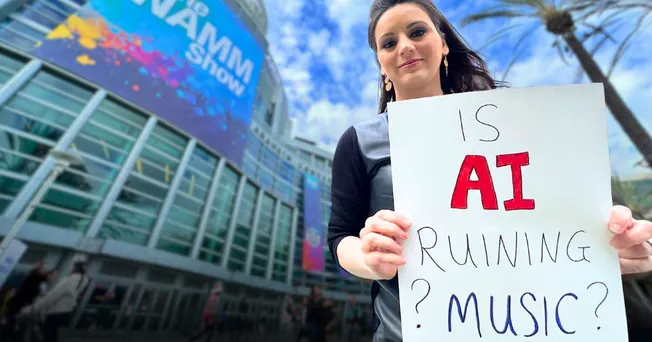
AI Took Over NAMM This Year — Here’s How the Debate Took Shape
Four-time Emmy Award-winning journalist and the founder of Blue Moves Media, Lindsey Mastis, went to NAMM this year with one thing on her mind.
She set out with her camera and mic as defacto thermometers to take the temperature of how folks working in music are feeling about the growing presence of artificial intelligence in the myriad daily operations of the music industry. With 20 years in broadcast news, Mastis now focuses on AI and emerging technologies, producing features, keynotes, and thought leadership that explore their impact on society.
Her newly published mini-documentary feature, “Is AI Ruining Music?”, viewable in full on YouTube and shot entirely at this year’s National Association of Music Merchants (NAMM) Show conference, takes an investigative approach to examine how artificial intelligence is reshaping the music industry and whether creativity itself is at risk. Mastis’s video features both candid interviews and official panels, with artists like Jackson Browne, Rosanne Cash, and others weighing the promises and perils of AI.
“Musicians are facing a historic turning point,” Mastis said. “From voice cloning to AI-generated tracks, there are questions about protecting culture, art, and the human stories behind music.”
The feature is available to watch here:
Artists Voice Concerns Over AI’s Role in Music
Singer-songwriter Rosanne Cash articulates her apprehension about AI’s potential to overshadow human creativity in songwriting. She emphasizes the irreplaceable value of human emotion and experience in crafting authentic music.
Jackson Browne also shares his perspective on the challenges AI poses to the traditional music-making process, highlighting concerns about the authenticity and emotional depth of AI-generated compositions. But Jackson was also quick to admit that he had used AI tools in the studio to recreate a part in one of his recent songs, and that it was enormously helpful in doing work that would’ve otherwise been laborious and time-consuming.
AI’s Dual Impact: Innovation vs. Authenticity
While AI introduces innovative tools for music production, such as generative algorithms and automated mixing, it also raises questions about the preservation of artistic integrity. The documentary features a segment where AI-generated music is played alongside human-created compositions. The contrast underscores the debate between technological innovation and the preservation of authentic musical expression.
In many examples, people were quick to share how AI can streamline certain processes while potentially compromising the emotional resonance of the music. Xavier Jameson of the music collaboration platform Musiversal shared that AI doesn’t necessarily have a place in the core model of the company — which is designed to connect musicians in virtual recording and writing sessions — but that it can help its members streamline the other aspects of their process.
What Should the Role of AI Be in the Music Industry?
Music industry professionals, including producers and sound engineers, share their perspectives on AI’s evolving role. Some view AI as a valuable asset for streamlining production processes and enhancing creative possibilities, while others caution against its potential to overshadow human talent and craftsmanship.
For example, a sound engineer shares his experience with AI tools in music production, discussing both the efficiencies gained and the challenges faced in maintaining the human touch in the final product. A music industry executive provides insights into the evolving landscape, explaining how AI is being integrated into various aspects of the industry, from composition to distribution, and the implications for artists and consumers alike. And Kim Bullard, a musician, producer, and composer, had a moment where he was unexpectedly nearly brought to tears by something AI had written via his prompts.
4. Public Perception and Consumer Awareness
The documentary also touches upon the public’s awareness of AI-generated music. Mastis mentions early on that — in contrast to her experience at CES (Consumer Electronics Show) just a few weeks prior, where the word “AI” was plastered everywhere — here, that branding wasn’t exactly front row center.
And perhaps rightly so, both musicians and consumers at large are becoming increasingly discerning with the notion that AI is now part of our daily lives, whether we like it or not. This shift in perception prompts discussions about transparency and the ethical considerations of AI in music. In one moment, a focus group is shown reacting to a song, initially unaware that it was AI-generated. Their reactions highlight the growing awareness and sensitivity of audiences to the origins of the music they consume.
People’s perception is largely based on the polarity of social media’s timbral posting, people either hate it or love it, but don’t take time to engage with it in a way that fits their use case. YouTuber and artist Samuraiguitarist noted that for him, the line is drawn when he needs to decide whether to hire a human or ask an AI bot to create something.
The importance of transparency and ethics is something important to us all, but it can be a helpful exercise to find where our own personal edges of comfort and discomfort come into play.
A Call for Balance and Ethical Considerations
Mastis concludes by advocating for a balanced approach to AI integration in music. She emphasizes the importance of ethical guidelines, transparency, and ongoing dialogue between technologists and artists to ensure that AI serves as a tool that complements, rather than replaces, human creativity. A roundtable discussion among artists, ethicists, and technologists, exploring frameworks for integrating AI into the music industry responsibly, was deeply resonant.
The acknowledged goal, for many who shared their thoughts in this piece, is to ensure that human creativity remains at the forefront… of human creativity.
Jeremy Young