

By Ian Temple of Soundfly Weekly
“The artist must give warning, his struggle must make a noise, it must be a signal. Our screams of anguish and anger will contort our faces and bodies, our shouts will be “to hell with death,” our actions will make a noise that will shake the heavens and hell. Of this stuff our art will be” — Rafael Montañez Ortiz
This week, I ended up down the weirdest rabbit hole. Who needs AMSR when you can watch people smash, burn, and even shoot pianos on YouTube all day?
These videos are wild. There’s this one where someone lights a broken piano on fire. I can’t help but find its smoking husk incredibly alluring — I want to play it. I can imagine my fingers skittering across the keys while clouds of smoke pour out of its frame above them, the wood warping and strings snapping as I play.
Or this one where the staff of a piano restoration company engages in a savage group ritual, laughing, cheering, and dancing while sacrificing a piano that desperately clings to life beneath their blows. It’s like something from Lord of the Flies. The tone of the soundboard being hit by a sledgehammer is especially haunting.
Or, you can watch the band TOOL shoot a piano with a shotgun and then beat it with sledgehammers during the recording session for their song “Disgustipated.”
You might now be asking: Whyyyyy? Dear god, why? Those poor little instruments, the complex culmination of a rich, centuries-old tradition of instrument engineering, the potential furnace for a thousand beautiful tunes.
To be fair, sometimes things don’t work anymore, and need to be trashed. Most of these videos are because the pianos are unusable and need to go. It’s easier to move a piano that’s in pieces.
I also got a wonderful email from a Hollywood sound designer-turned-professor last week who once recorded a spinet piano being dropped 30 feet from a forklift to serve as the explosion sounds in the 1997 film Starship Troopers. The samples themselves are stunning — full of interesting pitch bends and possible laser noises. I can see why they chose them. So that’s a decent reason to destroy a piano.
But is there more to it than that? And why was I watching them?
Destruction has not traditionally been a word that resonates with me. I tend to get more excited by birth, by design and creation, by the idea of imagining something new into existence than the idea of destroying something already there. I suppose I did creatively destroy my ear drums playing music too loud in high school, but that’s the extent of my relationship.
I recently came across the “destructivist” artist Rafael Montañez Ortiz.
Ortiz is an avant-garde artist who has worked in a variety of media — film, sculpture, painting, etc. He’s most known though for his performance pieces, especially the piano destruction events he hosted and led throughout the 70s and 80s where he’d often invite the audience to destroy a piano with him on stage. Weirdly, they’d often tune the piano first. He participated in the 1966 Destruction of Art Symposium in London alongside Yoko Ono, Gustav Metzger, and others, and wrote a manifesto called “The Destructivist Manifesto” in 1962 (I started annotating it here to help myself better understand it. You’re welcome to contribute by adding your own comments).
Ortiz’s work goes against all my instincts, which made me curious: Can destruction be creatively fertile? How and why? What am I missing?
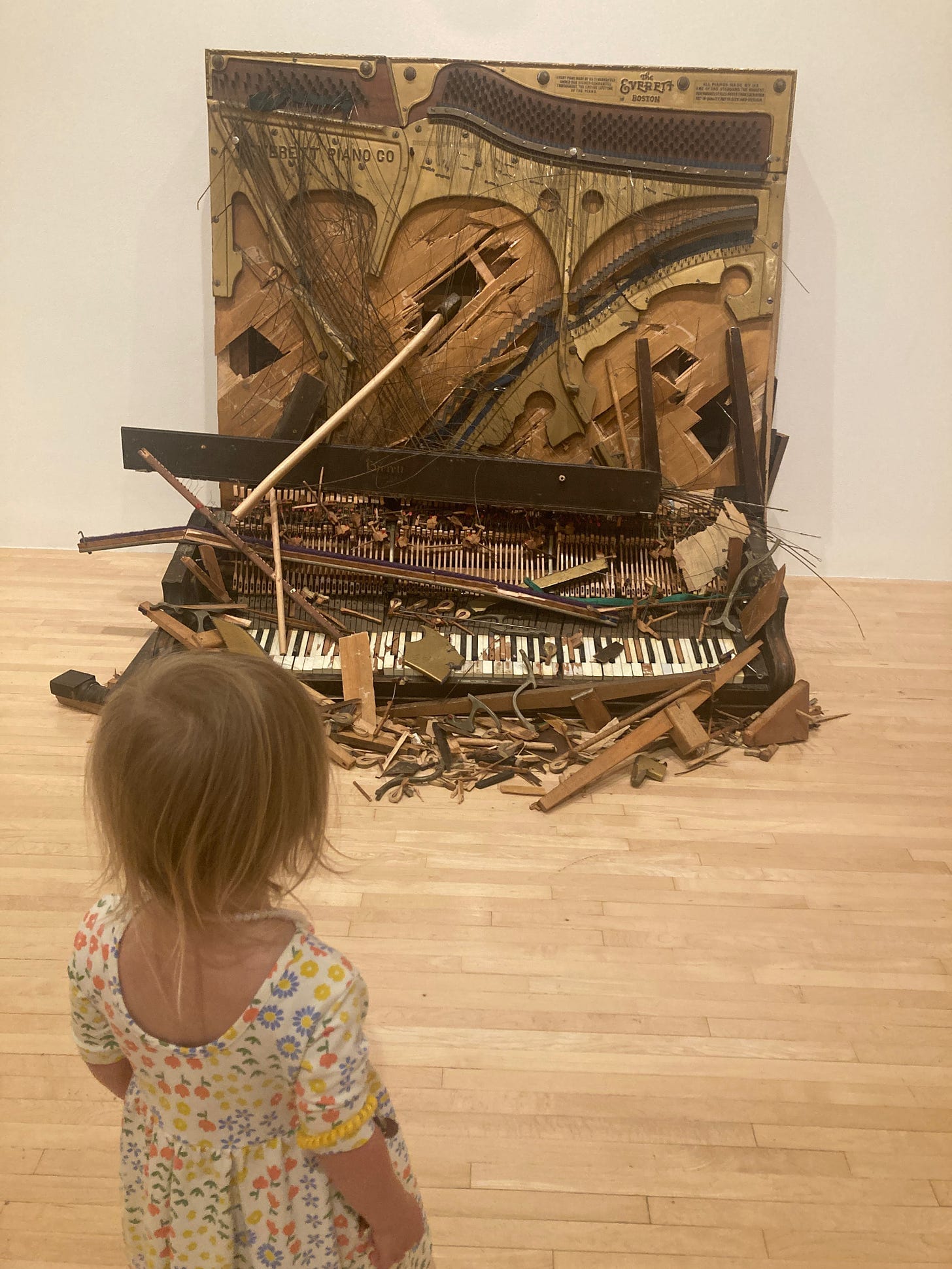
For Ortiz, destroying things serves a number of purposes, as far as I understand it. It’s a critique of materialism. It’s a reflection on the fragility of life. And building on the work of the Dadaist movement of the late 1910s and 1920s, it’s an exploration of our deeply irrational side as humans, the side that society often tries to suppress.
Dadaism was a reaction to how society’s supposed progress — its rationality, its technology, and its morality — led to the industrial slaughter of World War I. Instead, the Dadaists embraced non-conformity, irrationality, and a hefty dose of nonsensical whimsy as a critique of society. Ortiz is doing something similar by allowing space for our unconscious destructive urges to flourish. If we don’t exercise our destructive side somewhere, then we’ll do it in the real world, to disastrous consequences. The act of artistic destruction can allow a safe space for us to exercise our inner conflicts.
That certainly resonates with the joy some of the people in the videos above seem to be experiencing as they bash in pianos. Their laughter is one of childish misbehavior, a giggle that they’re doing something they know they’re not meant to. I can see elements of that same spirit in the way The Who’s Keith Moon used to blow up his drums or Nirvana’s Kurt Cobain used to smash his guitars. It’s mischievous. It’s defiant. It’s childish. It goes against all the expectations and norms of polite society. And maybe also fun.
But there can also be beauty in destruction. While Dadaists maybe didn’t prioritize beauty, I find Ortiz’s destroyed pianos aesthetically stunning, chance patterns and shapes created from a mindless act. Creating something new by destroying it allows in chance and serendipity as a co-creator. The pieces lie where they fall. The artist does not have ultimate control over the final outcome.
The composer William Basinski explored this in incredible depth in his Disintegration Loops — a collection of musical ideas captured as the tape on which they’re played slowly deteriorates through multiple extended repetitions. You can quite literally hear the destruction, the pops and cracks, the changing frequencies of the sound, but it takes on an eery beauty — the soundtrack to the birth and death of a musical idea.
(Coincidentally, Basinski finished work on the Disintegration Loops in New York City on the morning of Sept 11, 2001, a day that’s become synonymous in modern history with wanton destruction. Obviously, no beauty there, only tragedy and horror, although as a New Yorker, I would be so bold as to say that there have been many acts of creative beauty that have arisen out of the way our city has recovered since then).
The collaboration between the act of destroying something and creating something new also calls to mind improvising, where you’re spinning up something new in the knowledge that it’s not planned, that it won’t stay the same, and that you may not be able to do it again. You put it out there only for it to disappear right away. The act of improvising when you’re really in the zone can feel mindlessly freeing in the same way destroying something might. My kids joyfully stomp on sand castles. I play a series of barely connected phrases and unplanned notes. Same thing.
Finally, I think of the way destruction can be a creative force in your day. Destruction is the ultimate solution to the calcified pathways that build up around us. Have you ever had one of those days where your to-do list is so long that you just throw it away and go for a long walk outside instead? In some ways, that’s the ultimate act of administrative destruction, and so important from time to time. How else will you create the space for new ideas and processes to emerge?
So this week, I challenge you to think about destruction as a creative force. You don’t have to smash up a piano or anything, but what inspiration can you find in acts of destruction? Can you destroy a melody? Or a song you’ve already written? Or your routine if it’s not inspiring you? How does the process of destroying it lead to new possibilities? If you do something specific, reply and let me know. I’d love to hear about it.
At the end of all this, I still think of myself more as a creator than a destroyer. I’m trying to build a family, a home, a community, a music school, a full and rich life around me. I love making stuff. But it’s a fantastic reminder that there’s a huge risk in holding too tightly to acts of creation and all the build up and calcification and expectations that go along with it.
Maybe to stay creatively inspired and mentally sane, we all need to just break some shit from time to time and see what happens.
Ian Temple is the Founder and CEO of Soundfly. Follow his Substack, Soundfly Weekly, or join the growing community of musicians and educators on Soundfly for free today.