

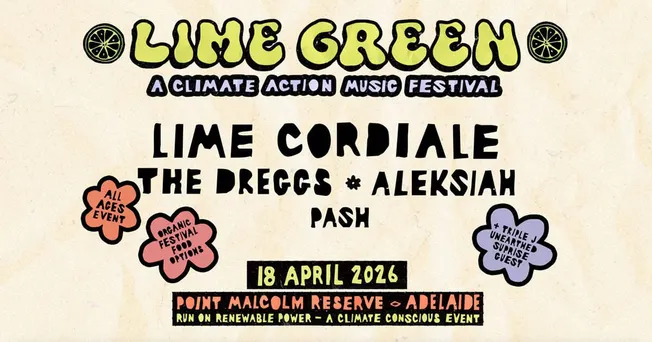
In an ambitious rethinking of what live music can look like in a warming world, Australian indie duo Lime Cordiale announced the launch of their Lime Green Festival — a one-day, fully off-grid, climate-focused music festival designed to confront the environmental impact of touring and live events.
Scheduled for April 18, 2026 at Point Malcolm Reserve in Adelaide, the festival promises vibrant performances alongside bold sustainability initiatives that put climate action at the centre of the live music experience.
Headlined by Lime Cordiale and featuring acts like The Dreggs, aleksiah, and PASH — plus emerging artists spotlighted via community partnerships — Lime Green Festival aims to show that high-energy live music and environmental responsibility can coexist.
How the Festival Aims to Go Green
Unlike most music festivals that rely on diesel generators, large-scale infrastructure, and supply chains with heavy carbon footprints, Lime Green is being engineered from the ground up to minimize its environmental impact. Here’s how the festival plans to lessen its carbon footprint:
1. 100% Off-Grid, Renewable Power
The festival is designed to operate off the grid — powering the main stage (and potentially the entire site) with industrial-scale battery systems supported by vegetable-oil generators, reducing dependence on fossil fuels in favor of a recyclable small-scale energy source.
2. Low-Impact Transportation & Energy Solutions
Attendees will be able to charge devices using solar and bike-powered stations, and the festival encourages low-emission travel options wherever possible. Plus it gives festival-goers a chance to exercise too!
3. Waste Reduction & Circular Practices
The organizers are prioritizing plastic elimination, using upcycled merchandise (including experimental materials like seaweed-based products), donating surplus food to charities, offering free drinking water onsite, and working with local and carbon-neutral food vendors.
4. Climate Impact Funding
Through Solar Slice — a world-leading environmental ticketing model — $1 from every ticket sold will support science-backed climate and restoration projects, starting with a South Australian community-led response to local algal blooms.
Lime Cordiale’s approach reflects their own introspection about the carbon costs of touring, which the band has wrestled with for years, stating that rather than stop touring altogether, the goal is to change how live music operates.

Why This Matters Now — Live Music’s Carbon Footprint in the Spotlight
Live music is a powerful cultural force — but it also comes with notable environmental costs. Artists and festivals have increasingly gone public with recognizing, and pledging to re-engineer, the toll that their touring efforts have taken on the environment. For example:
Coldplay redesigned their Music of the Spheres tour to be one of the most eco-conscious global tours ever, cutting emissions significantly through renewable power, biodegradable materials, and audience travel planning tools.
Artists like Harry Styles and Billie Eilish have both championed sustainability through partnerships with the non-profit Reverb, reducing waste on tour and investing in renewable energy projects.
Massive Attack set up a fully battery-powered concert in Bristol, reportedly slashing greenhouse gas at that event by a whopping 98%!
Across Australia, musicians and groups have been acknowledging the climate impact of touring as well, exploring low-emission travel, and using ticket surcharges to fund environmental work — all aimed at redefining what a greener live music industry can look like. Environmental advocates have highlighted that the carbon emissions associated with touring and large events are significant — estimated in the tens to hundreds of thousands of tonnes globally — prompting calls for innovation and systemic change.
The Lime Green Festival this conversation not just in spirit but in practice, and offers a potentially powerful model for how artists, organizers, and advocacy groups can tackle the growing crisis of climate change with alternate approaches to live music production.
Find out more about the Lime Green Festival and buy tickets here.