

By Trevor Loucks of Dynamoi
11:47pm. Text from a label exec: “How can we get this to 10 million views by Friday?”
I’ve gotten versions of that message for years. Different numbers, same request: buy me a metric.
I get why. Views show up instantly. Streaming revenue shows up months later. But optimizing for views is how you burn budget and learn nothing.
Monday vs Tuesday
I’ve run paid campaigns for e-commerce and music for years. Monday I’m running campaigns where every dollar is tracked in ROAS terms. Tuesday someone asks me to “make it go viral.” Same exact platforms. Same tools. It never stops being weird.
E-commerce is simple. Brutal, but simple. You know exactly what you spent and exactly what you got back. The math either works or it doesn’t. There’s no “we got great engagement though.”
The music industry walks into the same platforms and asks for views. Likes. Engagements. Surface metrics. Views can be useful for PR, but they’re a bad optimization goal. These should be side effects of a good campaign, not the point of it.
Meta, Google, TikTok are giant ad platforms for a reason. They invested billions in engineering and data science to solve one problem: help businesses find customers who buy things. That’s the machine.
Why fight it? The machine is built for revenue. So use it for revenue.
Three Reasons This Is Harder
But I get it.
E-commerce has had ROAS-based bidding for over a decade. Set your target, feed the machine conversion data, watch it optimize. The revenue event is a purchase. Happens in seconds. Money in your account in days. Every click tied to every dollar.
Music streaming doesn’t work like that.
The Attribution Gap
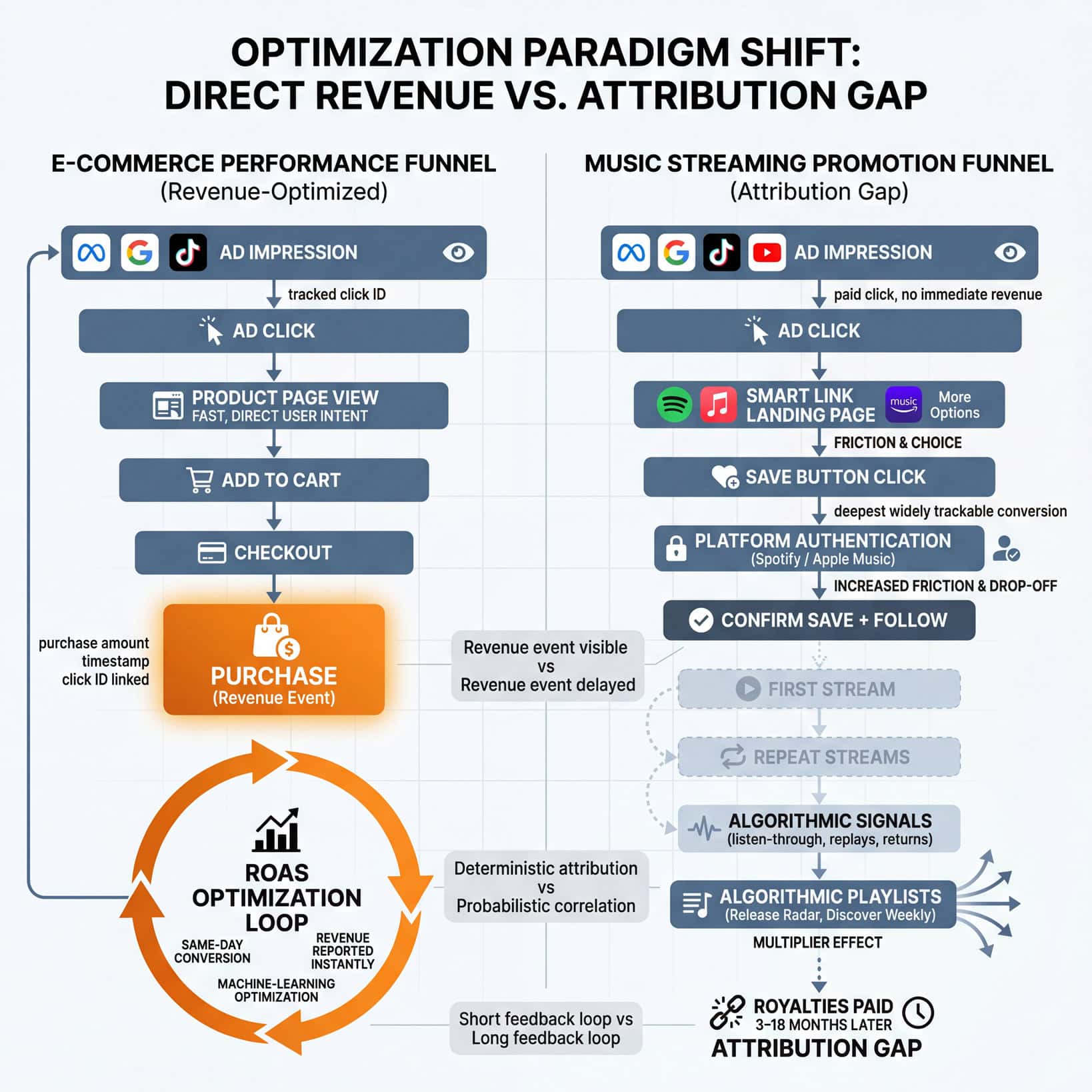
- E-commerce: someone clicks your ad, buys something. Click ID, timestamp, purchase amount. All connected.
- Music: someone clicks your ad, streams your track, saves it, becomes a fan. You will never see that connection on your royalty statement. The click lives in the ad platform. The stream lives in Spotify. They don’t talk to each other.
The Timing Gap
- E-commerce: ad today, purchase today, money this week. Reinvest tomorrow.
- Music: ad today, stream today, royalty statement in 3-6 months. Publishing royalties? 6-18 months. By the time the money shows up, you’ve forgotten what campaign drove it. You can’t build a reinvestment cycle when the money takes that long to arrive.
The Value Gap
A click in the US on Meta can run $0.30 to over a dollar. A Spotify stream might net a few tenths of a cent on average, and it varies wildly. Before splits. You pay for a click. Best case, they stream once, and the math collapses.
This is why artists chase views. Not because they’re stupid. Because the real revenue event feels impossible to reach. And for many artists, the real ROI shows up off-platform anyway: tickets, merch, and owned audience.
And this is exactly why the bot industry thrives. Search “buy YouTube views” right now. Google will happily serve you thousands of services starting in position one. 10,000 views for $20. 100,000 streams for $50. It’s alluring. The math finally makes sense, even if everything else about it is broken.
These services have been around for 20 years. Nothing has changed. Spotify cracks down on bot streams, YouTube fights it constantly, but they persist because artists are desperate for numbers that feel achievable. When the legitimate path to ROI seems impossible, the illegitimate path starts looking rational.
Don’t do it. If you get caught, you can get flagged, demonetized, or dropped by your distributor. But understand why the temptation exists.
The Distance
So what does a legitimate path look like?
Paid media: Ad impression → Click → Smart link landing page → Save button → Spotify/Apple Music authentication → Confirm save and follow → Redirect to streaming platform
Seven steps before a single stream happens. You’re paying for step one. That friction is the point: it filters for intent and creates a conversion event you can actually optimize.
Organic growth (the actual goal): User streams → Saves → Comes back → Repeat across thousands of users → Algorithm detects healthy engagement signals → Tests the track with similar listeners → Release Radar / Discover Weekly → Algorithmic playlists drive streams with zero marketing spend
This is where the ROI lives. Not in the ad view. Not in the click. In the algorithmic lift that happens weeks or months after the campaign ends.
Personalized playlists like Release Radar and Discover Weekly are algorithmic, not editorial. Engagement is the lever you can influence.
The save event is the best widely trackable conversion event to optimize for right now. It’s the deepest measurable action before the attribution gap swallows everything. But a save only matters if it comes with listen-through and return plays. No targeting hack beats a track that people finish and replay.
Measuring What Matters
So how do you make the math work when cost per click is usually greater than revenue per stream?
You stop trying to measure single interactions. You measure lift over time.
For Spotify and Apple Music campaigns, the economics tend to work best when you’re tracking algorithmic lift. Did the campaign move the needle on Release Radar placements? Did Discover Weekly picks increase? Are monthly listeners growing faster than the marketing spend? These are the questions that matter, not whether you got a 2% click-through rate.
This requires correlating multiple data sources: Spotify for Artists analytics, distributor royalty data, third-party tracking tools. You build a country-by-country forecast, then validate it against lift.
The simplest version is geo holdouts: run paid in a few matched countries, keep a few dark, then compare algorithmic playlist and returning listener lift. Use 30 days for direction, 90 days for truth.
It’s an extremely tough data science problem precisely because of the attribution gap. There’s no clean click ID connecting ad spend to royalty statements. You’re working with correlation, not causation. But correlation at scale tells you a lot. Run the same analysis across 20 countries and you start building a predictive model that actually works. I’ve seen campaigns turn profitable this way.
For YouTube, the story just got more interesting.
What Changed in 2025
In 2025, Google introduced a way to optimize YouTube engagement campaigns for what happens after the ad: organic views on your channel. These are views that happen after someone sees your ad. The person watched your music video ad, then came back to your channel and watched more content on their own. You can choose to just report them or actively optimize for them.
That matters because the paid view is a cost, but organic viewing is where watch time, subscribers, and AdSense revenue can compound (if your channel is monetized and ads serve).
The windows aren’t infinite. Google lists a 30-day click-through window and a 3-day engaged-view window for this conversion action. Not perfect for music where intent can build over months, but it’s a real step toward measurable outcomes.
But even with those limitations, this is the first time music marketing can work like e-commerce marketing. Not in theory. In practice. On the backend, you can optimize geo bidding at the campaign and country level based on which countries are generating organic views that turn into real revenue.
We’re finally able to treat YouTube campaigns the way e-commerce has treated their campaigns for over a decade. Optimize for revenue, not surface metrics.
What I’m Doing About It
Remember the 11:47pm text? I want the music industry to consider that the wrong question. Where the conversation is “what’s our projected streaming ROI” instead of “how cheap can we get views.”
I built Dynamoi so indie artists and small labels can run performance-style music marketing without a label-sized analytics team. Not just a routing link: Dynamoi creates user-authorized save/follow conversions you can optimize in ad platforms, then ties campaigns to lift and geo allocation. Labels have teams for this. Indie artists don’t. Now you don’t need one.
13 months of code with a wild roadmap to tackle. If you’re an indie artist or running a smaller label and any of this resonated, reach out. I want to talk to people who care about streaming ROI, algorithmic lift, and data-driven geo optimization. Not surface metrics. The real stuff.
Trevor Loucks is a founder, musician, and developer who has spent his career building solutions for clients in the music and ecommerce industries. After teaching music for two years at the University of Central Africa in Kigali, Rwanda, he returned to the United States and founded several companies in the music and ad tech space – including 92 Keys, a violin and piano duo where he composes and performs. He now works full-time on Dynamoi, founded 2025, a platform that gives independent artists and small labels access to the same data-driven campaign automation that major labels build in-house.