

What the Spotify Data Scrape Means for Independent Artists
By Ariel Hyatt of Cyber PR
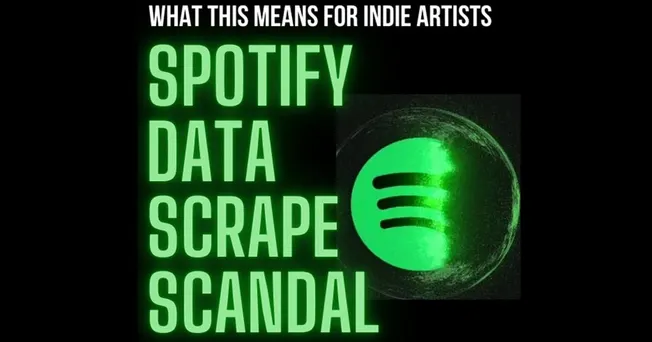
The Spotify data scrape has made one thing clear as the industry moves into 2026: the cost of chasing numbers on Spotify is no longer just financial. It’s strategic. Streams, followers, and playlist placements still signal legitimacy, even as fewer artists see those numbers translate into real income, leverage, or stability.
I’ve written recently about the cost of the numbers game. This article goes one layer deeper.
Because the same system that underpays artists also doesn’t protect them. And the Spotify data scrape makes that impossible to ignore.
TL;DR — What Just Happened to Spotify
A piracy or “shadow library” group called Anna’s Archive claims it scraped almost the entire Spotify catalog:
- 99.9% of metadata (titles, credits, artwork)
- 86 million actual music files
- Releases prioritized by popularity (hits first, but that also includes a LOT of indies)
Spotify says it shut the accounts down. But the damage is already done because once music and data are copied at this scale, you can’t un-copy it.
This isn’t about whether Spotify handled this “well” or “poorly.” (But IMHO so far they have not gotten out in front of this.) It’s about the reality that music hosted on massive platforms can now be copied, analyzed, and reused in ways that artists and rights holders never consented to — often without their knowledge.
7 Reasons Why This Is Especially Bad for Musicians (Not just “the industry”)
1. It nukes the already-broken streaming payment model
Musicians were already earning fractions of pennies per stream. Now anyone can host a free mirror of Spotify.
No ads.
No royalties.
No reporting.
No recourse.
In theory, you could start your own Spotify if you had the storage. Let that sink in.
Streaming didn’t meaningfully pay artists before. This accelerates the slide from unfair to functionally irrelevant. If music becomes freely downloadable again — without even the illusion of payment — streaming stops being a revenue stream and becomes pure promo. Most musicians were already told to treat it that way. Case in point: if your track doesn’t hit 1,000 plays, it may as well not exist. But I digress.
2. It turbocharges AI training on stolen music
This stolen music is almost certain to be used to train AI models.
AI companies already scrape copyrighted material. Now they get clean, labeled, modern music on a massive scale. That means your songs, style, and IP become training data.
3. It permanently weakens copyright enforcement
This quote, amongst the coverage of the Spotify data scrape, stood out
“If your media is accessible, even behind a paywall, it should be assumed it can and will be copied.” – María José Gutierrez Chavez, Inc. Magazine
Once mass scraping becomes normalized, copyright enforcement becomes symbolic. Laws still exist, but enforcement doesn’t scale. Big labels might litigate. Independent musicians don’t have the money, time, or leverage to fight AI companies or piracy networks.
4. Metadata theft breaks attribution — and income tracking
Metadata isn’t just “info.” It’s how songwriters get paid. It’s how producers get credited. It’s how PROs track usage and establish catalog value. Once metadata is detached from official systems, credits get lost. Payments get missed.
For musicians who already struggle to get proper credit and are underpaid by Spotify, this is amplifying the problem.
5. It normalizes the idea that music is a public utility
Anna’s Archive frames this as “preserving humanity’s culture.” That sounds noble — until you ask a fundamental question.
Who pays the humans who made the culture?
This mindset treats music like air or water. Creators become irrelevant to the equation. Artists are framed as inputs. This is the natural endpoint of a rent-based music economy built on platform dependency. Scraping isn’t a glitch in the system. It’s what happens when everything valuable lives in one place.
6. This isn’t just about music being copied – they have more than you realize
This is the piece that hasn’t been widely discussed.
A group like Anna’s Archive isn’t just sitting on audio files and album art. They almost certainly have behavioral data. How people listen. How playlists are built. How music moves through the system. How attention is shaped. That includes playlist curation patterns, consumption habits, sequencing, skip behavior, and the signals that explain why certain tracks surface and others disappear.
This is the layer Liz Pelly’s book Mood Machine gestured toward. The unseen mechanics inside streaming platforms that quietly shape taste, momentum, and visibility. There’s likely more happening inside these systems than artists will ever be told — whether by platforms, labels, or anyone else with privileged access. That insight is enormously valuable to AI companies, marketers, and competitors. Artists remain locked out of the very data generated by their own work.
This story isn’t just about stolen files. It’s about who gets to see behind the curtain.
Why does this suck for individual artists?
Streaming was never meant to be the foundation of a career. It helps people find you. It doesn’t sustain you. Bigger numbers don’t automatically translate into stability, support, or longevity. Real careers are built on listeners who return, engage, and care over time — not on scale alone. If your entire strategy depends on a single platform or algorithm, that’s the risk. Not your music.
You don’t need to fight AI or outsmart the system. Your advantage has always been human connection. That hasn’t changed. Trust, meaning, shared experience, and community can’t be automated or scraped.
That’s why every artist needs at least one owned way to stay connected with fans — email, text, or a private space. Not to sell. To stay connected. When you control the connection, you build resilience no platform can take away.
7. The leverage leaves the room (and no one tells artists it’s gone)
The most damaging part of this story isn’t piracy, AI, or even unpaid use. It’s that artists lose leverage quietly. When your music, metadata, and audience behavior can be copied and analyzed at scale, decisions about value, visibility, and use happen without you in the room.
You may still be accumulating streams. You may still think your numbers look “healthy.” But your ability to negotiate, opt out, or control timing erodes behind the scenes.
When everything valuable about your music lives in one centralized system, you lose leverage without realizing it.
Large-scale copying doesn’t just affect billion-dollar platforms. It changes how your work is valued downstream. Songs stop being treated as something people come to you for and start being treated as interchangeable files that move freely without context, credit, or consent. It widens an already unfair gap. Big companies can enforce their rights, absorb losses, and negotiate from a position of strength. Independent artists can’t.
Most importantly, this model trains audiences to engage with music without responsibility. When listeners don’t own what they love and don’t know where it comes from, the connection between artist and audience continues to weaken.
This doesn’t mean your music has less value. It means your music can’t be the only place your values live anymore.
But you already knew this… right?
Cyber PR is an artist development and marketing strategy firm serving musicians and music-related brands. We create long-term marketing plans called Total Tuneups, coach artists through the new music business and handle social media posting and growth strategy.