

By Shifa Ali of Wiingy
TikTok has become one of the fastest pathways to music stardom, turning unknown artists into national names with a single viral moment. In the streaming era, the platform has emerged as a powerful discovery engine, allowing musicians to reach massive audiences without traditional industry backing.
As music discovery continues to move online, an important question remains. Does geography still matter? Are certain states and cities producing more TikTok breakout artists than others, or has the platform truly leveled the playing field?
To explore this, we analyzed 100 US-based artists whose careers meaningfully accelerated after a viral moment on TikTok. Each was largely unknown before their breakout and later achieved measurable success, offering a clear view into how place continues to shape opportunity in the TikTok era.
You can read the full study, “Where America’s Viral TikTok Music Stars Actually Come From” here.
Key Findings
1. California produces the most TikTok breakout artists.
24 out of 100 viral artists come from California, meaning nearly 1 in 4 breakout musicians originate from a single state.
2. Just 4 states produce more than half of America’s viral music talent.
California, Texas, New York, and Georgia account for 53 of the 100 breakout artists, leaving the remaining 47 spread across 24 other states.
3. Big cities are not required for viral success.
34 artists come from small towns with populations under 100,000. TikTok has opened a national stage for artists from places such as Willard, Missouri and Hagerstown, Maryland.
4. Mid-size cities are the dead zone for TikTok virality.
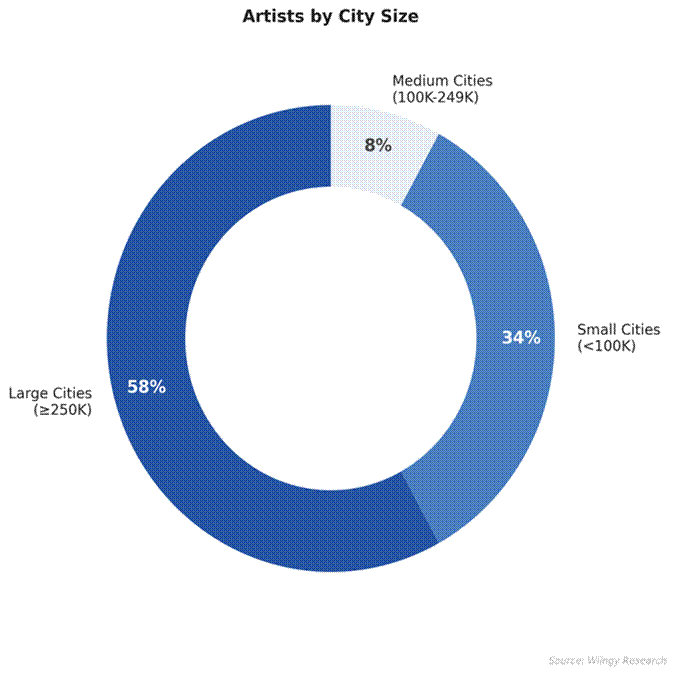
Only 8% of breakout artists come from cities between 100,000 and 250,000, far fewer than small towns (34%) or major metros (58%).
5. The South is the top region for TikTok music breakouts.
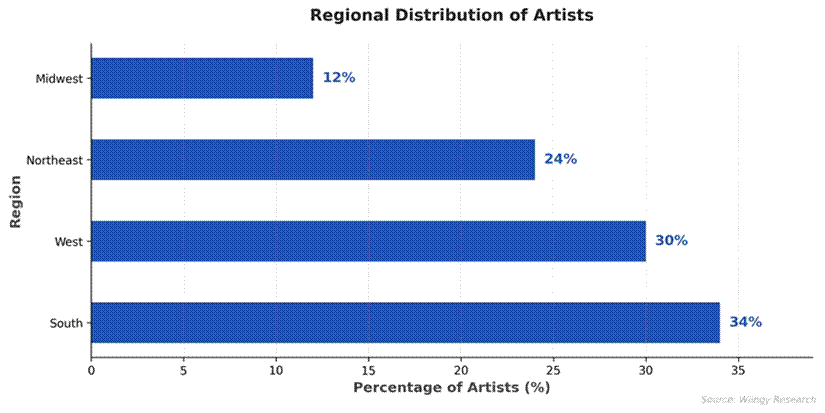
Southern states account for 34 of 100 breakout artists, outpacing the West (30), Northeast (24), and Midwest (12).
6. Being from a big state doesn’t guarantee success.
Florida produced only 5 viral artists, the same number as Pennsylvania, a much smaller state with less music industry presence.
Which States Produce the Most TikTok Artists? A State-by-State Breakdown
Every TikTok viral artist starts somewhere: a city, a town, a neighborhood that shaped their creative identity. Mapping the home states of 100 TikTok breakout artists reveals clear concentration in the geography of viral music success. While viral success is now possible from nearly anywhere, it is not evenly distributed across states.
Here’s a breakdown of breakout TikTok artists by state.
| Rank | State | Number of Artists |
| 1 | California | 24 |
| 2 | Texas | 12 |
| 3 | New York | 10 |
| 4 | Georgia | 7 |
| 5 | Florida | 5 |
| 5 | Illinois | 5 |
| 5 | Pennsylvania | 5 |
| 6 | Connecticut | 3 |
| 6 | North Carolina | 3 |
| 6 | New Jersey | 3 |
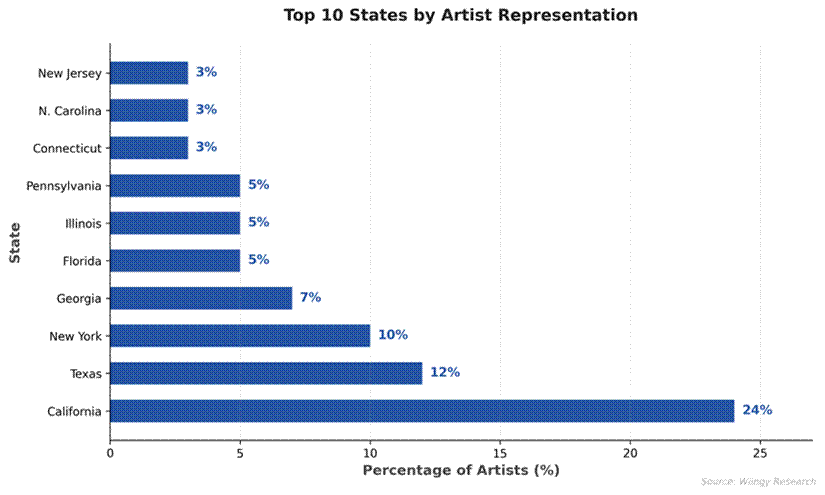
From the above data, we can see that while some states lead the charge, others are quietly contributing to the growing TikTok music wave. California, Texas, New York, and Georgia account for 53 out of the 100 breakout artists. The remaining 47 artists are spread across 24 states, with most producing only one or two viral musicians each.
#1 State: California Leads the U.S. in Viral TikTok Artists
24 out of 100 artists (24%)
How many TikTok artists come from California? 24 out of 100 viral TikTok musicians, meaning nearly 1 in 4 TikTok music breakouts, comes from a single state. Artists such as Olivia Rodrigo (drivers license, good 4 u), Doja Cat (Say So), 24kGoldn (Mood), Gracie Abrams, Yeat, Ricky Montgomery, and Claire Rosinkranz illustrate the state’s range across pop, hip-hop, indie, and alternative.
Despite TikTok lowering barriers to discovery, California continues to produce repeat viral outcomes, suggesting that its creative infrastructure still converts exposure into sustained success more effectively than any other state.
#2 & #3 States: 22 TikTok Viral Artists Come From Texas and New York Combined
12 + 10 artists
Texas and New York follow different but equally stable patterns. Texas contributes 12 artists, including Conan Gray and Don Toliver, showing steady viral output rather than isolated moments. New York’s 10 artists, including Ice Spice, Lil Tecca, Madison Beer, and d4vd, reflect a creative ecosystem that adapts well to TikTok’s discovery model.
Neither state relies on a single breakout. Both demonstrate repeatability, which is rare in viral music.
#4 State: Georgia: Where TikTok Trends Turn Into Mainstream Hits
7 artists with disproportionate impact
Georgia appears 7 times, fewer than the top three states, yet its impact is disproportionate. Artists like Lil Nas X (Old Town Road) and Blanco Brown (The Git Up) generated some of TikTok’s most influential early music moments. These were not short lived trends but songs that crossed into mainstream charts and public consciousness.
Georgia’s role highlights how a state can shape TikTok music history without dominating artist counts.
Mid-Tier States Deliver 15% of America’s TikTok Viral Music Stars
Florida, Illinois, and Pennsylvania each contribute 5 artists, together accounting for 15 percent of all viral stars. While these states do not dominate rankings, they produce artists with significant reach, such as Pink Sweat$ (At My Worst) from Pennsylvania and David Kushner (Daylight) from Illinois.
Their presence shows that states do not need high volume to generate nationally resonant artists.
8 States, 8 Artists: Where Viral Fame Struck Once
States like Alabama, Kentucky, Louisiana, Massachusetts, Minnesota, Mississippi, Rhode Island and Wyoming, each produces a single breakout artist. In several cases, those artists became major stars, most notably Jack Harlow, whose viral success from Kentucky with “What’s Poppin” proved that TikTok stardom doesn’t require a coastal address.
This pattern reinforces a key insight: TikTok allows talent to emerge from anywhere, but repeat viral success remains rare and geographically concentrated.
How City Size Affects TikTok Music Breakouts: From Big Cities to Small Towns
The most striking finding in this analysis is the TikTok artist demographics across city sizes. For decades, breaking into the music industry was closely tied to living in a major city. Large urban centers offered access to studios, collaborators, and established creative communities.
But does location matter for TikTok music success today? The data suggests TikTok has changed that model significantly.
Large Cities (≥250K)
58% of Viral TikTok Artists Still Come From Big Cities
Out of the 100 breakout artists analyzed, 58 come from large cities with populations above 250,000.
At the same time, large cities no longer dominate discovery in the way they once did. Artists such as Olivia Rodrigo, Jack Harlow, Ice Spice, Conan Gray, JVKE, Lil Tecca, and Gracie Abrams come from major urban centers that offer long-standing advantages like studio access, creative networks, and exposure to music-focused communities.
This shows that large cities continue to play an important role in artist development, even though they no longer dominate discovery in the way they once did.
Small Cities (<100K)
1 in 3 TikTok Breakout Artists Comes From a Small Town Under 100K Population
A surprising 34 artists come from small cities with fewer than 100,000 residents, proving that independent artists can achieve TikTok success from anywhere. Artists in this group include globally recognized names such as Lil Nas X, Doja Cat, Madison Beer, d4vd, Benson Boone, 24kGoldn, Sombr, and Isabel LaRosa.
Their success shows that early visibility on TikTok no longer requires proximity to traditional music hubs.
Medium Cities (100K-249K)
The Mid-Size Gap: Only 8% of Breakouts Come From Mid-Tier Cities
Medium sized cities appear far less frequently as breakout starting points. Only 8 artists in the dataset come from cities with populations between 100,000 and 249,999. Notable examples include Addison Rae, tied to a mid-sized city origin, along with artists linked to places like Temecula, Carlsbad, Lafayette, Tallahassee, and Rochester.
This suggests an interesting pattern. Breakouts tend to emerge either from very large cities with established ecosystems or from smaller places where TikTok acts as the primary discovery engine.
| City Size | Artists | Notable Examples |
| Large Cities Population ≥ 250,000 | 58 | Conan Gray, Ice Spice, JVKE, Kaliii, Nessa Barrett, Olivia Rodrigo, Powfu, Jack Harlow, Gracie Abrams, Lil Tecca, David Kushner, Ricky Montgomery, Pink Sweat$ |
| Medium Cities 100,000 – 249,999 | 8 | Addison Rae and artists from Temecula, Carlsbad, Lafayette, Tallahassee, Rochester |
| Small Cities Population < 100,000 | 34 | 24kGoldn, Benson Boone, Blanco Brown, d4vd, Lil Nas X, Sombr, Doja Cat, Madison Beer, Isabel LaRosa |
TikTok Viral Artists by Region: Where America’s Music Stars Are Coming From
By breaking down the 100 breakout TikTok music artists by U.S. region, it shows that viral success is spread widely across the country rather than concentrated in a single area. No single region dominates discovery entirely. Instead, each region contributes in distinct ways, reflecting how TikTok amplifies different styles, sounds, and cultural contexts nationwide.
#1 Region: Southern TikTok Musicians Lead the Nation With 34% of Viral Artists
34 Artists
The South has emerged as the nation’s most influential incubator of viral talent, producing 34 out of 100 breakout artists and gifting America some of its most defining cultural moments.
From Georgia, Lil Nas X’s “Old Town Road” shattered Billboard’s all-time record, sparking the “Yeehaw Challenge” that swept TikTok. Kentucky’s Jack Harlow put Louisville on the map with “What’s Poppin,” earning a Grammy nomination and inspiring over 400,000 user-generated videos. From small-town Georgetown, Texas, Conan Gray wrote “Heather”, a song so resonant that the name became generational shorthand for unrequited love.
These artists emerged from Southern towns rather than traditional coastal industry hubs. The region has proven that significance isn’t about proximity to power, it’s about connection. In shaping how America discovers, shares, and feels music today, no region has contributed more than the South.
#2 Region: The West: Home to Ricky Montgomery, Gracie Abrams, and 24kGoldn
30 Artists
The West follows closely with 30 breakout artists, nearly matching the South. While California is a major contributor, West Coast virality is not confined to Los Angeles or any single trend. Here, success often builds slowly. Ricky Montgomery’s “Mr. Loverman” was released in 2016 but found its audience years later when TikTok users rediscovered it.
Gracie Abrams’ “That’s So True” spread through emotional storytelling rather than choreography. Even 24kGoldn’s “Mood,” which hit number one, climbed steadily through repeated use rather than a single explosive moment.
The pattern suggests that in the West, staying power matters more than immediate spike and that virality often starts in suburbs and smaller cities before reaching the mainstream.
#3 Region: Northeast TikTok Music Breakouts: 24 Artists and New Paths to Success
24 Artists
The Northeast contributes 24 artists and continues to play a significant role in TikTok music discovery. Major cities remain influential, but they no longer define the entire pathway to success. Lil Tecca recorded “Ransom” in Queens at age 16, and it became one of the most streamed songs of its year. Ice Spice introduced Bronx drill to a national audience through “Munch (Feelin’ U),” while Pink Sweat$’s “At My Worst” crossed from Philadelphia’s R and B scene to global playlists.
In a region long associated with traditional industry access, TikTok has created parallel routes to visibility, allowing artists to bypass conventional gatekeepers while still reaching mass audiences.
#4 Region: Why the Midwest’s 12 TikTok Breakouts Defy Regional Music Trends
12 Artists
With 12 artists, the Midwest contributes the smallest share by count, yet its impact remains notable. Breakout moments from this region tend to stand out for their individuality rather than regional cohesion. David Kushner’s “Daylight,” originating from Chicago, became a global hit driven by emotional resonance on the platform. Kaliii’s “Pound Town” brought a distinctly local energy into national conversations.
Rather than amplifying a single sound or scene, TikTok elevates unique outliers from the Midwest into mainstream attention.
Conclusion
TikTok has fundamentally reshaped how the music industry discovers new talent in the United States. This analysis of 100 breakout artists shows that while viral success is now possible from almost anywhere, it is not evenly distributed. A small group of states and regions continue to produce repeat breakouts, while many others see virality only rarely.
Large cities still matter, but they no longer hold a monopoly. More than one-third of TikTok music stars come from small towns, suburbs, and edge cities, proving that geography is no longer a gatekeeper to discovery. What TikTok has changed is not where talent exists, but how far it can travel.
In today’s music landscape, connection matters more than location, even as place still quietly shapes opportunity.
Our Methodology
We analyzed 100 U.S.-based music artists whose careers significantly accelerated due to TikTok-driven virality.
Artist Selection Criteria (At Least 3 Required)
- ✓ Became widely recognized after a song went viral on TikTok
- ✓ Verified U.S. hometown or birthplace from reliable sources
- ✓ Achieved a peak position on the Billboard Hot 100
- ✓ Earned Platinum or Diamond RIAA certifications
- ✓ Received major industry recognition (Grammy nominations, Billboard awards)
- ✓ Demonstrated viral longevity (trend duration, chart placement, media coverage)
Geographic Classification
U.S. Census population data was used to classify hometowns into Large Cities (≥250,000), Medium Cities (100,000-249,999), and Small Cities (<100,000). This framework allowed for a direct comparison of where viral TikTok music artists come from and helped examine whether certain regions or city sizes consistently produce more TikTok-driven music success than others.
Time Period
Results reflect trends from late 2018 to early 2025 and capture the evolution of TikTok’s music discovery ecosystem over this period. This timeframe includes multiple discovery cycles, allowing patterns to be observed across different phases of platform growth. It also reflects shifts in artist discovery as platform usage expanded globally.
Limitations
- The study focuses on 100 U.S.-based artists, which may not capture all emerging TikTok-driven musicians.
- TikTok virality was identified using publicly available indicators, which may overlook platform-specific metrics not publicly disclosed.
- Chart performance and certifications favor artists with commercial releases, potentially underrepresenting independent creators.
- Hometown classification is based on reported birthplace or upbringing, which may not reflect where an artist’s career actually developed.
- Results reflect trends from late 2018 to early 2025 and may evolve as TikTok’s music ecosystem changes.
Wiingy is a top-rated tutoring marketplace that connects school students, college students, and young adults with over 4,500 expert-vetted tutors for 350+ subjects including coding, math, science, computer science, AP, test-prep, language learning and music. Moreover, Wiingy’s CoTutor AI application turns live lessons into engaging podcasts & review tools, enabling deeper understanding and better retention.
We are committed to providing our students with the highest quality education possible. We vet each tutor meticulously. Our tutors are highly qualified and experienced, and most importantly they are passionate about helping students learn. Students and parents have continuously rated the teaching experience as 4.8/5 and above.
In addition to our paid lessons, we also offer a number of free resources, including web tutorials, practice problems, and study guides. We believe that everyone should have access to high-quality education, regardless of their financial situation. Since our inception, we have helped over 20,000 students across 50+ countries reach their learning goals.