

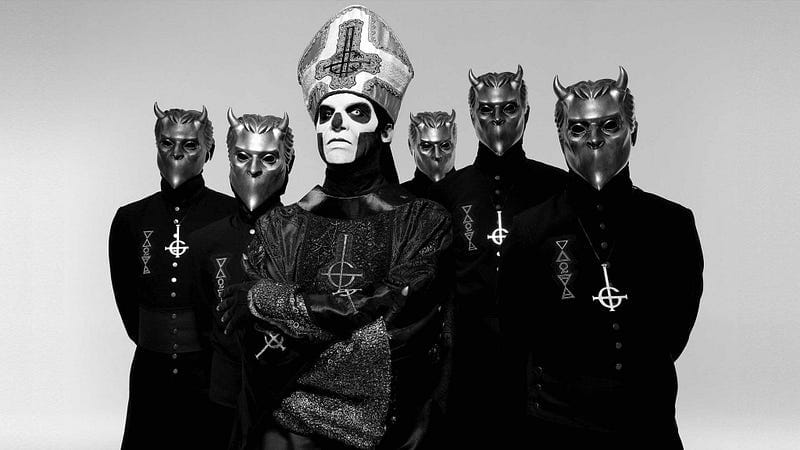
Ghost BC, a.k.a. Ghost, one of the few metal bands with songs popular at both Pandora and hard rock stations.
A side-by-side comparison shows Pandora’s appeal for metal fans. Two thirds of Pandora’s 30 most popular metal songs have no spins at a panel of monitored radio stations that lean heavily toward hard rock and metal. This list of artists includes True Widow, Lesbian, Charred Walls of the Damned, High Spirits, Skeleton Witch, Salem’s Pot and Wode, up and coming bands that are far from household names. The songs with meaningful number of spins — more than 100 or so per week — includes “Square Hammer” by Ghost B.C., a Swedish heavy metal group signed to Loma Vista Recordings, the label founded by A&R exec Tom Whalley that’s part of Concord Music Group. Last week, “Square Hammer” is currently #29 on Billboard’s Mainstream Rock National Airplay char and #8 on Pandora’s metal top 30. Veteran groups Anthrax (represented twice) and Meshuggah also make the list. The 26 lesser-known artists popular with Pandora have received zero or near zero spins at commercial hard rock stations.Few of the bands in Pandora’s top 30 have ever received regular airplay at active rock. None of the top 10 songs on Pandora’s “New Rock” station is currently in the top 25 songs on the Active Rock broadcast chart. On Pandora’s “New Metal” station, the most popular song that receives airplay is “I. The Planet” by Norma Jean,” heard almost exclusively at Christian radio airplay, and “Square Hammer,” which last week was #29 on Billboard’s Mainstream Rock National Airplay chart.And while metal is relatively popular at Pandora, there’s still room for improvement at Pandora. Metal accounted for 4.0 percent of US album purchases in the first half of 2016, according to BuzzAngle (track sales and streams were converted into albums for this metric). Yes, metal fans are dedicated album buyers but they’re getting into streaming. Metal’s share of listening hours at Pandora is currently about 1.5 percent. The 2.5 percentage point spread is indicative of the opportunity to attract metal fans’ attention that isn’t being satisfied by radio.Active rock radio’s risk aversion has pushed playlists to the safety of music from the ’90s and ’00s. Well known names like Disturbed, Slipknot, Korn and Red Hot Chili Peppers dominate playlists and squeeze out the hard rock and metalcore preferred by today’s young audience. There are a few theories why that has happened. One issue is the long, difficult slog faced by active rock songs. A Jacobs Media Strategies survey found the average active rock song takes months for a new song to gain get established, requiring radio stations to remain faithful to a song until it resonates with listeners. In comparison, country, which has a reputation for lengthy promotional cycles, sees a new song get established in just a few weeks. But there are “more barriers to making hits in active rock — and more [portable people] meter punishment for a bad risk — than in any other format that relies on new music,” according to Fred Jacobs of Jacobs Media Strategies.Radio expert Sean Ross has noticed commercial radio’s inability to graduate “post-Linkin Park hits to CHR,” or contemporary hit radio, otherwise known as top 40 or pop radio, he explained in an article last month. At the same time, the common strategy of starting songs at alternative radio means an alternative hit “can be tagged with ‘too weird/not rock enough’ for active rock.” (This helps explain why the Hot 100 is devoid of rock songs.)“Active rock programmers have bemoaned a dearth of current product for years,” he wrote. “Many have responded by becoming more library-based and adding some surprisingly mainstream classic rock (Queen, Steve Miller, Tom Petty). Now stations like KVRK Seattle and KFMB-FM San Diego have emerged that simply eliminate most recent music altogether.”A promotional email by the band The Amity Affliction sums up the state of active rock. The band’s single “All Messed Up,” from an album released on Roadrunner Records, was having a difficult time getting radio play even though, as the email proclaimed, it was “outselling and out-streaming half the records on the active rock chart.” The point was clear: there’s a disconnect between what people are streaming and what active rock programmers are spinning. Broadcast radio is too slow to adapt and incapable of matching streaming’s diversity and depth. But at Pandora, to borrow a song title from Night Ranger, you can still (hard) rock in America.Related articles