


___________________________________
By Mark Mulligan on his Music Industry BlogWe are in the era of the always-on fan, with artists making themselves ever more available to their fans. It is a transition that comes with no shortage of challenges, not least the extra workload it places on artists and the way it chips away at the magical aura that surrounds them. There is an inherent tension between increasing an artist’s appeal through increased accessibility and creating it by maintaining distance. Contrast this with YouTubers like Jenna Marbles, PewDiePie and Phil and Dan who share so much of their lives with their fans. Platforms like Kickstarter, Paetron and the ever excellent PledgeMusic have given artists the ability to balance artistic credibility with monetizing their super fans. But while such efforts are currently on the fringes there is a country where super fans are at the heart of recorded music revenue. Artistic credibility however is not exactly at the top of the menu.Merchandise Disguised As AlbumsIn Japan 78% of music sales are still physical. On the surface, for such a technologically sophisticated country as Japan this looks like a resounding success story for the CD. But all is not as it may at first appear. The Japanese music business long ago mastered the skill of using the CD as a tool for driving ancillary revenue. J-Pop artists used to routinely simultaneously release multiple editions of albums. But while in Western markets special editions typically entail different tracks, artwork and packaging, J-Pop special editions often featured exactly the same tracks and artwork but a different free gift. In practice this was merchandise sales disguised as music sales. This strategy banked on the repeatedly proven theory that super fans would buy every single edition. The practice still continues but looks patently philanthropic compared to the successor strategy of Japanese idol artists.One Fan, Many VotesIdol artists are Japan’s reality TV pop stars. Typically tied to a TV show they build the same sort of audience relationship that contestants do on western shows like American Idol and the XFactor. But whereas the western shows most often see competing acts, these shows usually focus on just one. The most successful of these acts so far is AKB48, an all girl troupe featuring 48 members. However the crucial twist to AKB48 is that fans get to vote for their favourite members, the most popular of whom then go on to be the core focus of the band and get all the best appearances and TV slots. While in a western talent show the vote would take place via a premium phone line, votes for AKB48 can only be cast with an official voting slip, which conveniently enough comes inside the band’s latest CD. So fans flock to the shops on release day not because they desperately want to hear the latest AKB48 tunes but to vote. In fact, street bins are often full on release day with discarded CDs, with the voting slips removed.But it doesn’t stop there. Voting follows a process Stalin and Saddam Hussein would be proud of. Instead of one-fan-one-vote, AKB48 fans can vote as many times as they like, just so long as they buy more CDs, and boy, do they do just that. As you can see from the graphic, some fans go to extreme lengths to try to influence the outcome of the vote for their favourite members of AKB48 and copycat acts like Nogizaka 46. Some fans literally bankrupt themselves in the process. The bottom left picture in the graphic shows what one fan got for spending $330,000.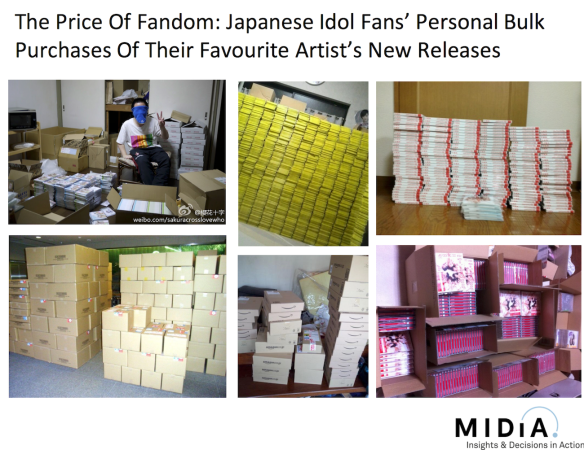
Related articles