

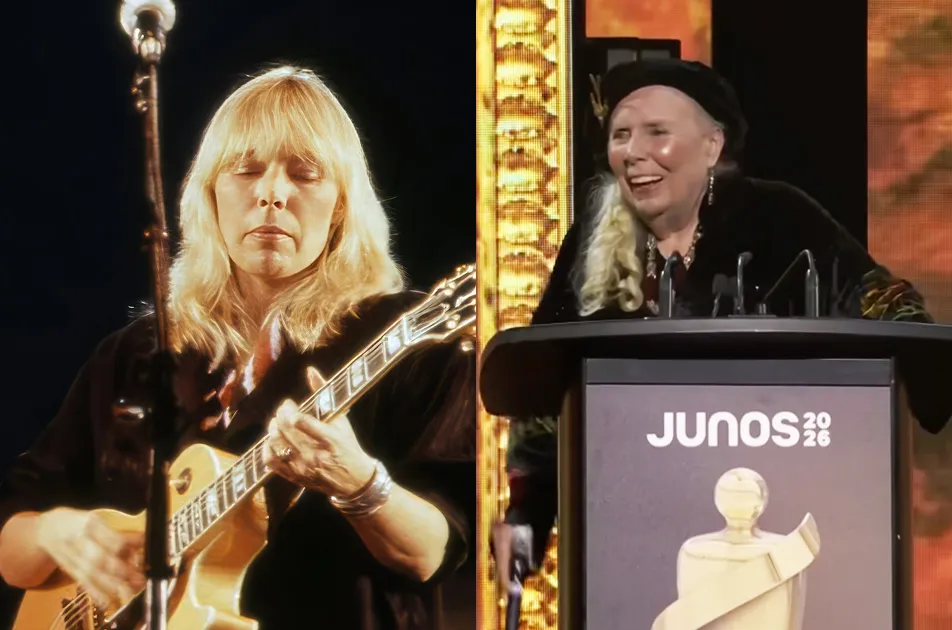
At 82 years old, Joni Mitchell accepted the Lifetime Achievement Award at the 2026 Juno Awards, held at the TD Coliseum in Hamilton, Ontario last night. It was an iconic moment for Canadian and North American music fans alike, which felt both celebratory and also reflective.
Few artists have shaped modern songwriting as profoundly as Mitchell, whose catalog spans folk, jazz, pop, and orchestral traditions, and whose music has touched the lives of millions of listeners as well as inspired thousands of artists over time.
Watch her Lifetime Achievement Award acceptance speech at the 2026 Juno Awards, with an introduction by Canadian prime minister Mark Carney:
Beyond all the albums and accolades that have dotted Mitchell’s career, her live performance history has also been defined by memorable moments on stage. Looking back at Mitchell's various eras in her touring legacy could also help to trace the arc of her artistic evolution over more than six decades.
From smoky coffeehouses in the 1960s to triumphant comeback concerts in the 2020s, the Alberta-born Mitchell’s live concert history tells a parallel story to the music itself. Here’s a look back at the key eras of Joni Mitchell’s remarkable live career.
The Coffeehouse Years [1960s]
Before she was a global icon, Mitchell built her reputation in the folk clubs of Canada and the United States. After emerging from Toronto’s Yorkville folk scene, she toured relentlessly across North America, performing in small venues where audiences were just beginning to hear her distinctive songwriting voice.
Her unusual guitar tunings and poetic lyrics quickly set her apart from other performers in the folk revival. One early milestone came when she appeared at the Newport Folk Festival in 1968, an event that helped introduce her to a wider audience and positioned her alongside the leading voices of the era’s folk movement.
These early performances established Mitchell not only as a gifted songwriter but as a compelling live performer capable of commanding a room with little more than a guitar and voice.
Woodstock (But Not Really) [1969]
One of Mitchell’s most famous live-related moments actually revolves around a performance she never gave. She did not appear at the historic Woodstock Music & Art Fair in 1969, after her manager David Geffen advised her to remain in New York for a television appearance on The Dick Cavett Show.
Watching news coverage of the festival from her hotel room inspired Mitchell to write “Woodstock,” a song that captured the spirit of the moment despite her absence from the event itself.
Early television performances of the song helped cement it as an anthem of the era, later becoming even more widely known through a recording by Crosby, Stills, Nash & Young.
The Confessional Era and Carnegie Hall [1969–1974]
Following the release of Blue, Mitchell became one of the defining artists of the singer-songwriter movement. Her concerts during this period were often intimate and emotionally direct, with audiences hearing songs such as “A Case of You” and “River” performed in their rawest form.
A landmark moment came with her February 1969 performance at Carnegie Hall, which marked her transition from folk clubs to the world’s most prestigious stages.
Throughout the early 1970s, Mitchell expanded her live instrumentation — adding piano and dulcimer while continuing to deliver performances that felt intensely personal even in large concert halls.
The Jazz Years and the Shadows and Light Tour [1979–1980]
By the late 1970s, Mitchell had begun exploring jazz and fusion influences, collaborating with some of the genre’s most respected musicians.
The Shadows and Light tour became one of the most musically ambitious chapters of her career, featuring an extraordinary band that included bassist Jaco Pastorius, guitarist Pat Metheny, and saxophonist Michael Brecker.
The performances blended Mitchell’s lyrical songwriting with complex jazz arrangements, resulting in the acclaimed live album and concert film Shadows and Light. For many fans, these shows represent the moment when Mitchell pushed her live performances into new musical territory.
Rare Appearances and a Retreat From Touring [1990s–2000s]
As the 1990s progressed, Mitchell began stepping away from the constant touring that had defined earlier decades of her career. Her live appearances became less frequent, making each performance feel like a special occasion.
Concerts supporting Both Sides Now featured lush orchestral arrangements of jazz standards and reinterpretations of earlier songs. These performances revealed a different dimension of her artistry — one that emphasized vocal phrasing and musical sophistication over the stripped-down folk style of her early career.
The Newport Return [2022]
After suffering a brain aneurysm in 2015 that temporarily left her unable to walk or speak, many fans believed Mitchell might never perform again.
That assumption changed dramatically in 2022 when she made a surprise appearance at the Newport Folk Festival, joining Brandi Carlile and a group of musicians for an emotional set.
The highlight was a moving rendition of “Both Sides Now,” delivered to a stunned audience. The performance instantly became one of the most powerful comeback moments in modern music.
The “Joni Jam” Era [2023–2024]
Following the Newport surprise, Mitchell began participating in collaborative concerts informally known as “Joni Jams.” These events bring together friends, admirers, and collaborators to reinterpret her catalog on stage. The most notable took place at Gorge Amphitheatre in 2023, where Mitchell performed for a massive crowd surrounded by an ensemble of musicians and guests.
Rather than traditional touring, these gatherings feel more like communal celebrations of Mitchell’s music — proof that even after six decades, her songs continue to connect generations of artists and audiences.
As the recent “Joni Jam” performances have shown, even after a lifetime of achievements, Joni Mitchell’s connection with a live audience remains one of the most powerful parts of her legacy.