

By Sebastian Vidal, Founder of BookedKit
Linktree is everywhere, and that alone tells you something.
You see it in the bios of rappers, DJs, indie bands, singer-songwriters, influencers, brands, stores, comedians, restaurants, and basically anyone else trying to compress an entire online identity into one social media link.
That is not an accident. Linktree works. It is fast, flexible, and dead simple to set up. But artists started asking it to do a job it was never built to do. They started using it not just as a link hub, but as a stand-in for a professional identity. A press kit. A booking page. A resume. A catch-all answer to the question: what should I send when someone serious wants to work with me?
That is where things start to break — because a fan and a booker are not trying to do the same thing.
Fans browse. Bookers decide.
Fans are fine clicking around. They will open Spotify, check your Instagram, watch a video, maybe tap through to merch, maybe bounce to another platform. That kind of wandering is normal. In fact, it is part of how fandom works.
Bookers do not move like that, however. Promoters, venues, talent buyers, festival curators, journalists, managers, and music supervisors all usually don't have time to explore by clicking random links. They operate in "evaluation mode" and want a fast read to determine an artist's identity. They ask the following questions:
- Who is this artist?
- What do they sound like?
- What do they look like?
- Does the project feel coherent?
- Can I contact them easily?
- Can I send this to someone else on my team without having to explain it first?
That is a completely different use case from fans wanting to engage with an artist's music or brand. And yet a lot of artists are still using the same generic link-in-bio tools for both moments, as if discovery and evaluation were the same thing.
They are not.
Fans click out of curiosity. Bookers click with a deadline.
A Linktree can help people find you. That does not mean it is helping the right people book you.
The fact that everyone uses Linktree is part of the problem
One of the clearest signs that the artist link-in-bio category is still underdeveloped is that so many serious artists are using the exact same tool as beauty influencers, clothing stores, restaurants, startup founders, and online creators of every kind. Like I said before, Linktree works.
But universal tools are usually designed for flexibility, not for the professional needs of one very specific kind of user. That matters.
If one product works equally well for a DJ, a makeup creator, a coffee brand, a fitness coach, and an online candle store, then by definition it is probably not deeply optimized for what a musician actually needs when somebody is trying to assess them professionally.
There is still no widely accepted standard for what an artist’s link-in-bio should become once the goal shifts from “here are my links” to “here is my professional presence.”
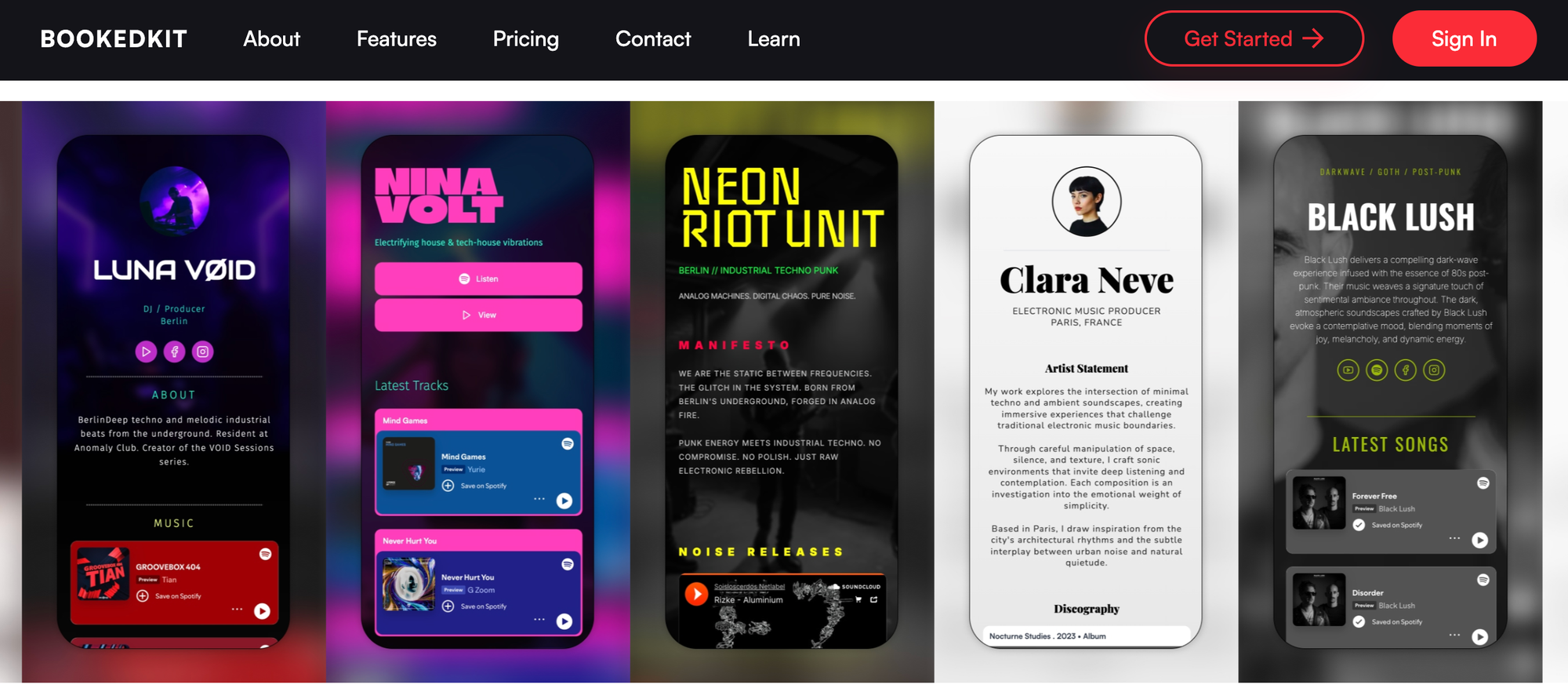
BookedKit is one attempt to solve that problem. There are other tools moving in that direction too. The larger point is not that one platform wins. The larger point is that artists need something more specific than a generic stack of buttons, and the market is only beginning to admit that.
+Read more: "ABB ('Always Be Booking') Is Great Advice for Working Artists — Here's Why."
Your link-in-bio is not the same thing as your artist resume
Musicians have normalized something that would look ridiculous in almost any other profession: using one static version of themselves for every opportunity.
- One EPK.
- One bio.
- One set of links.
- One PDF.
- One photo folder.
- One structure.
The same package, over and over, no matter who is on the receiving end. That makes no sense.
The version of your project that helps you get booked at a neighborhood bar is not necessarily the version that helps you pitch a festival. The materials that matter to a local promoter may not be the same ones a journalist, brand partner, talent buyer, or manager wants to see first.
Imagine applying to every job with the exact same resume, regardless of role, context, or company. People would call that lazy, or at least careless.
But in music, it is still treated as normal, and it should not be.
Artists should start thinking less about having one permanent press kit and more about having a professional identity that can flex depending on the opportunity. That is why I keep coming back to the idea of an artist resume, and partly what led me to build BookedKit in the first place: not as another generic link-in-bio tool, but as a more dedicated way for artists to present themselves when the goal is not just to be found, but to be understood and booked.
A real artist resume would be a clean, living presentation of who you are, what you sound like, what you look like, what matters most about the project, and how someone takes the next step.
The UX problem no one talks about
Linktree's strength is that it was designed like a directory. It gives people a simple menu of destinations. Choose your own path. Go where you want. Click what interests you.
That is useful for discovery. But the UX for discovery is not the same as the UX for evaluation.
When someone is trying to hire an artist, they usually do not want to build the profile in their own head by opening five different tabs. They do not want to assemble the artist out of fragments. They want the artist to be legible.
A generic link hub says: "Here are my buttons. Pick one."
A dedicated artist platform says: "Here is the artist. Here is the music. Here is the identity. Here is how to contact them."
That is a meaningful UX difference, and a major thing we kept in mind as we designed BookedKit, which feels more like a structured presentation than a generic link menu. The idea is not just to help someone navigate outward. It is to help someone understand the artist before they ever leave the page.
That matters because the more professional the opportunity, the less patience there is for friction. Fans click around for fun. Bookers click with a goal. If your digital presence feels like homework, you are already losing ground.

+Read more: "Stop Chasing Likes: Why Your Most Valuable Social Media Strategy is Actually Bandsintown"
Bookers do not want a scavenger hunt
If someone has to open Spotify in one tab, Instagram in another, a PDF somewhere else, then a photo folder, then maybe scroll through social highlights to see if there is a contact email hiding in there, your materials are no longer helping you. They are slowing the other person down.
And most people do not reward extra friction. They move on. The harder it is to understand an artist quickly, the easier it becomes to say no and check the next option.
One of the strangest things about the current music ecosystem is how often serious booking conversations still start with an Instagram DM. Not because it is ideal, but because the artist has not provided anything cleaner. That is not a professional workflow.
DMs get buried. Requests get missed. Notifications get ignored. The person hiring has no idea whether the message was seen, filtered, or forgotten. Meanwhile, the artist may be talented, active, and ready to work, but the contact path makes them feel harder to hire than they really are.
If the contact path is messy, the opportunity usually gets messy too.
Linktree did its job. Artists need something else now.
As I hope you've understood by now, this is not really an anti-Linktree argument. Linktree solved a real problem for the internet: how do I put many destinations behind one social bio link?
Great. It worked. But musicians, DJs, and artists started using that solution as if it also solved a second problem: how do I present myself professionally when somebody wants to book me, cover me, manage me, or hire me?
That problem is more demanding, and it needs a different kind of product. Artists do not just need one link anymore. They need one place that actually works as a professional read on the project. That is the difference between a link-in-bio and an artist resume.
And until more artists start treating that difference seriously, they will keep creating unnecessary friction at exactly the moment someone is most interested in saying "yes."
Fans can click around. Bookers should not have to.
Check out BookedKit to learn more.
Sebastian Vidal is the founder of BookedKit, a platform that helps artists, DJs, and musicians create clean, booking-ready digital press kits and profile pages. He is also a musician focused on artist presentation, music marketing, and the gap between discovery and professional readiness.