


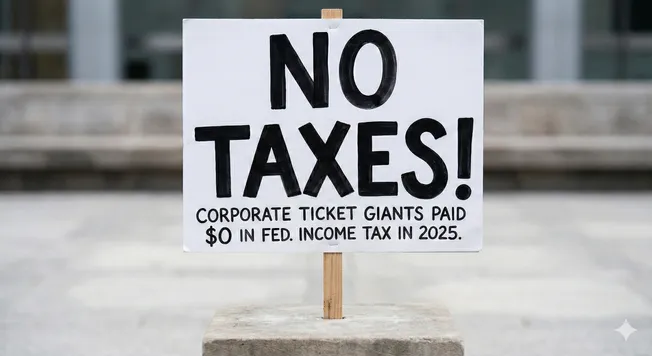
The live music industry is under a microscope with the DOJ vs Live Nation and Ticketmaster trial scheduled to begin. The lawsuit comes at the same time that Live Nation and some of live music's biggest players are celebrating a record 2025.
But a look at recent public filings reveals a striking trend. Despite billions in revenue, some of these companies paid no or almost no federal income taxes last year.
2025 Federal Tax & Spend
| Company | Public/Private | Paid Federal Tax? | Estimated Amount |
| Live Nation (LYV) | Public | No | $0 |
| The Sphere (SPHR) | Public | No | $0 (Tax Benefit) |
| StubHub (STUB) | Public | No | $0 |
| MSG Entertainment | Public | Negligible | <$1M (Est.) |
| Vivid Seats (VSTAT) | Public | Negligible | ~$0 |
| AEG | Private | Unknown | N/A |
| SeatGeek | Private | Unknown | N/A |
AEG and SeatGeek are privately held companies, so no public federal tax information is available.
The "Paper Loss" Strategy
To be clear, none of this was because of clever accounting.
The biggest major factor in these "no tax" filings is Trump's "One, Big, Beautiful Bill Act" (OBBBA). Signed into law on July 4, 2025, it introduced permanent 100% bonus depreciation and other credits that significantly reduce federal tax liabilities for many capital-intensive companies.
The OBBBA’s 100% bonus depreciation allows companies to write off the entire cost of a new amphitheater, theater, or club in the year it opens. These massive "paper losses" and other tax laws can wipe out taxable profits from tickets, fees, sponsorships, and concessions.
Live Nation & The One Big Beautiful Bill
In their 2025 annual report, Live Nation stated: “There was no cash paid for United States federal income taxes as we generated a taxable loss... due to the provisions allowed within the One Big Beautiful Bill Act.”
For 2025, Live Nation (LYV) reported $25.2 billion in 2025 revenue (up 9%), operating income of $1.3 billion (up 52%) and adjusted operating income (AOI) of $2.4 billion (up 10%).
But the concert giant offset their record income by using OBBBA's 100% Bonus Depreciation on about $1B in venue construction.
Live Nation is not the only live music industry player benefiting from these tax deductions.
MSG & The Sphere
Madison Square Garden operators MSG Entertainment (MSGE) paid essentially no federal income tax in fiscal year 2025 despite reporting an adjusted operating income of over $222 million. That was primarily due to the timing of its corporate restructuring.
Following its 2023 spin-off from what is now Sphere Entertainment, MSGE inherited significant net operating loss (NOL) carryforwards and tax basis adjustments that shield its current earnings from federal liability. While the company reported small "cash taxes paid" in its 10-K filings, it was almost entirely dedicated to state, local, and foreign taxes.
By leveraging non-cash expenses like depreciation on its iconic venue portfolio and utilizing the "One Big Beautiful Bill Act" (OBBBA) provisions for immediate capital expense write-offs, MSGE created a "tax-efficient" structure that allowed it to reinvest 100% of its profits back into operations and venue improvements rather than the federal treasury.
MSGE spinoff Sphere Entertainment (SPHR) claimed a $97M tax benefit thanks to its own massive construction losses.
A New Financial Feedback Loop
While "Zero Tax" headlines spark public debate, these tax advantages have also created a powerful financial feedback loop for live music's biggest players.
Live Nation and a handful of other companies are using them to build a widening competitive moat that makes it more difficult for independent players to compete.
The Financial Feedback Loop
- Build/Renovate: Use profits to build new venues and high-margin VIP clubs and amenities.
- Depreciate: Write off 100% of those costs immediately.
- Reinvest: Use the resulting tax savings (millions in cash) to build more and outbid independents and other competitors for talent and land.
Companies reinvesting their profits can lead to more jobs and other economic benefits to a community. In this case, by turning profits into depreciable concrete, staging and LED screens, Live Nation is also securing its long-term dominance while the federal government and tax payers effectively foot much of the bill.
Ticket Resellers Love Trump Too
For secondary ticketing platforms, it is important to distinguish between Gross Merchandise Sales (GMS) - the total value of all tickets sold - and Reported Revenue, which is the cut of those sales the company keeps in fees and commissions.
Instead of massive construction write-offs, StubHub and Vivid Seats used non-cash expenses - like the value of their stock and the decreasing value of their brand names - to cancel out the cash they collect from service fees.
Based on their 2025 filings (covering the first three quarters of the fiscal year), here is the revenue versus the tax bill for each.

StubHub: A Paper Loss Powerhouse
In the first nine months of 2025, ticket reseller StubHub moved a staggering $6.8 billion in Gross Merchandise Sales (GMS), retaining $1.3 billion in reported revenue (a ~19% take rate).
Despite this massive cash inflow generated, for tax purposes StubHub reported a net loss of $1.33 billion for the period.
This "loss" was almost entirely engineered by a one-time $1.4 billion stock-based compensation charge triggered by their September 2025 IPO. By converting years of executive equity into a massive non-cash expense, StubHub effectively zeroed out its federal income tax liability, showing the IRS a deficit while maintaining a fortress-like cash balance of over $1.4 billion.
Vivid Seats: An Asset Write-Down Play
Vivid Seats saw its 2025 volume dip slightly. But the ticket resale marketplace remained highly profitable on an operational basis, processing $2.12 billion in tickets through September 30. From this, the company generated $444 million in revenue.
However, Vivid Seats utilized "impairment charges," effectively writing down the value of brand assets and goodwill, to report significant net losses that shielded its profits from federal taxation.
Combined with a strategic exit from its Tax Receivable Agreement (TRA) which internalized $180 million in lifetime tax savings, the company limited its total cash tax payments to just $3 million. Most of that was paid to foreign and state governments rather than the U.S. Treasury.
Hypebot's Bottom Line
In 2026, the live music business is no longer just about who books the best tour or sells the most scalped tickets. It’s about who can build the most depreciable assets.
As long as the OBBBA and these kind of write downs and paper losses stands, expect live music's zero tax trend to continue.