


Here MiDIA principle Mark Mulligan shares his future vision of the music industry, suggesting that, while artists may have to adapt to some fundamental economic shifts, they will emerge more empowered than ever.
Guest post by Emmanuel Legrand of Legrand Network
The music industry will have to adjust to a series of “mega trends” if it wants to continue to grow in the new digital environment, according to analyst Mark Mulligan, a principal at London-based MiDIA Research. Mulligan was speaking at the Eurosonic Noorderslag conference and festival in Groningen, Netherlands.
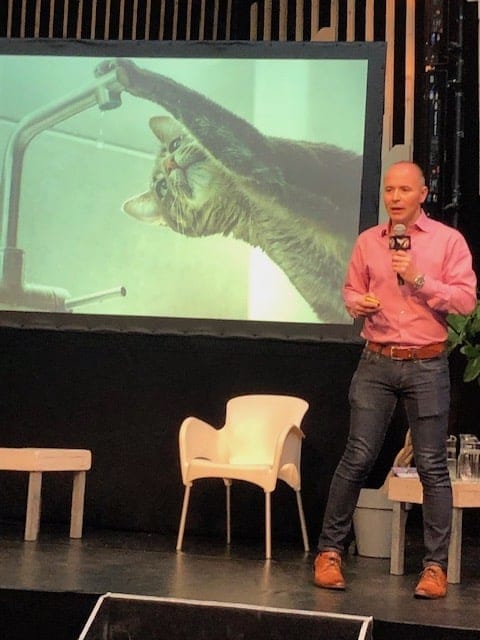
Mulligan outlined what the future of music could look like in an eco-system dominated by the attention economy, the rise of independent creators, the business of rights, and the dominance of streaming as the main music distribution channel. “Music no longer operates in its own vacuum,” he quipped. Music, he added, is among the products that compete in the attention economy, alongside video games, video streaming, books, live entertainment, sports, etc.
On the positive side, Mulligan noted that “the music industry is in a good place” with revenues up to $21 billion last year, counting 340m subscribers to music streaming services, and with about $4.5bn invested in the acquisition of music rights. “There’s a lot happening, a lot of growth and a lot of revenues,” said Mulligan, “but when is this going to end?”
In the short term, Mulligan suspects there is an economic recession looming which could hit streaming services’ revenues as consumers will discard non-essential expenses. “It is easy to cancel a subscription and still have a quality experience with YouTubeor free tiers,” said Mulligan.
Streaming growth to slow down
But overall, he sees global streaming revenues continuing to grow, even though the growth will be slowing, especially in mature markets. “There’s still a lot of growth there,” said Mulligan, predicting that by 2026, global revenues for the music industry will reach $44.5bn, with 20% growth in 2019 down to 7% in 2026. Growth will come from territories such as Mexico, Japan, Russia and India.
Streaming has a very US-centric outlook, with a majority of the music market controlled by US-based companies. “If the US sneezes the rest of the world catches a cold in the music business,” joked Mulligan.
Mulligan warned that more changes are coming both for labels and for streaming services. For example, he noted that “tension exists” between streaming services and record labels (or, as he puts it, distribution v. rights) with distribution services “doing more things and start competing with what record companies do.” There’s a conflict between “the new way of doing things v the old way of doing things.”
As an example, he mentioned Spotify building sets of tools for creators. “It’s subtle way to start a long journey,” he said.
A Netflix moment for radio
In terms of consumption, “streaming is eating radio, as young listeners have switched to streaming, and older audiences are eaten away by podcast,” explained Mulligan who predicted “a Netflix moment for radio.” He added: “Consumers listen to radio, then switch to podcast and podcasts are competing for listeners time. When we will get podcasts and music together and create content that did not exist, we will se an upswing in consumption.”
However, Mulligan said that the music business still revolves around charts and sales, as well as the album format. “These are old ways of viewing the world,” he said. “It’s trying to interpret the new world through old language. It is not just that people are not buying albums anymore, but listening is more fragmented. Niche is becoming the new mainstream.”
For Mulligan, it will be important to sustain growth that streaming services find ways to differentiate themselves. “About 20 years ago, people were talking about internet making music like water, so yes, this is where we are,” said Mulligan. “But when music becomes a utility it is less important. Music is increasing becoming this sonic stream around us. The platforms are all the same, so they have to make sure we get the best and most new music in order to we feel that we cannot exist without our streaming service.”
The rise of the independent artist
One of the key takeaways from recent market developments is, according to Mulligan, “the rise of the independent artists,” who represent “the fastest growing part of the recorded music business,” with artists’ direct revenues and label services revenues reaching $1.580 billion in 2018. “We are at the cusp of really big changes,” said Mulligan. “There is a new generation of artists who do not want to play by the old rules.”
Some companies have embraced the new paradigm and are focused on the needs of artists, said Mulligan, for whom “artists are more empowered than ever and fandom may be tomorrow’s currency.”
This new way of doing business will have an impact of the way record labels traditionally operated. “If you cannot own the copyright anymore, you have to think about how you approach the market, and maybe you do not want to invest as much in it,” said Mulligan in reference to the recent wave of highly paid catalogues.
Aligned with creators
At Eurosonic, Paul Hitchman, president of Kobalt‘s artist services division AWAL, also embraced the notion that there is a wide future for independent artists, who now have tools at their disposals to reach the global music market. “Artists need to be entrepreneurs,” said Hitchman.
Hitchman said AWAL’s model is to be “aligned with creators.” He elaborated: “We think this is a good business principle as well as a moral principle. We work for artists rather than artists work for us. If you think you are bigger than the artists, this is where you are going wrong. We now we have a roster that is more than a match for the majors, we have nine offices, and we are really the alternative to the majors.”
Hitchman noted however that “transparency has a long way to go” in today’s business. He added: “That’s a principle the industry should embrace. Any data we collect we share with artists. People in business should be sharing data, sharing information. The problem with a lot of the incumbents in the industry has been to focus on their share of the pie rather than increase the size of the pie.”
The post format era
Mulligan concluded by offering several options for the future of the music industry. “We can carry on as we are,” he said. “The system is not broken enough so we can carry on, and focus on how much money is generated. “Another option is that streaming gets social. “Look at what happens in China where streaming services monetise fandom,” said Mulligan. “Services make more money with virtual gifts than money made by music.”
And further up on the road, there is the prospect of the end of streaming. “Eventually, something new replaces streaming,” said Mulligan. “We are in a post format era. So there’s no limits.”