

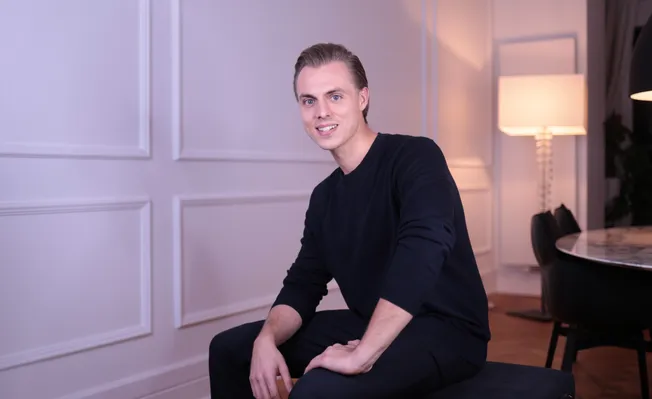
Markus Hetzenegger is the CEO of NYBA Media, a data-driven agency that works with artists, brands, promoters, and high-profile event organizers to sell more concert tickets using AI, behavioral psychology and audience metrics, and a keen understanding of social media algorithms and trends.
NYBA was also one of the first TikTok global beta partners back in 2019 and is now an official TikTok business success case. What has particularly defined their recent success in targeting and converting audiences around live music event calls to action is that they've been able to adapt their methodology across global markets, responding to cultural differences and interests when top artists are investing millions in world tours.
In other words, they've mastered the art of finding and attracting audiences using data tools, AI, and creativity. I wanted to chat with Markus to see if what NYBA is learning could be adapted to the indie artist and management teams on any level.
Here's our conversation.
Hypebot: Hi Markus, thanks so much for taking the time to answer some questions. So you lead NYBA Media, a company that uses data insights to drive ticket sales for live artists. Tell me a bit about your background.
Markus: "I didn’t come from a traditional music industry background. I started in marketing very early and founded my first business at 17, officially launching at 18. From the beginning, I was fascinated by how predictable human behavior becomes when you look at enough data."
While studying, I began promoting events at university and applied those early marketing concepts to small-scale events. What we saw was extremely clear: most shows don’t fail because the product is bad, they fail because demand isn’t engineered properly."
Those early experiments worked surprisingly well and became the foundation for everything that followed. That’s where the idea for NYBA came from. What if ticket sales weren’t driven by guesswork, but by a system that understands demand, predicts it, and scales it?"
Over the last 12 years, that has evolved into an infrastructure built on data from more than 75 million tickets sold."
"Live entertainment is not only relevant, but becoming more important than ever. It creates something that digital environments fundamentally cannot replicate: real presence, shared emotion, and collective experience."
H: Did you grow into the music industry with a particular interest in live music, over recorded music?
M: "Very clearly, live over recorded. We are entering a world that is evolving at an unprecedented pace through AI and digitalization. Attention is shifting more and more toward screens, and real human interaction is becoming increasingly limited."
That is exactly why live entertainment is not only relevant, but becoming more important than ever. It creates something that digital environments fundamentally cannot replicate: real presence, shared emotion, and collective experience. You are not just observing something, you are part of it. You feel it together with thousands of others, in the same moment."
It’s a true physical experience in the real world. A real-world experience."
H: What — in a basic sense — does data driven marketing for live events look like?
M: "At its core, it’s about removing guesswork. Before anything else, the fundamentals need to be right and this applies equally to small independent promoters and the largest global touring companies. That means building a solid technical and creative foundation with the following."
- Accurate tracking across all platforms, ideally combining pixel tracking with API-based tracking to ensure high data quality and signal accuracy
- A strong and diverse creative setup, ranging from static graphics and social assets to animations, trailers, UGC videos, and testimonial-driven content
- A focus on personal, relatable, emotional, and entertaining formats that feel native to each platform
- Producing and testing creatives across key formats such as 1:1, 4:5, 9:16, and 16:9
- A clear data-driven strategy combined with the right budget allocation and platform distribution"
Once these fundamentals are in place, the same core principles can be applied by any promoter."
- Start with real demand signals. Look at past sales data, artist markets, streaming data, and social engagement
- Build audience clusters. Not just “fans of artist X,” but behavioral groups such as frequent concert buyers, last-minute buyers, and premium buyers
- Match message to intent. Different audiences convert on different triggers: scarcity, social proof, urgency, and exclusivity"
Today, social proof is one of the strongest levers. People want to see that others are already buying, attending, and engaging. At the same time, creative has shifted heavily toward UGC-style content. Ads that feel like real content, not advertising, consistently outperform polished campaigns. It’s less about perfect production and more about authenticity, community, and FOMO."
What has fundamentally changed is that the focus has shifted away from pure targeting toward creative. The content itself increasingly finds the right audience through platform algorithms. That means you need to build the right content for each audience segment, rather than relying on targeting alone."
- Test fast, scale fast. Launch multiple creatives early, identify winning hooks quickly, and scale what works
- Track everything properly. Tracking is the foundation of everything. If your tracking is broken, your decisions are random and most campaigns fail at this exact point"
In parallel, TikTok has become one of the most relevant platforms over the past 12–18 months, especially for driving discovery and top-of-funnel demand."
H: Using social media targeting is a lot more personalized than traditional live concert marketing campaigns. To some degree it requires thinking through the behavior and point of view of an artist’s target listenership to understand the most resonant message to convert them. How do you go about sourcing that info?
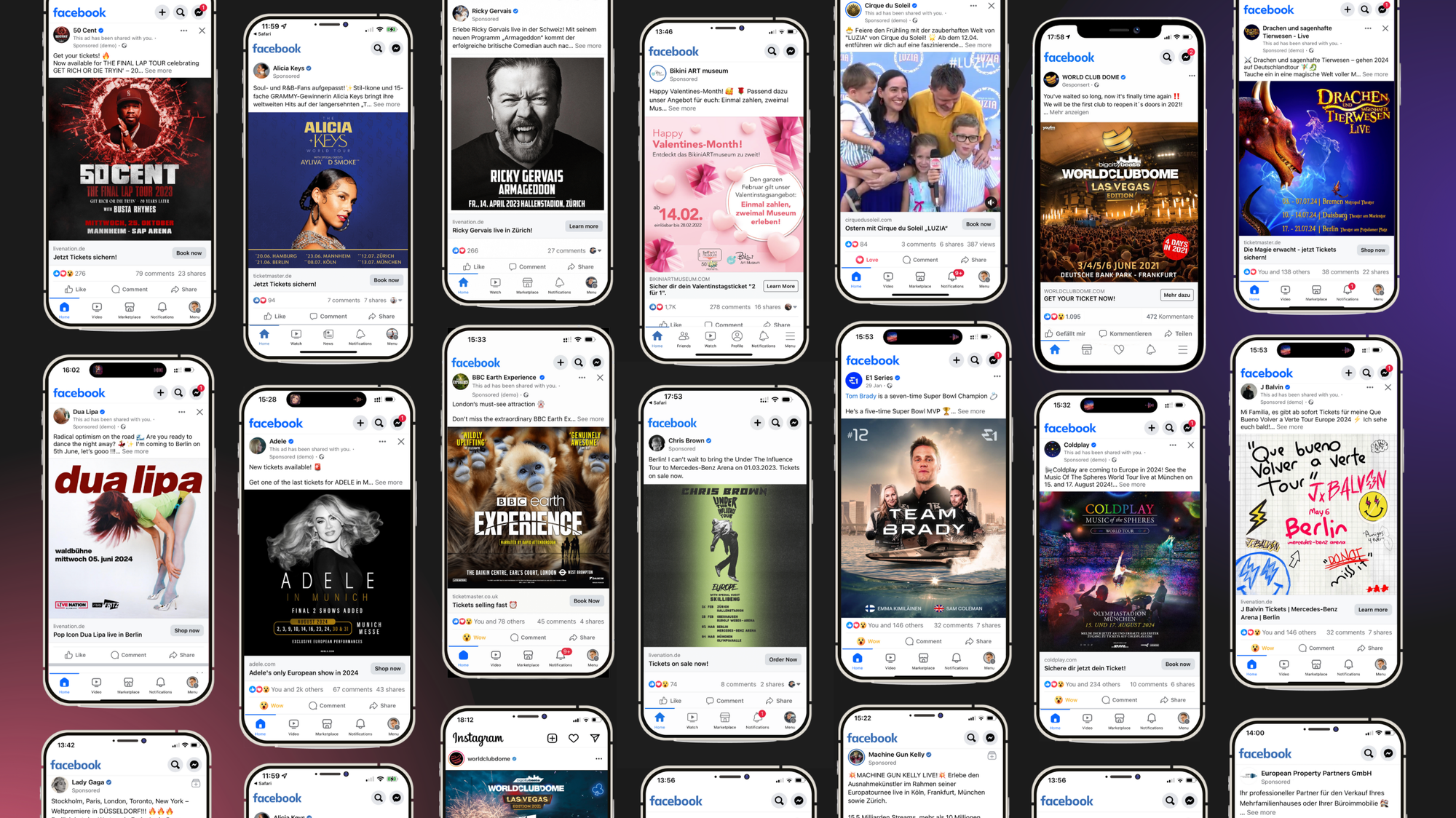
M: "That’s exactly right. It enables a much more personalized way of addressing audiences and, most importantly, it makes everything measurable. Traditional channels like out-of-home, radio, TV, or print reach a broad audience, but not necessarily the right audience."
With performance-driven, AI-powered, data-driven marketing, we can reach the right people on the right platform, with the right message, at the right frequency. More importantly, we can guide them through a structured content funnel, from the first impression all the way to ticket purchase. For example, someone might first discover an event on TikTok, engage with content, be retargeted on Meta, and finally convert through Google. Every step along that journey is measurable and optimizable."
For most events, it’s not enough to push out a generic message to a broad audience. Standard creatives like a social banner or generic trailer are rarely sufficient. You need to deeply understand how your audience thinks, speaks, behaves, and what actually captures their attention."
The most effective way to do that is natively within the platforms themselves, by observing how audiences communicate, what content they engage with, what formats they consume, and what conversations they are part of."
Based on that, you create content that feels native to that environment. Content that doesn’t feel like advertising, but like something that naturally belongs in the feed. It needs to be relevant, entertaining, and aligned with the audience’s mindset."
H: Are there general checklist items that are a must for any live concert or tour marketing effort?
M: "Yes, and they are consistent across all levels. If you get these right, you cover the majority of what drives ticket sales:
- Tracking foundation. Everything starts with clean data. Set up pixel tracking combined with API-based tracking to ensure maximum accuracy across platforms.
- Strong creative and content funnel. Build a full funnel from awareness to conversion using UGC, social proof assets, testimonials, trailers, and native video formats.
- Platform-native content. The best-performing ads don’t feel like ads, they feel like content. Focus on authenticity, relevance, entertainment, community, and FOMO.
- Smart retargeting and audience structure. Re-engage users who showed interest but didn’t convert using urgency, scarcity, and social proof.
- High-performing ticketing infrastructure. Your ticket platform must be mobile-optimized, fast-loading, and frictionless. Clear social proof and seamless checkout are essential and everything must be fully trackable."
If these elements are in place, you create a system based on measurable performance and continuous optimization, not assumptions."
"If your content resonates, you get higher engagement rates, better quality scores, and ultimately lower costs. So the real lever to reduce CPC is not tweaking targeting, it’s improving creative... In practice, the campaigns with the lowest CPC are almost always the ones where the content is most relevant to the audience."
H: Is there a universal way to keep Cost Per Click (CPC) low when designing campaigns for live tour ticketing?
M: "Yes, but it’s often misunderstood. CPC is not primarily a media buying problem. It’s a relevance problem."
Platforms like TikTok, Meta, and Google reward content that users actually engage with. If your content resonates, you get higher engagement rates, better quality scores, and ultimately lower costs. So the real lever to reduce CPC is not tweaking targeting, it’s improving creative."
That means creating strong hooks in the first seconds, using native, platform-specific formats, focusing on social proof, urgency, and emotional triggers, and building content that feels like real content, not advertising."
The more your content blends into the feed and captures attention, the more efficiently platforms will distribute it. Testing also plays a critical role. You don’t find winning creative by guessing. You find it by launching multiple variations and letting performance data guide decisions."
In practice, the campaigns with the lowest CPC are almost always the ones where the content is most relevant to the audience."
H: You mentioned that marketing events in the UK and Europe had to factor in different priorities than in Asia or the Middle East for example. What are some ways that cultural differences come into play here?
M: "Cultural differences play a massive role and often determine whether a campaign succeeds or fails. The biggest mistake is assuming you can take one campaign and simply translate it into another market. What works in one region can underperform significantly in another because the underlying psychology is different."
- In the UK and Europe, credibility and social proof are key drivers. People respond strongly to reviews, press coverage, reputation, and cultural relevance.
- In the Middle East, positioning and exclusivity play a much bigger role. Premium experiences, VIP access, and scarcity can significantly increase demand.
- In many Asian markets, speed, mobile behavior, and trend-driven content dominate. Audiences respond strongly to fast-moving, visually engaging formats."
Beyond regional patterns, it ultimately comes down to understanding local behavior. Such as: How people communicate, what content they engage with, and what motivates them to take action, among other things. The platforms may be global, but the way people use them is not. That’s why the most effective campaigns are not translated, they are localized. Not just in language, but in messaging, creative style, pacing, and emotional triggers."
H: What does the future of concert and tour marketing in the digital space look like? For example, how is AI reshaping this landscape in your perspective?
M: "The shift is already happening. From manual campaign management to fully automated, AI-driven systems. Instead of building, testing, and optimizing campaigns manually, the future lies in systems that continuously learn, predict, and optimize in real time. Targeting is becoming increasingly automated by platforms themselves, which means the real competitive advantage is shifting toward data and creative."
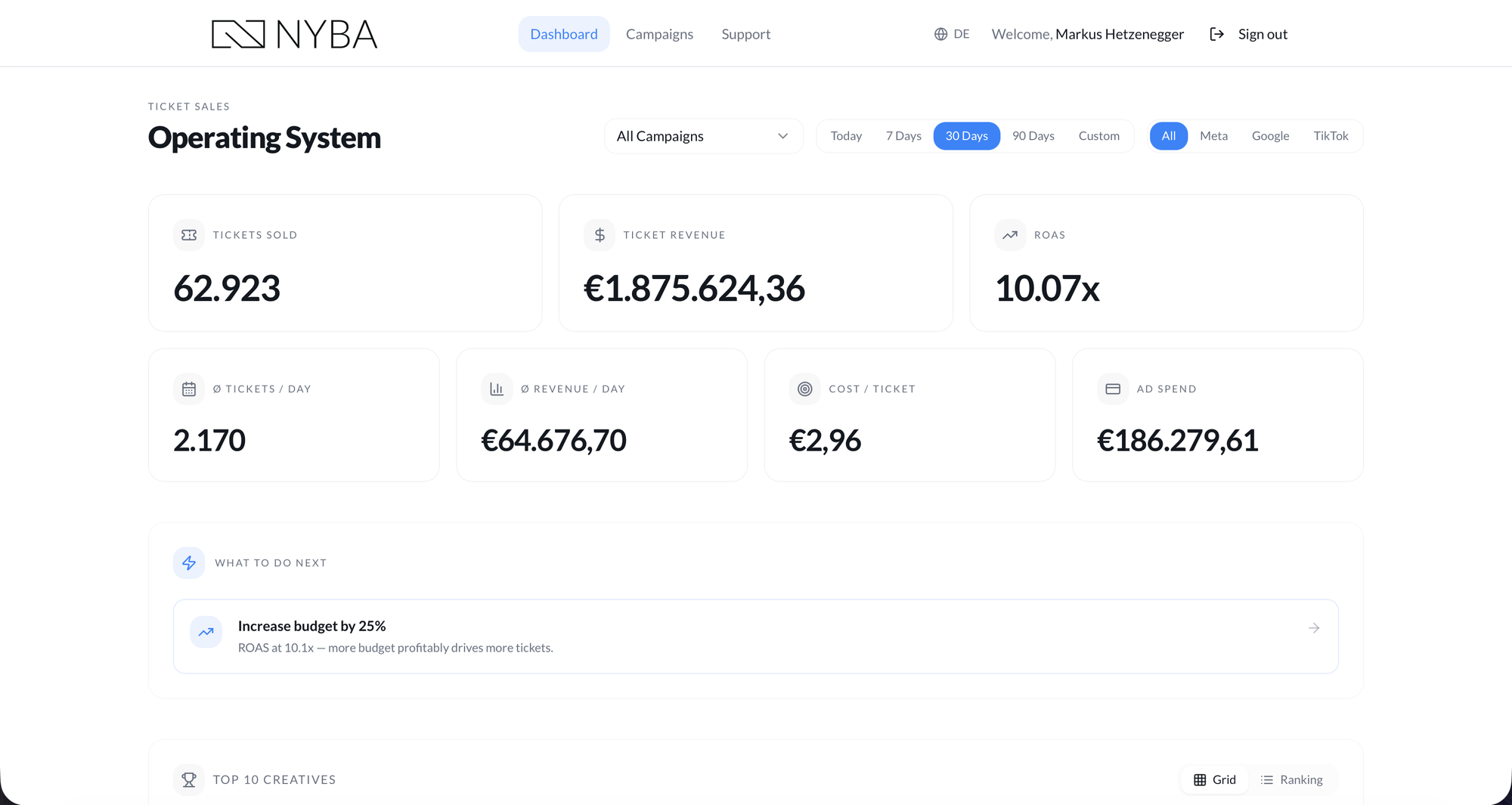
At NYBA, this is already a reality within our internal system. What traditionally required manual work is now handled automatically. Campaigns are created, optimized, and scaled through AI-driven processes. Budgets shift dynamically, audiences are continuously refined, and performance is optimized across platforms without manual intervention."
At the core of this is our data foundation. Built from more than a decade of campaign data across 75 million tickets sold. All of these learnings feed directly into the system, allowing it to make better decisions over time."
At the same time, as everything becomes more automated and digital, live entertainment itself becomes more valuable. Because while marketing and distribution are increasingly driven by AI, the product remains deeply human: real experiences, real emotions, real moments."
The future is where these two worlds meet: AI-driven demand generation and real-world experiences."
"We attended Adele's final show of the tour in Munich together as a team, we all got goosebumps! Not just because of the performance, but because we had been part of the journey from the very beginning."
H: What was the first ever artist you saw perform live?
M: "The first artist I saw live was David Bisbal. He was my mother’s favorite artist, and I saw him perform when I was twelve years old in Águilas, in the south of Spain. It was a very special moment and, looking back, probably one of the first times I truly felt the power of live entertainment."
H: What was the last great live concert you saw?
M: "Without a doubt, Adele in Munich in 2024. The show itself was extraordinary, but what made it truly special was our involvement. From day one, we were responsible for the entire online marketing, from strategy and content to execution and distribution across Europe and worldwide. In total, around 800,000 tickets were sold."
We attended Adele's final show of the tour in Munich together as a team, we all got goosebumps! Not just because of the performance, but because we had been part of the journey from the very beginning."
Seeing the full audience, the energy, and the emotional impact live after building the demand behind it, made it a very personal and memorable experience for all of us."
NYBA Media helps turn clicks into sold out shows. The agency works with live entertainment brands and promoters to sell more tickets through AI-driven digital marketing. The result: higher revenue, stronger ROI, and sold-out shows.