

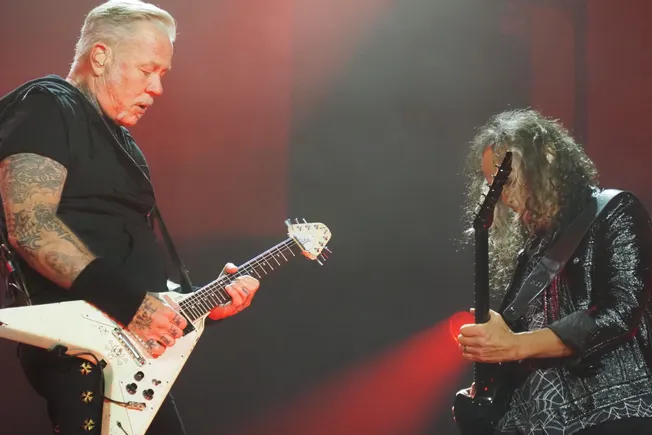
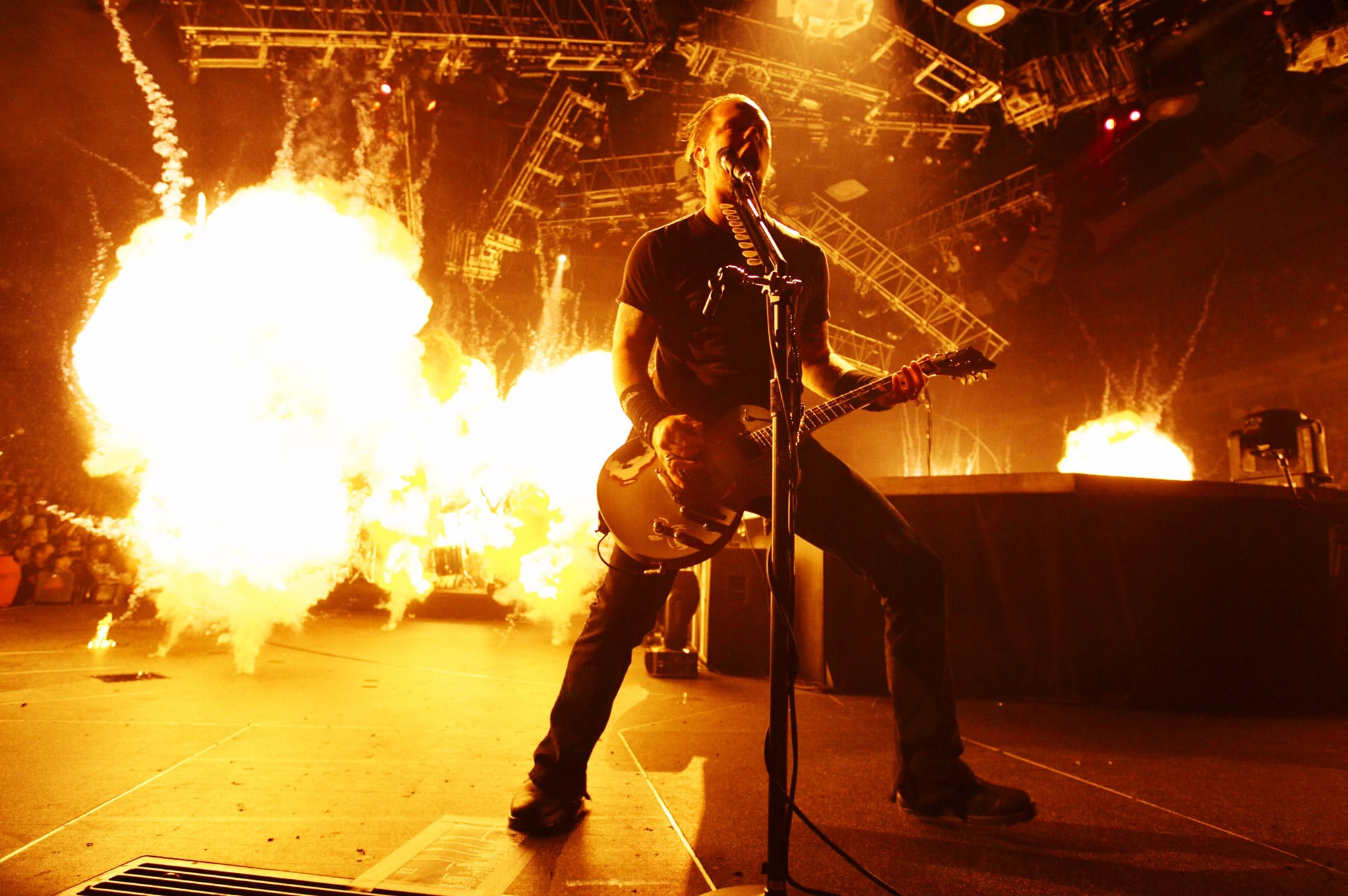
When Metallica took the stage at Cardiff's Principality Stadium last night, few expected one of the night's most talked-about moments to come during the band's lighthearted mid-show tradition.
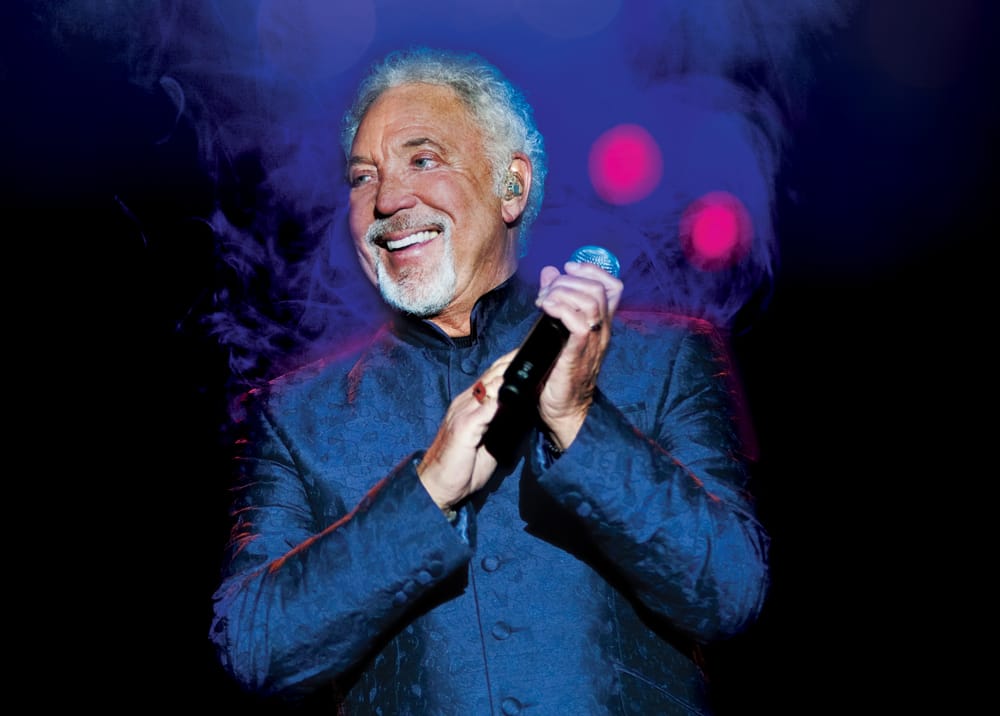
As part of their now-familiar "Kirk and Rob Doodle," bassist Robert Trujillo and guitarist Kirk Hammett paid tribute to Wales by performing a stripped-back version of Tom Jones' controversial hit"Delilah."
The crowd immediately joined in, filling the stadium with a song that has long been woven into Welsh sporting culture — and one that, just three years earlier, had been removed from official Welsh Rugby Union matchday choirs over concerns about its violent subject matter.
The song was banned in 2023.
Metallica's performance wasn't framed as an overt political statement. But it inevitably reopened one of live music's oldest and most complicated questions: What should we do with songs whose stories make us uncomfortable?
Let's talk about it.
Why "Delilah" Became So Controversial
For decades, "Delilah" has functioned as an unofficial anthem at Welsh rugby matches, with thousands of supporters belting out the chorus before kick-off. Yet the song's narrative has always been darker than many casual listeners remember.
Written in 1968, the lyrics tell the story of a man consumed by jealousy who ultimately kills his partner after discovering her infidelity. In 2023, the Welsh Rugby Union announced that official choirs would no longer perform the song at international matches, citing concerns that its depiction of violence against women was no longer appropriate for a modern sporting event.
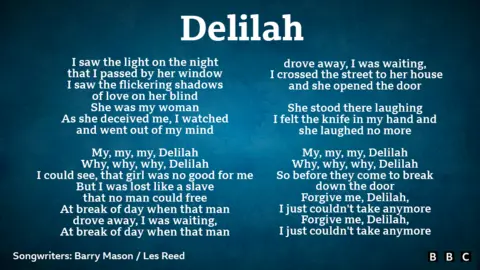
The decision came amid broader conversations in Wales surrounding misogyny, safeguarding, and cultural reform within rugby itself. For many, removing the song was a symbolic acknowledgment that traditions can — and sometimes should — change alongside society.
But while the WRU's choirs stopped singing "Delilah," the song never disappeared from the stands. Fans continued to sing it anyway. Metallica's keen comprehension of a city in conflict, and their inevitable performance last night, simply reminded everyone that the debate itself had never really ended.
+Read more: "The Stage Is a Microphone — Use It Like One"
Are Song Lyrics an Endorsement of Behavior?
The controversy surrounding "Delilah" points to a much larger question that extends far beyond rugby or Tom Jones. Should songs be judged solely by the actions described within their lyrics? And is it responsible or logical to take lyrics at face value, or must we allow them to exist as cautionary tales?
Popular music has always explored uncomfortable subjects.
- Murder ballads date back centuries.
- Country music is full of revenge narratives.
- Hip-Hop frequently adopts fictional personas and references to violent environments.
- Heavy metal embraces violence almost as metaphor, fantasy, and theatre.
- Opera has long revolved around jealousy, betrayal, abuse, and murder.
Very few listeners assume these works are instructions for living. They understand them as stories. Art has never existed solely to portray admirable behavior. Often, its greatest value comes from examining humanity at its worst.
Yet context also plays a role. And live music — even just live gatherings of people, such as in a sports event — can complicate the distinctions that keep stories at the center of an artistic experience. The tribalism of sports, unifying thousands of people for the sake of momentum to beat another team, can complicate those distinctions as well.
The Welsh fans filling Principality Stadium weren't celebrating domestic violence. They were participating in a tradition that has connected generations of supporters for decades. Yet, admittedly, in this environment, a song's lyrics are significantly removed from their original, intended context.
Communal singing often transforms the meaning of a song beyond its literal narrative. Audiences sing "Hey Jude" without thinking about its original inspiration. Fans happily shout along to songs about addiction, heartbreak, crime, and personal failure without interpreting those lyrics as endorsements.
That doesn't erase "Delilah's" uncomfortable story, nor should it. But it does remind us that live music creates meaning collectively. Songs evolve. Traditions develop. Audiences attach their own memories and identities to music in ways that often extend far beyond the words on the page.
Does Banning a Song End the Conversation?
It's reasonable that people disagree about whether "Delilah" belongs in a stadium singalong. What is harder to argue is that banning the song made the conversation disappear.
If anything, the opposite happened.
The WRU's decision prompted millions of people to revisit the lyrics, discuss the song's history, and ask broader questions about how we engage with difficult art. Those conversations continue today — three years later — precisely because the issue remains unresolved.
There is value in questioning long-standing traditions. But there is also value in allowing art to remain visible enough to be questioned in the first place. Removing a song from public performance may reduce its presence, but it can also remove one of the spaces where audiences collectively examine its meaning.
Metallica didn't settle the debate by performing "Delilah" in Cardiff. How could they? But if anything, the band demonstrated that live music has always been one of society's most important public forums — not because it offers easy answers, but because it gives us somewhere to wrestle with difficult ones together.
One Final Note
This didn't fit into the article's topic, but we'd be remiss without mentioning that last night, Metallica donated £20,000 to a local foodbank, helping to fund over 9,000 meals for people experiencing homelessness in Cardiff, just off ticket sales from their concert alone.
The donation was made on behalf of the bands' All Within My Hands foundation, which is dedicated to supporting workforce education, the fight against hunger, and other critical local services where the band tours.
+Read more: "The Top 10 Live Music Controversies of 2025"
Metallica 2026 Tour Dates
JUL 03 — London, United Kingdom @ London Stadium
JUL 05 — London, United Kingdom @ London Stadium
OCT 01 — Las Vegas, NV @ Sphere
OCT 03 — Las Vegas, NV @ Sphere
OCT 08 — Las Vegas, NV @ Sphere
OCT 10 — Las Vegas, NV @ Sphere
OCT 15 — Las Vegas, NV @ Sphere
OCT 17 — Las Vegas, NV @ Sphere
OCT 22 — Las Vegas, NV @ Sphere
OCT 24 — Las Vegas, NV @ Sphere
OCT 29 — Las Vegas, NV @ Sphere
OCT 31 — Las Vegas, NV @ Sphere
NOV 05 — Las Vegas, NV @ Sphere
NOV 07 — Las Vegas, NV @ Sphere
NOV 19 — Uncasville, CT @ Mohegan Sun Arena
NOV 21 — Uncasville, CT @ Mohegan Sun Arena
JAN 28 2027 — Las Vegas, NV @ Sphere
JAN 30 2027 — Las Vegas, NV @ Sphere
FEB 04 2027 — Las Vegas, NV @ Sphere
FEB 06 2027 — Las Vegas, NV @ Sphere
FEB 18 2027 — Las Vegas, NV @ Sphere
FEB 20 2027 — Las Vegas, NV @ Sphere
FEB 25 2027 — Las Vegas, NV @ Sphere
FEB 27 2027 — Las Vegas, NV @ Sphere
MAR 04 2027 — Las Vegas, NV @ Sphere
MAR 06 2027 — Las Vegas, NV @ Sphere
MAR 11 2027 — Las Vegas, NV @ Sphere
MAR 13 2027 — Las Vegas, NV @ Sphere