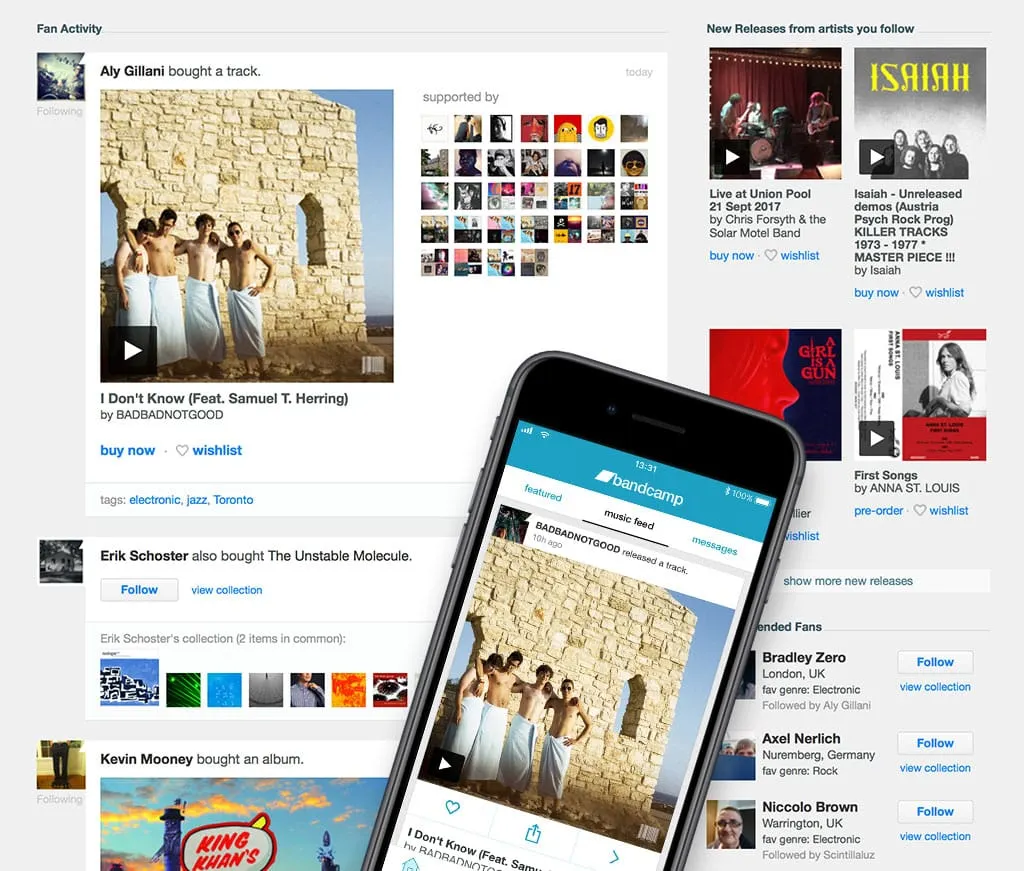
Last week Bandcamp engineer Drew Harris posted: "My 13 years at Bandcamp are coming to an end – I've been laid off along with most of the remaining engineers." The news sent shockwaves through the independent music community.
my 13 years at bandcamp are coming to an end - i’ve been laid off along with most of the remaining engineers. best job i’ve ever had, working with the best people you could ever work with. unceremonious end to quite a ride.
— drew (@grmnygrmny.bsky.social) June 29, 2026 at 12:25 PM
UPDATE: Bandcamp owner Songtradr confirmed the layoffs in a statement to Hypebot.
"We reorganized our Engineering department to improve our delivery capabilities. As part of this transition, 10 Bandcamp engineering roles were eliminated.
Our commitment to artists, fans and the quality of our work remains unchanged."
Why This Matters
For independent artists and labels, Bandcamp isn't just another platform.
While Spotify and other streamers pay artists a small fraction of revenue per play, Bandcamp facilitates direct to fan sales. Artists keep roughly 82% of revenue and up 93% on special Bandcamp Fridays. Since launch, Bandcamp has facilitated $1.2 billion in artist payouts.
Why Are Artists So Concerned
In 2022, Epic Games acquired Bandcamp. Less than two years later, in 2023, Epic sold it to Songtradr, a music licensing company. That acquisition immediately triggered a 50% staff cut. Now, many online fear that Songtradr is finishing the job.
It's unclear why Bandcamp is cutting staff. Other recent tech company layoffs have cited AI as creating new efficiencies, including in engineering. Bandcamp is also dealing with increased competition and a growing desire among artists to sell directly to fans via their own website, app, or superfan platform.
Bandcamp Alternatives
If you're thinking about making a move, there are a wide range of Bandcamp alternatives, each with their own strengths. Here are some of the more popular and promising.
Subvert https://www.subvert.fm/
We've written about this promising spiritual successor to Bandcamp. The worker-cooperative, artist-owned model supports merch, digital sales, and vinyl.
Sleeve https://sleeve.fm
0% platform fees, full artist website with email list. Free tier available; paid from $16/mo.
Single Music https://singlemusic.com
Integrates with Shopify, you own all fan data and are eligible for Billboard charts.
Ampwall https://ampwall.com
Musician-built platform where more revenue flows directly to artists.
Bandzoogle https://bandzoogle.com
Long-standing musician web site and marketing platform offers commission-free sales, EPK tools, merch stores, and email integration. $8.29–$16.62/mo.
CD Baby https://cdbaby.com
Distribution + direct-to-fan sales in one place. One-time setup fee.
Musicly
https://musicly.space
Strong live-show features and QR-code selling for touring artists
What Artists Should Do Now
It may not be time to panic, but there are four things you can do now short of jumping platforms.
- Backup your data — Download sales history and catalog before any issues arise.
- Capture emails — Use free tools like Bandsintown to capture fan data and build your own direct fan list. Don't rely on Bandcamp's discovery alone.
- Test alternatives — Find one or two platforms that match your release schedule and audience.
- Don't panic — Bandcamp still has search traffic and your sales history. Keep it while you diversify.
Hypebot's Bottom Line
While its too early to know the impact of changes at Bandcamp, the future of direct to fan sales will be more fragmented and potentially more equitable. More and more artists and labels are gravitating to multiple platforms where they can own their data and keep more revenue.
But that's also messier than having one trusted hub.
Bandcamp proved that fans will pay for music. Now dozens of platforms are rebuilding that model with different features and economics. With fewer engineers will Bandcamp be able to keep up?
The key is not to panic, but to strategically diversify.
Perhaps the platform that served everyone in 2015 can't serve everyone in 2026; and the alternatives are better than they've ever been.