


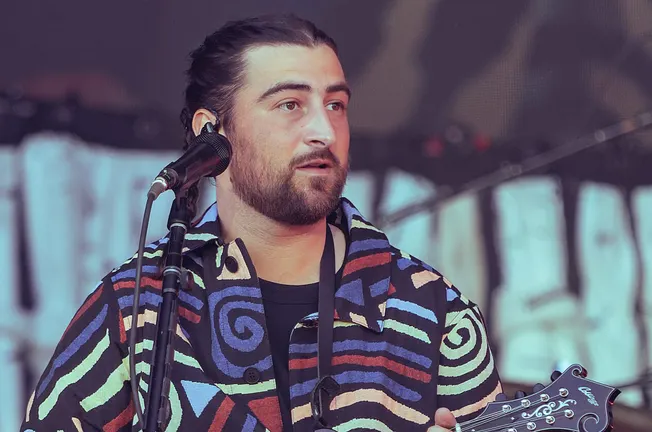
As popular as the Vermont singer-songwriter has become in the past couple years, there is still something so intriguing about the idea of Noah Kahan playing a football stadium. Let alone an entire tour of them.
His music is filled with small-town frustrations, homesickness, family tensions, and the complicated business of growing up. It's one of the reasons his work creates such a close, emotive identification together between him and his fans. And it's that small world sense of intimate storytelling, in the acoustic folk package he shares it, that befuddles the mind when I think of him playing to thousands on the gridiron.
Alas, among the 2027 stops are some of North America's largest sporting venues, including Levi's Stadium in California, Allegiant Stadium in Las Vegas, MetLife Stadium in New Jersey, and Boston's Fenway Park for four nights (he already sold out four consecutive shows there earlier this year).
But exactly how did music that feels so rooted in small places become capable of filling such enormous ones?
From Stick Season to "Stadium Season"
Kahan's commercial breakthrough arrived with 2022's Stick Season, an album steeped in the geography and psychology of New England. Its acoustic guitars, folk arrangements, and singalong choruses drew comparisons to Mumford & Sons and the Lumineers, but its appeal was rooted in something more particular.
Kahan wasn't simply writing about longing or heartbreak. He was writing about the places, people, and histories that shape our identities, often with a self-deprecating humor that made the heavier material easier to embrace.
Those songs found an audience far beyond Vermont.
His 2026 Great Divide World Tour has sold more than 1.8 million tickets worldwide, according to Pollstar. Two sold-out nights at Seattle's T-Mobile Park alone moved more than 91,000 tickets and generated $13.6 million. Earlier this summer, he drew 65,000 fans to the Rose Bowl in Pasadena.
These aren't the numbers of a niche folk revival. They're the numbers of a major stadium act brewing in the dark corners of the Billboard charts in real time.
+Read more: "From Piano Rock to Paper Airplanes: A Brief History of Ben Folds Live"
Making the personal feel enormous
Part of Kahan's appeal is how naturally his songwriting translates into a communal experience. His songs frequently begin with specific observations or private frustrations before building toward enormous, emotionally charged choruses. What sounds like an individual confession on a recording can become a collective declaration when tens of thousands of people sing it together.
His live performances also balance the seriousness of the material with humor and an approachable stage presence. That combination has helped him develop a concert experience that feels conversational, even as the venues grow considerably larger.
The production itself reinforces that sense of place. At a sold-out Philadelphia show in June, Kahan performed against a backdrop of a rustic house, moss-covered rocks, tall grasses, and an abandoned gas station. Changing seasons and imagery from his native Vermont appeared on enormous screens, effectively transporting more than 40,000 fans into the world of his songs.
In other words, the staging made Citizens Bank Park feel remarkably like a small-town backyard. His latest album, The Great Divide, takes that approach further, incorporating broader arrangements and heartland-rock influences without abandoning the regional detail that distinguishes his songwriting.
Kahan himself has acknowledged the record's live ambitions. In the album's promotional biography, he described the songs as:
“Custom-built for a live show.”
+Read more: "The Warning Keep Having to Prove They Belong. The Burden Is on Rock Music."
A bigger stage for folk-pop
Kahan's success also belongs to a broader movement of singer-songwriters whose commercial appeal challenges conventional ideas about stadium entertainment. Artists like Zach Bryan and Sam Fender have demonstrated that guitar-driven, emotionally direct songwriting can attract enormous audiences without relying on the elaborate pop spectacle traditionally associated with large-scale touring.
Their music differs in numerous ways, but they share an ability to turn highly specific personal experiences into something thousands of fans recognize as their own.
For independent artists, his trajectory puts forth an interesting lesson about scale. The elements that make a song feel distinctive — a regional identity, an unusual perspective, recognizable details, even an artist's particular sense of humor — don't necessarily have to be sacrificed in pursuit of a larger audience.
And in fact, these days, those qualities might be precisely what allows an artist to find one.


