

By Steve Giard, Co-Founder of SongTakes
Promoters, media outlets, and talent buyers receive tons of “cold-emails” from artists. Imagine opening your inbox in the morning and seeing a few hundred messages sitting there, most of which do not offer any real information needed to make a decision. Somewhere inside those links might be the band bio, a good photo, a few songs, maybe a press quote, maybe tour history.
But, the person reading the email has to actually go hunting for it. At that point, for them for skip to the next email.
It’s not that promoters don’t want to discover new music — most of them actually do — the problem is time, and they don't have a lot of it.
If you're an artist and you're taking someone's time without giving them what they're looking for, that might be the end of a conversation never started.
Okay, but what about social media?
Industry stakeholders want artists to believe all that matters is numbers (followers, likes, subscribes, reshares). It's why artists have a love/hate relationship with platforms like Instagram, TikTok, YouTube, and Spotify — artists don't mind making content for their fans, but when that relationship boils down to pure data, it irks them.
What's worse: the reality is that social media is not really designed to act as a professional artist portfolio or resume. These platforms are built for quick, short-term content and endless scrolling, not for presenting clear information. A promoter might see a few photos, some clips, a tour poster, but the important details are often scattered across different posts or hidden behind a few links.
Building a meaningful “artist portfolio” takes a bit more effort. It usually means writing a short bio, gathering professional press photos, organizing the best streaming links and presenting everything clearly so it can quickly be understood by talent buyers or media managers.

Other common mistakes artists make when presenting themselves online
We all pick up bad habits. As a guitarist who learned to play before YouTube existed (waiting for your song to play on the radio, recording it onto a cassette tape, and replaying it a million times until you figured out the chords and riffs... yeah, it was pretty rough), I am still trying to undo some of my worst guitar habits.
The same thing can happen on the business side. How you market yourself, promote your work, and build connections for your band can develop small habits that unintentionally create obstacles. They may seem harmless, but over time they can slowly undermine how you present yourself professionally. Here are some I've seen working with well-intentioned independent artists:
1) Trying to leverage every single platform known to humanity.
If someone reviewing a submission has to decide between seven different platforms just to hear your best track, that small moment of curiosity can disappear quickly.
2) Too short or way too long artist biographies.
Some bios are short and vague, offering nothing more than broad statements about creativity or genre boundaries. Others go on forever and start to sound more like a press release. Effective bios usually land somewhere in the middle and should cover what kind of music you make, notable accomplishments, and influences.
3) Visual representation.
Journalists and promoters need high quality, usable professional images when writing about you or advertising shows. If the only images available are on Instagram or Facebook, you are making it harder for people trying to feature you in a professional setting.
4) No contact information.
Surprisingly, this is common. Sometimes there is nothing at all, just relying on social media DMs, or an email address buried in the footer of the band’s website. A professional EPK should include clear contact information for the band manager, either an email address that is actively monitored or a contact form. Ideally both.
+Read more: "How Musicians Get Discovered in 2026: Case Study & Downloadable Checklist"
This is where an EPK comes in.
An EPK (or "Electronic Press Kit") does sound like an outdated industry document, but it really is sort of like a band's resume. And a good resume’s job is very simple: it helps the reader understand who you are and what you do without making them work for that information.
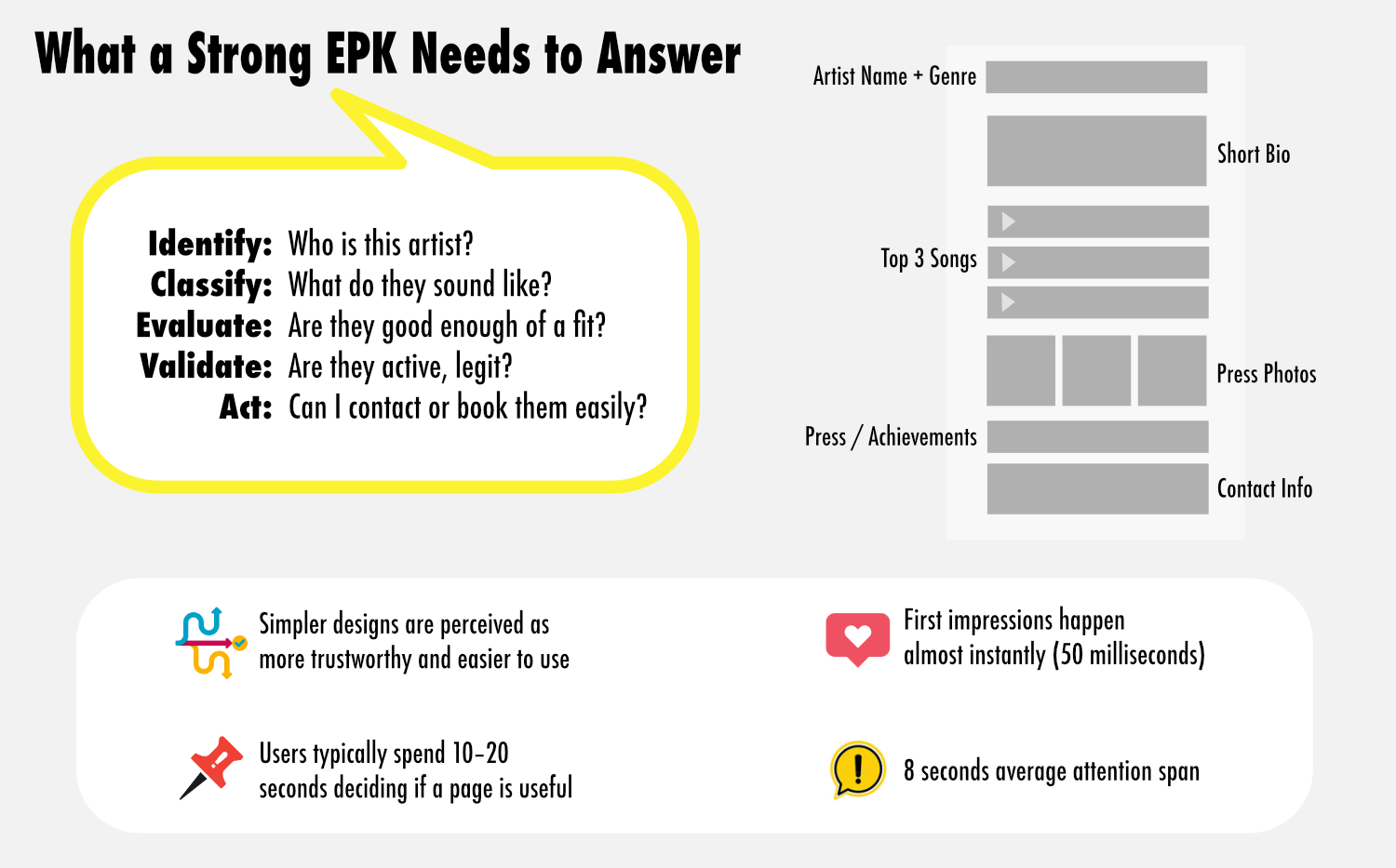
It helps answer questions like:
- What genre is this artist?
- Are they touring?
- What are their best songs?
- Where can I contact them?
Instead of sending someone down a rabbit hole of links, you’re presenting the information in a way that makes it easy for someone to quickly understand whether you might be a good fit for their venue, blog, playlist, or event.
It’s not about looking “corporate” or overly polished. It’s simply about respecting the time of the person reading your submission. And in a world where everyone’s inbox is already overloaded, making things easier for the person on the other side can make a surprisingly big difference.
👋 I'm here to help.
After years and years of working on various projects from IT, SAAS platforms to marketing and spending a lot of time around musicians (I grew up in a musical family too), I kept noticing the same pattern. Artists were putting crazy amounts of effort into writing, recording, and promoting their music, but the way they presented themselves online often made things harder than needed.
That’s what inspired me to build SongTakes. The goal wasn’t to create a better mouse-trap or another social media site for artists to chase followers only to be thrown away by algorithms. Instead I wanted to build a powerful “home base” for musicians to easily (and cheaply) build great band websites, proper EPKs and provide/receive feedback with other musicians who actually care about improving their craft. SongTakes continues to evolve to support the mission based on feedback from musicians.
More than anything, it's about musicians supporting each other.
So, what can I do now?
The saving grace in all of this is that you don't need an entire team or a huge budget to start improving your professional artist presentation online. The first step is simply to use what you've already got, and put together a simple EPK.
Start with a clear bio that introduces you or the band in a straightforward way, nothing fancy but talk about the music you make, list your best accomplishments and influences that would provide context for the music (RIYL - "Recommended If You Like"). It doesn’t need to be a 2,000-word essay.
Choose up to 3 songs, the best of the best. The songs that get the most attention and seem to “hook” people into getting interested about your music overall. Make sure the songs can be played easily without forcing the EPK reader to download or create accounts or log into anything.
If you do not already have this, get it done! Get high-quality photos and make it easily accessible to the EPK page where the reader can easily download or forward to their graphic design professional.
If only starting out, simplicity is usually the best practice. Your new EPK should be easy to scan and require almost no explanation. The reader should be able to open the page, press play and understand the essence of the band or artist within a few seconds. No friction!
One last thing to keep in mind
The modern music industry is shaped by algorithms, streaming platforms and social media trends (like it or not). Songs can spread quickly through short videos or playlist placements without traditional gatekeepers (albeit there are still gatekeepers, do not get me wrong).
But at the same time, many parts of the industry still rely on individual decisions made by real people.
The quality of your music will always be an important determining factor (an EPK won’t make artists more talented), but a decent presentation helps convince new contacts that you take yourself seriously. And when a journalist or talent buyer needs to decide between two artists, whether for coverage or an opportunity, clarity, professionality, and ease might end up making the decision.
Steve Giard is a co-founder of SongTakes.com and has spent over 20 years working in technology and marketing. Building powerful solutions across various industries such as banking, construction and gaming/education. As a musician himself who grew up in Montreal and now resides in Calgary, Canada, Steve is a passionate individual when it comes to music and building solutions.