

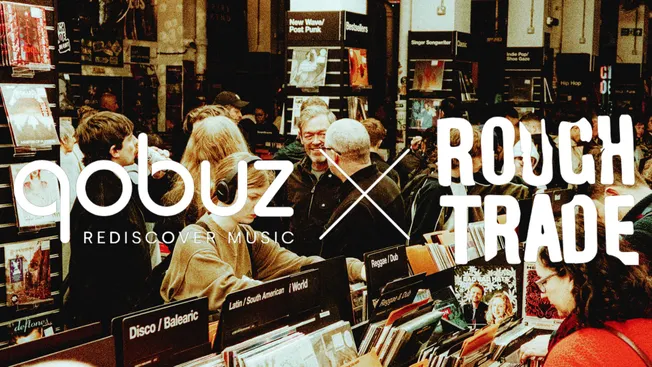
At a moment when much of streaming is racing toward algorithmic convenience, Qobuz and Rough Trade are moving in the opposite direction.
The two companies announced a new global partnership this week that will make Qobuz the official streaming service across all Rough Trade stores worldwide through 2028. The collaboration will span physical retail, online music sales, live performances, subscriber perks, and in-store listening experiences across Rough Trade locations in the US, UK, and Germany.
Both brands have built their reputations around a similar philosophy: music discovery should feel intentional, human, and deeply connected to community — not just optimized for passive consumption. That alignment is all over the announcement. The companies repeatedly emphasize curation over algorithms, independence over scale, and artist-focused discovery over frictionless background listening.
As part of the deal, Qobuz downloads will become available directly through Rough Trade’s retail ecosystem, while the companies also plan to collaborate on live in-store events and performances tied to Rough Trade’s 50th anniversary celebrations.
For Qobuz, the partnership continues its positioning as the streaming service for listeners who still treat music as something to actively engage with rather than simply absorb. The platform has increasingly differentiated itself through high payout messaging, editorial curation, and audiophile-quality streaming.
Rough Trade, meanwhile, remains one of the world’s most recognizable independent music retail brands precisely because it never fully abandoned the idea that taste — and the people shaping it — matters.
+Read more: "Why I Built a Music Discovery Platform That Finds, Not Buries, Niche Artists"
The “human curation” era might actually be coming back this time
For years, the dominant story in music tech was that algorithms would eventually replace most forms of editorial discovery. Recommendation engines became the storefront. Playlists became the radio station.
But there’s growing evidence that listeners are becoming fatigued by frictionless sameness.
Independent record stores survived because they offered something streaming often struggles to replicate: context, personality, scenes, and trust. A recommendation from a store employee, a hand-picked listening wall, a weird local in-store performance — those things create emotional texture around music.
That texture is increasingly valuable.
The interesting thing about this partnership is that it doesn’t treat physical retail and streaming as opposites. Instead, it imagines them as part of the same ecosystem: streaming that leads to community, stores that extend into digital listening, discovery that moves fluidly between online and offline spaces.
Why this matters for independent artists
Independent artists tend to thrive in ecosystems where curation still carries weight. When discovery is purely algorithmic, emerging artists often compete directly against volume: more uploads, more content, more optimization.
But in environments built around trusted recommendation and community identity, smaller artists can break through because someone believes in them enough to actively champion them.
That’s historically what independent record stores did. It’s also what many streaming services slowly stopped doing. By linking a streaming platform directly to one of the most influential indie retail brands in music history, Qobuz and Rough Trade are effectively arguing that human recommendation still has commercial and cultural value.
And honestly, they may be right.
+Read more: "Why I Truly Believe Artistry Beats the Algorithm, Every Time."