

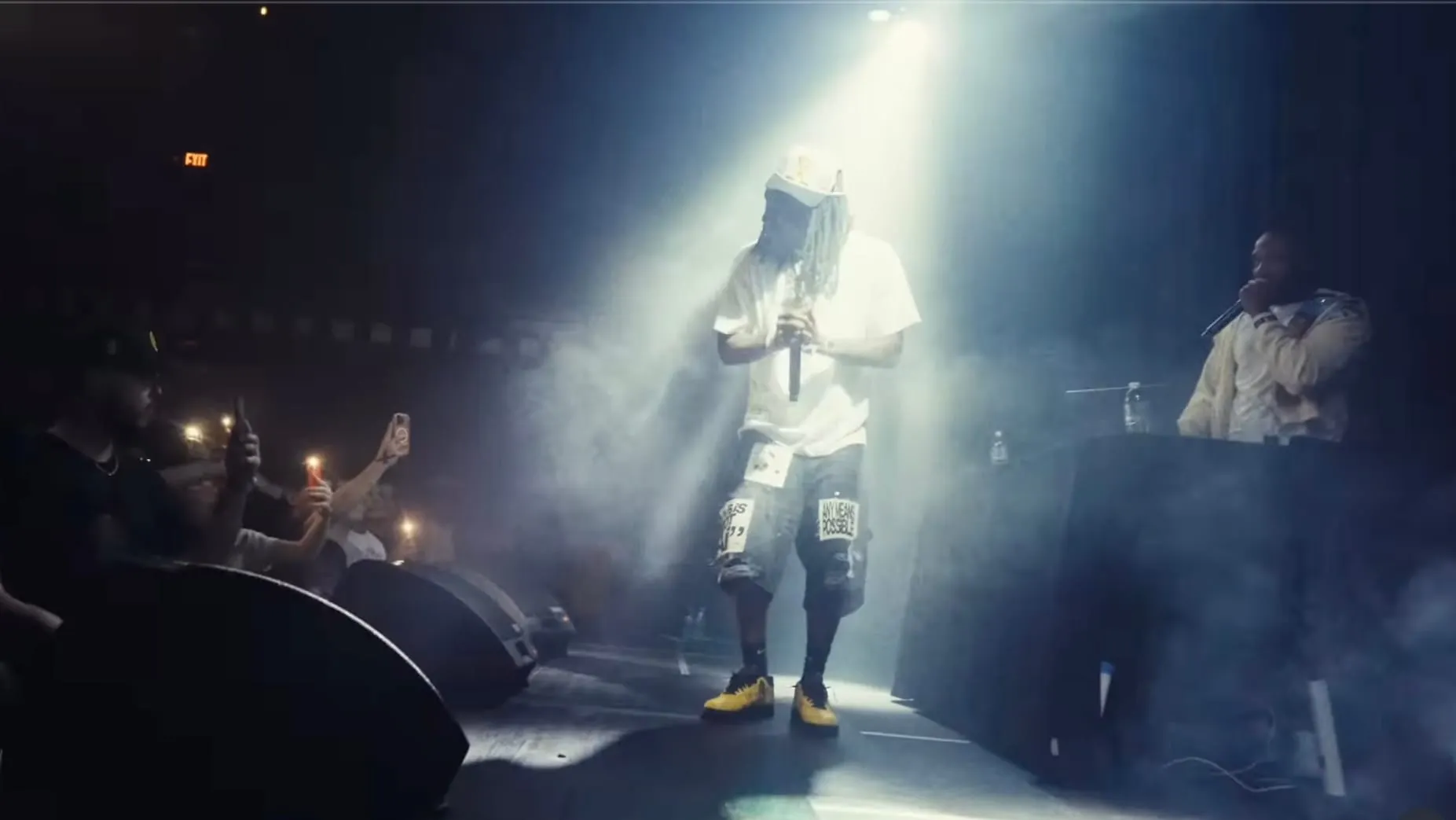
Texas rapper Ro$ama has progressed from performing for almost nobody to appearing at Rolling Loud and on The Tonight Show. His live education happened the old-fashioned way: one city, one crowd, and one opening slot at a time.
The thing people tend to know about Ro$ama is that he was famously fired from his FedEx job after filming a music video while at work there. Fortunately, the video went viral.
That origin story has the tidy shape of an overnight-success myth, but what happened afterward was much less instantaneous. The Paris, Texas, native released a steady run of music, performed wherever he could, and built an audience the grassroots way city by city. He eventually mounted a five-date Texas tour around his 2025 project Orange Tape, and started touring on its acclaim.
But that's when things really started to click. In an interview with Pollstar, Ro$ama detailed how he is still learning how to perform — and he is doing it by watching his friends.
The Road Is Where Ro$ama Studies
Ro$ama’s education came from watching the artists above him on the bill. While touring with artists like Key Glock and Kevin Gates, Ro$ama paid close attention to the way his fellow, more seasoned, rap artists moved and controlled a room from the live stage.
He borrowed a slow backward walk from Glock. From Gates, he picked up a movement that begins with jumping to the beat before suddenly exploding outward. Ro$ama experimented with those gestures, adapted them and folded them into his own performance language.
Great performers are often discussed as though they emerged fully formed, naturally possessing the ability to command thousands of people. Ro$ama talks about stagecraft more like a trade. You watch somebody who is better than you. You identify what works. You practice it. Eventually, the borrowed move stops looking borrowed.
You own it.
That is what touring has traditionally offered developing artists: an informal apprenticeship. An opener can watch the headliner handle soundcheck, recover from a quiet crowd, create anticipation, and decide when to let the audience take over a chorus.
The lesson repeats in a different room every night. No online tutorial can completely reproduce the moment when a technique works (or fails) in front of actual bodies.
+Read more: "Why Rod Wave's Fans Sing His Songs For Him"
Between Patience and Impact
Ro$ama’s emerging live identity appears to be built around contrast. The slow walk creates control, letting him occupy the stage without constantly scrambling across it. The more explosive movements do the opposite, turning the beat drop into a physical catharsis.
One establishes tension; the other releases it. This dichotomy has always been a crucial element of live performance, but in his case, it's embodied. And that combination fits Ro$ama’s music particularly well.
His songs are generally compact, bass-heavy and direct. The seven-track Orange Tape runs only 17 minutes, moving quickly through records like “Blueprint,” “Ight,” “Shit Popper” and “Bump Down.” Its most-streamed moments include the BigXthaPlug collaboration “Microwave,” while “Show Me the Money” brings in fellow Texas rapper That Mexican OT.
The production hits hard, but Ro$ama does not simply throw words on top of it. His delivery is forceful and rhythmically alert, with enough variation in pace and emphasis to give a performer something to work with. The tracks feel less like static recordings than compact packages of momentum.
That is intentional. Ro$ama thinks about the live show while he is still making a song: where he will breathe, how the beat will feel in the room and whether the audience should bounce or open a pit.
Plenty of artists write a record and only later ask how to reproduce it onstage. Ro$ama is building performance cues into the architecture. In this way, his shows do not rely on elaborate scenery or theatrical reinvention (at least not yet). Their appeal is physical and immediate: a heavy beat, a tightly constructed vocal, a rapper learning exactly when to stay still and when to detonate.
The Audience Gets to Watch
Ro$ama’s Orange Tape Tour had another practical purpose. Some listeners recognized songs connected to BigXthaPlug and 600 Entertainment without necessarily recognizing Ro$ama himself. Touring Texas allowed him to put a face (and a live personality) to the music.
We live in an era when a stream can make a song familiar without creating much attachment to the person who made it. A live show ties that knot.
It gives fans a voice, body and memory to associate with the record. It also gives the artist immediate information that streaming data cannot: which line people yell back, which song changes the temperature and which supposedly exciting moment leaves the room cold.
Ro$ama has already taken that feedback from tiny rooms to Rolling Loud’s enormous crowd. Yet he still talks like a developing performer. After appearing on Fallon, he came away curious about learning to perform with a live band rather than treating national television as proof that he had mastered the job.
The appeal of seeing one of his performances now is not that Ro$ama has arrived at some flawless final version of his show, it's that the show is visibly evolving. Every tour adds another technique. Every crowd teaches him something about the songs. Every larger stage tests whether the instincts developed in smaller Texas rooms can scale.
Ro$ama is using the road as his classroom — and audiences get to watch the lessons turn into a live performer in real time.