Not long ago, I was walking my dog, earbuds in, catching up on a favorite podcast. Suddenly, the hosts started talking about something on screen, and I had no idea what they were referencing. That little disconnect made me think: uh-oh, podcasts aren’t just audio anymore.
Very quietly but largely across the board, podcasts have evolved from an audio-first medium to video-first presentation. Even in 2023, in a Pew Research Center study, half of top-rated podcasts now have a video component. And Spotify says the number of creators publishing video has grown 70% year over year.
Why have podcasters made the move?
1) Audience Growth
For starters, video grows an audience so much faster and more effectively than whatever “traditional” podcast advertising or discovery tools are available to audio podcasts. Take Instagram for example, reels have a reach rate of 30.81%, which more than 2x higher than carousels, image posts, and stories there. To put it in caveman terms:
Video good for growth; audio great for intimacy.
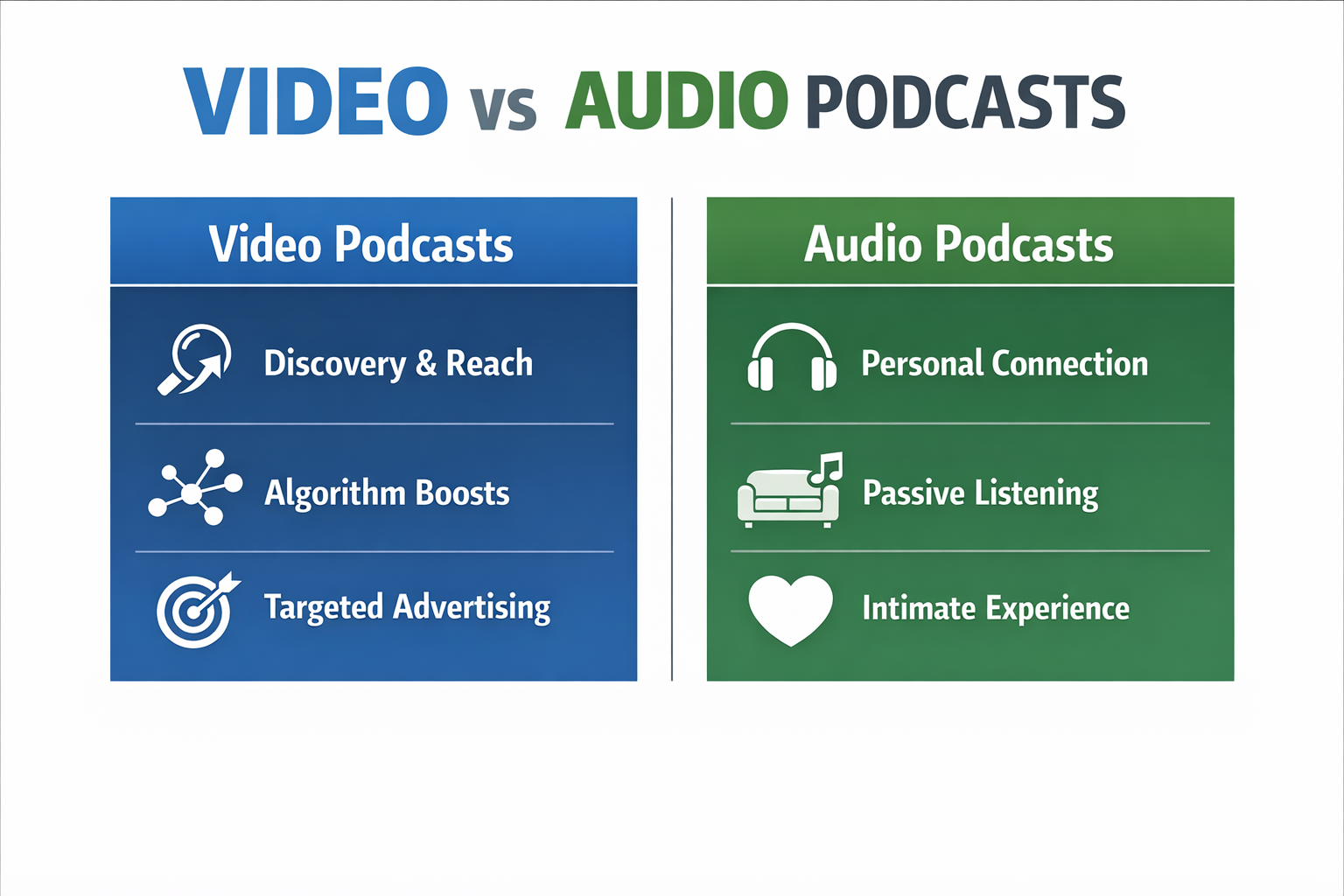
Advice for Creators: Try adding a simple video element on some platform. Track which platforms bring in new listeners and double down where engagement is highest.
2) Advertising Revenue
Ads are also more effective on video, and YouTube in particular. One commonly cited statistic claims viewers retain 95% of a message when watching video compared to about 10% when reading text. Even if that figure is inflated, it still points to the basic advantage video has for messaging.
Additionally, YouTube’s demographic targeting ability is much more sophisticated compared to traditional podcast ad networks, their analytics provide the most valuable information, and when it comes to clicking on an ad YouTube is closer to internet responsiveness than old-school television. The platform makes it easy for podcasts to get advertisers, too. When a show clicks on a box in their YouTube setup, they are pretty much immediately all set to monetize their show.
And if an episode or a clip goes viral, the return can be game-changing. Say most creators can very conservatively get somewhere between $1 and $6 of revenue per thousand views (maybe more), 1 million views can get YouTubers to $5,000 or $10,000 very quickly. Yes, there are advertiser networks for audio only podcasts, but they still take a lot of effort and a significantly less turnkey than YouTube.
Advice for Creators: Start by clipping your podcast intro or top moment for Shorts — monetization activates automatically on YouTube if eligible.
"The podcasting boom of the audio era celebrated "everyone having a voice" — the barrier to entry of self-expression was pretty low 15 years ago. Now, the video era may raise the bar on production, but it narrows the field of who can realistically start and sustain a show."
3) Discoverability & Algorithms
Discoverability and growth are other advantages of video. While attention spans shorten, content literally gets more digested for the “TL;DR” generation. And this oft-cited statistic is startling: Videos get 1,200% more shares than text and images combined — again, even if that figure is inflated by 200% it still makes one sit up and take notice about the power of video.
Google has been a dominant force in both organic and paid search for a long time. Since they bought YouTube years ago, the amount of Google results directing users to video and YouTube is starting to dwarf good old-fashioned text and link search results in many categories. Gee, I wonder what motivation Google would have to push people to YouTube?
Even if a creator is making an audio-only podcast, he or she needs to make some video content anyway just to keep up with basic promotion on YouTube Shorts, TikTok, Instagram and other social media.
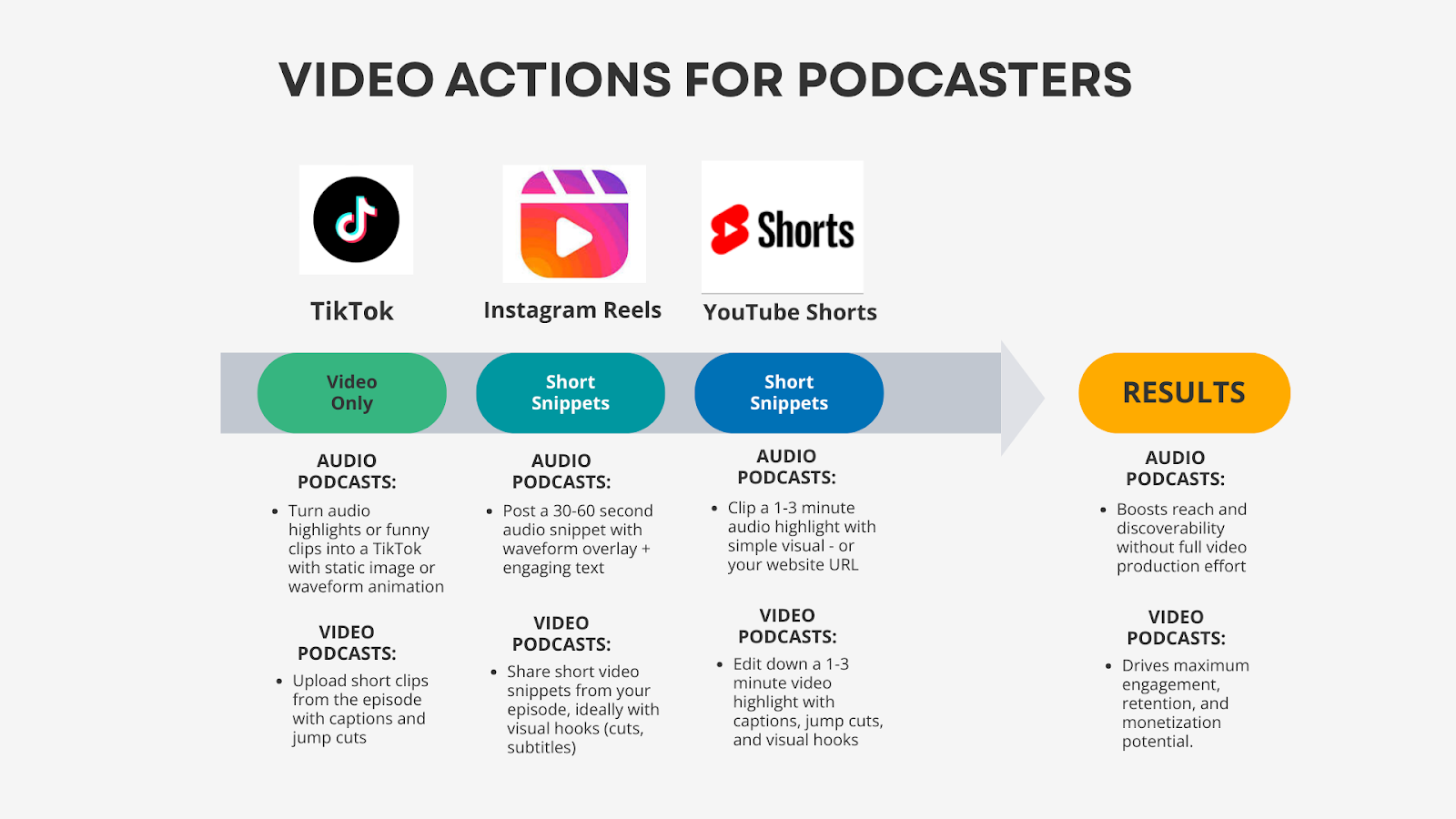
Let’s look at the percentage of people who consume podcasts on YouTube. Even according to this Edison Research study two years ago in 2024, 31% of "weekly podcast listeners over 13” choose YouTube as their listening service. (I don’t notice a ton of 7-year-olds listening to Freakonomics or The Moth, so that distinction is a little amusing.)
If a music artist is releasing music, they would never try to distribute their songs to stream on Apple and Amazon but not Spotify. Not releasing content on a major distribution service hobbles a show’s potential from the get-go. Podcasting is the same.
Technology and video can help growth, but the basics still matter: great content, and consistent release schedules. As Marc Maron has often said about his podcast, "never missing a deadline" was key to WTF’s long-term success. All of that is marketing. Strangely enough for aspiring podcasters, there is a lot of noise out there for promotion – but surprisingly little actionable advice for the more important part of making a podcast: production.
Advice for Creators: Optimize titles, captions, and hashtags so new viewers can find your content organically.
+Read more: "The Wikipedia Trap: Why You Don’t Own Your Story (And How to Fix It Anyway)"
Production: Audio vs. Video
As relentless as a weekly podcast schedule can be for smaller podcasters, adding video to the mix raises the stakes for shows that are barely making money to begin with. For these creators, moving to video is pushing your chips all in when you’ve got the smallest pile at the table.
The true cost of video podcasting (as opposed to audio-only) is a lot more than equipment. Yes, somebody can start an audio podcast for maybe $300, while at least $3000 is often needed for an entry-level video setup.
But the more prohibitive cost is time. Let’s say a two-person 30-minute podcast needs about 8-10 hours of attention per episode for many independent creators. Consider this typical workflow:
- Research
- Writing
- Guest coordination
- Recording
- Editing
- Release notes
- Distribution
- Promotion
That's 8-to-10 hours easy.
Now, make that same podcast a video podcast.
- A couple of new aspects such as getting camera ready (seems frivolous but that is real)
- I think it’s fair that video doubles post-production editing time, in my experience.
- Zoom recordings do cut back and forth to current speakers if you go with cheap ones, but a well-produced show takes time.
- AI tools can help streamline editing, camera cuts, and audio clean-up – if well used, then in ways listeners won’t notice. But this AI assistance only goes so far.
Budget Tip for Creators: If camera setup is too expensive, start with Zoom recording and royalty-free b-roll to keep costs low to make video.
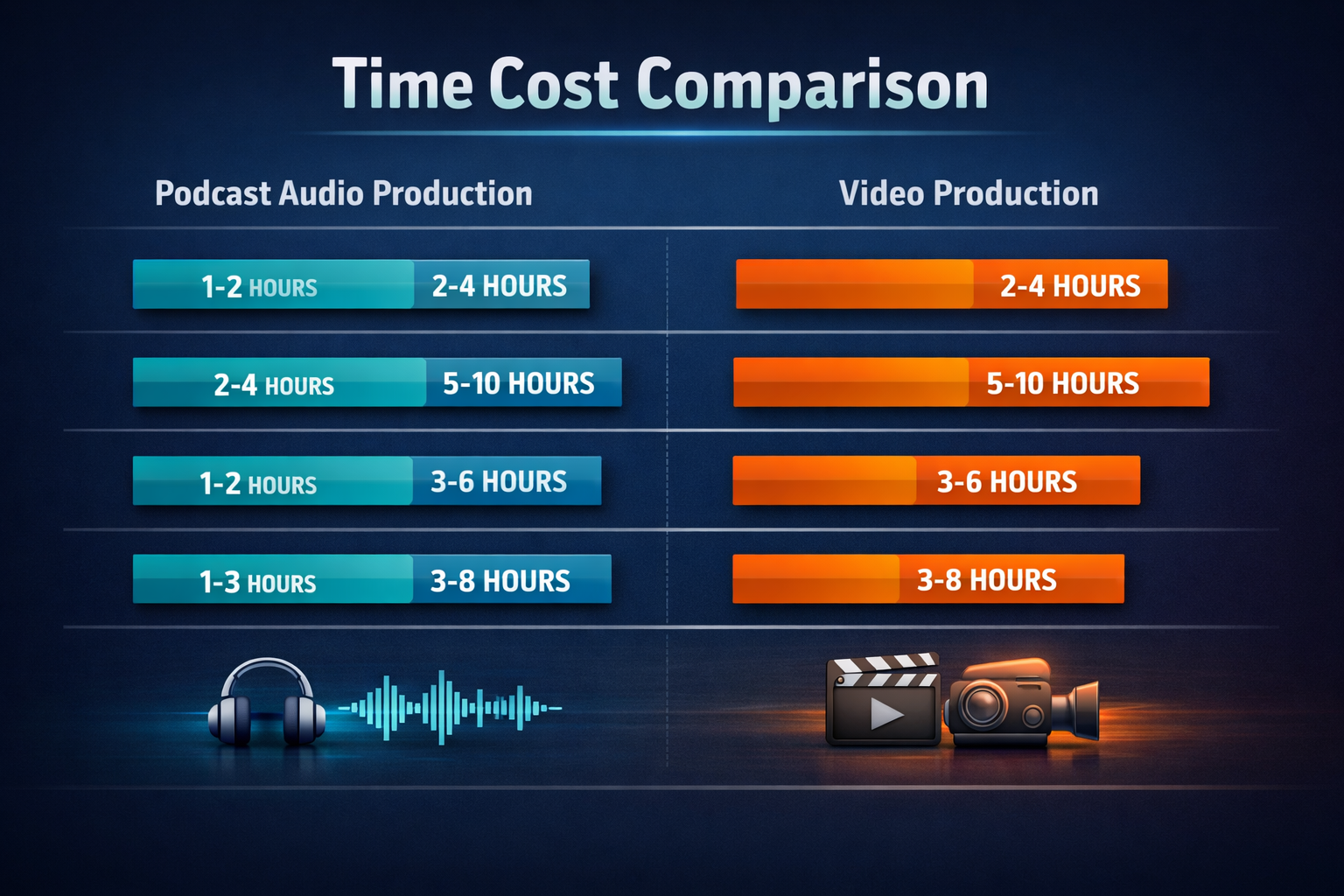
Every recorded interview, even ones just transcribed for print interviews need basic massaging to remove the “likes”, “you knows” and “umms” at the very least. That can be a lot of work but very do-able on audio podcasts. Editing that in video is exponentially harder. Then once you’re editing out what’s incorrect, boring, awkward or things that just plain don’t work, this is a lot of editing.
Video editing introduces new challenges like jump cuts; careful camera work or multiple angles can hide them. It’s a good fix – but it now turns a podcaster into a film editor, which is a new skill set to develop.
The podcasting boom of the audio era celebrated "everyone having a voice" — the barrier to entry of self-expression was pretty low 15 years ago. Now, the video era may raise the bar on production, but it narrows the field of who can realistically start and sustain a show.
And most of the podcasts we all listen to have decent sized production teams or are part of some podcast syndicates or production companies. The creator who wants to get their word out there still can – but it’s harder to compete with the higher production value or be audio only.
"Going to video, there’s a subtle structural change that happens when cameras are introduced; a podcast shifts from a conversation towards more of a performance."
A Conversation About Conversation
Let’s face it; podcasting is basically just a couple of people talking to each other — which turned out to be hugely popular as the importance of podcasts continues to rise. Going to video, there’s a subtle structural change that happens when cameras are introduced; a podcast shifts from a conversation towards more of a performance.
One odd personal anecdote: I’ve always listened to podcasts while falling asleep. More than once I’ve woken up remembering dreams where I was on a talk show and frustrated because I never got a chance to speak. That’s a silly true story, but there really is an audio intimacy effect when one just listens to a podcast.
On video, the consumer becomes somebody watching a show. And as good as some video podcast production is getting, the consumer is now watching a relatively boring and poorly-directed show compared to other professional television.
To Video Or Not to Video?
If you have a podcast, can you survive as still audio-only? Or rather, do you want to?
Every creator out there wants to be heard, so the lure of video promising more new viewers or listeners is very hard to resist. Just make sure not to water down the quality of your conversations for the sake of a great looking clip moment. You started a podcast for a reason; stay true to yourself.
The idea of having to choose between growth and identity is a false one. You can do both. If you make the leap to video, keep your eyes on the prize and keep the audio-forward intimacy.
Takeaways for Creators
- Invest time in making at least short video clips for social promotion.
- Maintain consistent release schedules - content quality still matters most. This is the unbreakable rule: do not miss a release.
- Consider AI tools for editing efficiency. You handle the interesting content and creativity, but let AI handle the grunt work like time-coding and transcribing what you have, making simple video scripts, etc.
- Don’t sacrifice audio intimacy even when going video-first. While making a video, make sure to think: “Does this also work for audio-only listeners?”
Charlie Recksieck is a musician, composer, and writer-for-hire focused on music, culture, and the realities of today’s creative economy. As a songwriter, he’s been called “the stupid man’s Randy Newman,” which he considers a fair warning label. Check out Charlie's music at The Bigfellas.