

Softside Merch is a company that everyone can get behind.
They empower artists with an opportunity to connect deeper with their most loyal, actively engaged fans, offer designers and creators the ability to work with their favorite artists and create with impact, and for both parties to collaborate on something original and earn money from it. And the platform takes care of the icky stuff around IP and licensing, streamlining the process so everyone is happy and nobody's getting screwed.
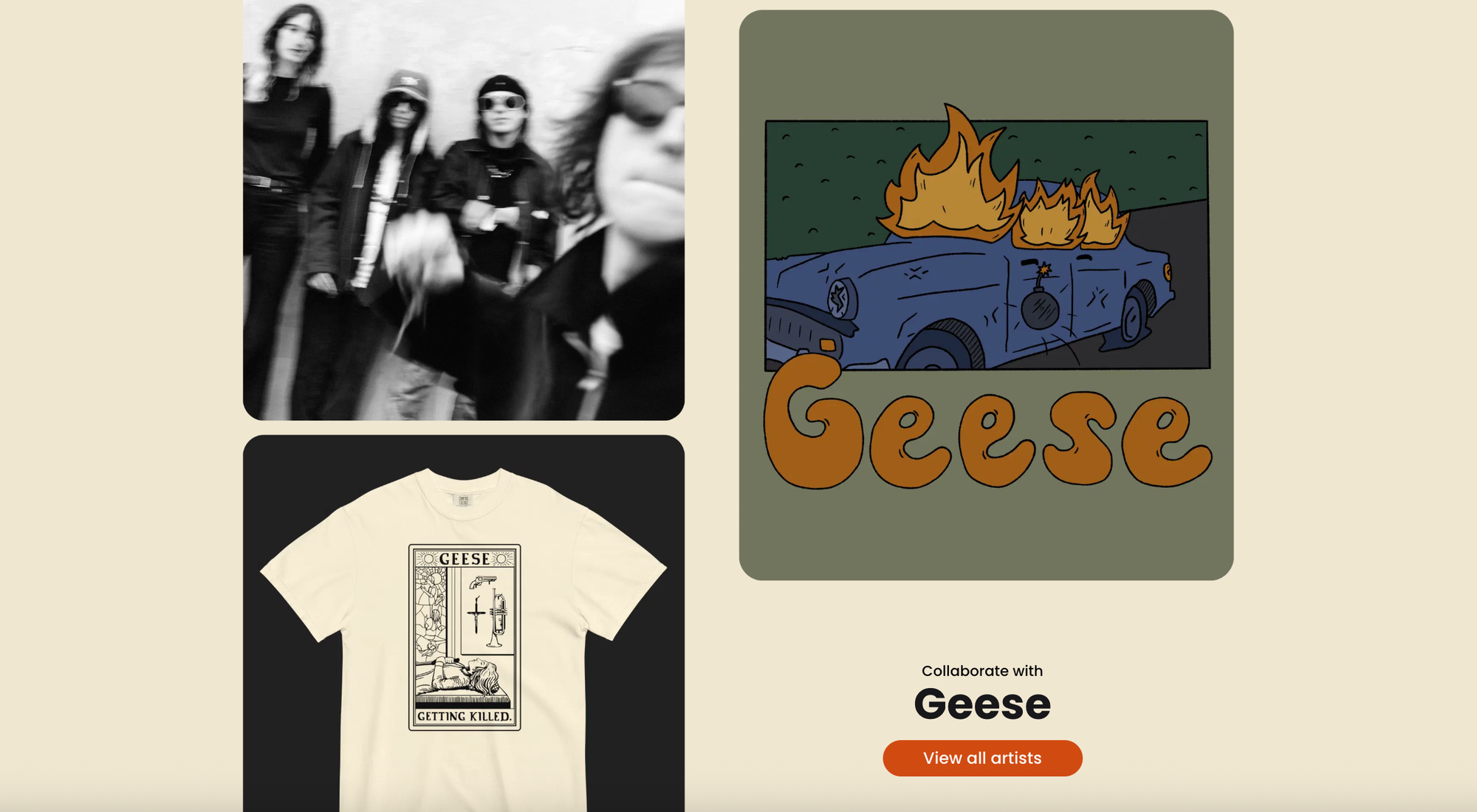
After a few brief email exchanges, I sat down with the founder and CEO, Erin Singleton, knowing we'd share a lot of music tastes, obsessions with live concerts, and fun stories around band merch. Erin is based in Brooklyn, New York. Having just signed rising artists like Geese, Black Country, New Road, and August Ponthier, Softside is definitely on the up and up.
Here's our conversation.
Hypebot: Hey Erin, thanks so much for doing this. How's it going?
Erin: "I'm great. Can you hear me okay? I just realized my dishwasher is running a few yards away, and I just wanted to make sure I'm not ruining the audio for you. I'm ready to chit-chat!"
H: Haha I can hear you fine. So why don't you introduce us to Softside Merch?
E: "Softside connects music artists with their creative fan communities through licensed fan merchandise. In simpler terms, everything we sell is fan-designed and artist approved. We've been doing it for a couple of years, we're currently in Beta, but we're open to fans worldwide and anyone can request to collaborate with music artists.
And we ensure that everything that they're selling is done correctly; because previously, fans would sell merch on Etsy or Redbubble or TikTok, and have their stores taken down due to licensing and trademark issues. So, we've made that process easier, and you know, happier, for both bands and fans."
"I would go onto Etsy and see these huge pop artist fans making merch and selling tens of thousands of units, and it would turn out to be just like some 16-year-old girl with a shop."
H: How did the idea for Softside come about?
E: "I had worked at a major talent agency, where I was booking a lot of shows for a lot of artists, and I would go to concerts every week. Often I would see fans in the crowds of our clients' concerts wearing t-shirts that would have the band name, but wasn't "official" band merch. Which is like, great, and bootleg merch has obviously been around for a while. But working on the inside, I also know that if those fans ever wanted to sell that stuff it would come under some serious licensing scrutiny, which was a bummer."
Even me, I used to make my own merch going to Jonah's Brothers concerts when I was 12. It's one of those things that once you see it, you can't unsee it, and it's everywhere. I would go onto Etsy and see these huge pop artist fans making merch and selling tens of thousands of units, and it would turn out to be just like some 16-year-old girl with a shop."
Around 2024-25 though, things started to shift because fans have now become so business savvy; everyone has a shop, there's drop-shipping and print-on-demand, the e-commerce boom after the pandemic — the ecosystem has changed, content and merch has really exploded."
H: I love this because it's such a truly mutually beneficial opportunity, for the artist who gets a chance to connect on a deeper level with their fan communities, and for designers looking to expand their portfolios (and earn a buck!).
E: "Absolutely. There are a few different things we think about every day. Firstly that empowering fans is always a winning strategy for artists. And sometimes this merch is just arguably better than their official merch."
We also don't look to compete with official merch. We do have some artists who have brought their official merch to us as well, because they just don't have the resources to sell their own merch and be conducting their creative business at the same time."
On the creator side, when we've talked to our users — fans, designers, creatives — the biggest thing they've said to us is that they want to do things the correct way, they just don't know how.So it feels like a win-win for both parties."
H: You’ve already signed some massive artists, many of whom are on the rise, like Geese, Black Country New Road, and Pom Pom Squad. How has the process been to lock these artists in so far?
E: "Totally! And their fans have been great too! Mostly there's just been such a great mutual trust within those bands' communities, where fans know what they want to be buying and the band acknowledges that freedom. In the past when I've worked with some artists — on the other side of the industry and touring — so much of what you'd see at the merch stand would just be like, the the classic black tee, you know?"
H: Haha, black band t-shirt: always a staple...
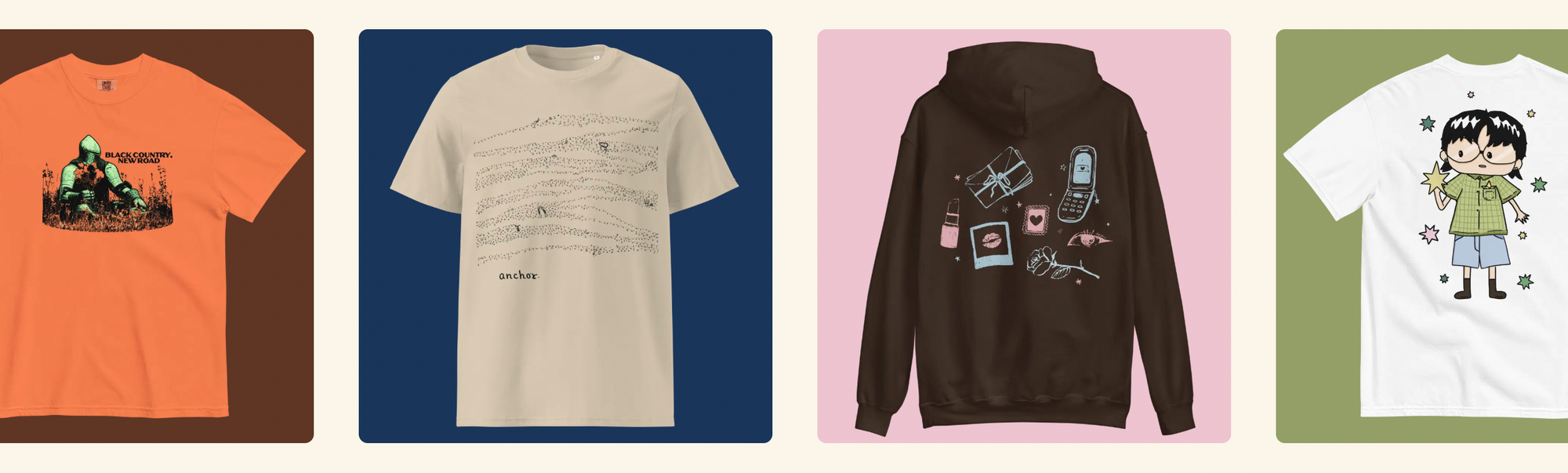
E: "Haha, well for good reason! I think people like having that classic band shirt, it connects folks. But for sure there's always a space for individuality. Black Country New Road released with us this bright orange t-shirt with a funky design, and it's doing so well right now; fans love it. So there's a real opportunity to create more art-forward merchandise that's not just a logo."
I also wear a lot of band merch to bed if it just doesn't feel like something I want to wear in public. But we're trying to make space for something that you actually do want to bring out into the light of day."
"Fan engagement is so much more active and participatory. They're looking for co-creation opportunities and for recognition... It's more about discovery, fan-to-fan exploring, and artist empowerment."
H: Why does this model work now in 2026 for both fans and artists?
E: "It's interesting because 'fan design contests' are also nothing new. Bands have been doing that kind of thing forever, but what has changed is that this is no longer being viewed as a one-and-done strategy, but a long-term development and collaboration plan. We've had artists drop merch with us 2 or 3 times, already! You can go through designs every month and empower so many of your fans, or you can do it a few times per year more strategically."
I also think fans are more industrious now, and fan engagement is so much more active and participatory. They're looking for co-creation opportunities and for recognition. Fan-designed artwork is also more nuanced than ever before. That's led us to build something different than a standard e-commerce marketplace. It's more about discovery, fan-to-fan exploring, and artist empowerment."
H: I totally agree. I think band communication used to be so much more one-directional: 'We make the records, you buy the records and you buy the tickets.' Now, with TikTok and the creator economy there's just more acceptance of a transference of creativity between parties.
E: "Yeah, it's their own perspective. We also try to advise artists when we bring them on, not to approve merch that already looks like their existing merch. That's just not what this is. So it might be a little different than your usual merch, because that's how fans interpret your music."
We actually refer to users on the platform as creators. Whether they're freelance graphic designers or students, or people who are very interested in blurring the space between design and music, you never know whose work will be selected by the artists, so it's pretty exciting. There's definitely a spectrum in fandom, let alone creativity, and we're trying to be mindful of that as well as we build."
H: So how does the platform actually work?
E: "When a creator joins our platform, they can create a portfolio and upload examples of past artwork. Whether or not it's related to merch design, it can just be that they're a painter and they want to upload examples of artwork they've made. They add a bio, pronouns, information, etc. and then their portfolio can be sent to artists on Softside in order to be commissioned for a design. That's one option, usually meant for busier, pro designers who don't want to spend 12 hours on something to submit and then have it rejected by the artist."
The other option is a traditional merch builder. Creators can download approved IP that the music artist has licensed, adding logos or typefaces, and then creating their own merch designs to be submitted."
From the music artist's side, when they log in they'll see a submission queue where they can approve, make edit requests and message creators, etc. The whole collaboration process on Softside includes IP transfer agreements — a very easy one-page document that states, in very plain English, that if you're approved, you're transferring the copyright to the music artist, but it stays in Softside and you get compensated X amount."
"Give the people what they want."
H: Does Softside suggest flat fees or only royalty splits?
E: "We have a minimum of 15% to protect the creator, and we are all print-on-demand, so there's never an upfront inventory purchase. We also don't have minimum order numbers, which means all parties get paid out on every sale. And we pay out weekly."
And although 15% is the minimum, we've seen artists go much higher. Geese, for example, went to 25% for their fans, and that comes out of their artist share, so they have a toggle where they can decide on how much they want to give to their fans. Capitol Hill Block Party Festival went as high as 40%."
H: Thanks for sharing that info. And you're in Beta right now, which I don't really think anyone really knows what that means...
E: " That's the beauty of it, haha! Yeah so what that means for us is that we're still automating things and working out expanded back-end functions to plan for scaling. Because at this point, 85% of Softside can run on its own with little to no human input from our team, but we need to close that gap from end-to-end. And at the moment we're signing artists every month and trying to get as much feedback on the platform as possible."
H: Besides your homemade Jonas Brothers merch, what's one piece of artist merch that is personally meaningful to you?
E: "I actually went to a CHANEL TRES show in Brooklyn in, oh gosh, 2019 or 2021? It was in this 200-cap room before he kind of blew up, and it was awesome. He was selling some merch in the back, and he had these thick t-shirts, where the typeface was almost as if someone stamped it on, like it looked wrong. There was no name anywhere. We're used to seeing an artist's face or name all over this stuff. But for him, at the time you would assume he'd want his name on it, but no."
I fell in love with it, bought it, and to this day, I still wear it. I get stopped all the time: that's such a cool shirt, where'd you get it? This was a very memorable merch experience, good quality, and I still get compliments on it."
H: On that note what was one of the most truly great live shows you saw recently?
E: "I actually saw Whitney open up for Camp. Camp is phenomenal (*my dad's the world's biggest fan), but I've been a Whitney fan for a long time and had never seen them live, so I was dying to see them. You know how sometimes they say 'don't meet your heroes?' Sometimes I get nervous for my favorite bands, but they performed way beyond my expectations, and we actually just brought them on as a SoftSide partner, so that was a nice full-circle moment."
H: There's kind of a hidden power in being the opening band too by the way. Like if you're really on that night, you can exceed a lot of people's expectations at a concert.
E: "I love that. Yeah, I think bands sometimes get in their heads about it not being their stage, or their audience, and the pressure can be a lot. But I guess when you give it your all, you're always going to have people walking away as new fans."
H: Totally, give the fans something to go home with. I guess that's sort of the theme of this conversation.
E: "Give the people what they want."
Softside is a merch partnerships platform dedicated to connecting music artists and creative communities through officially licensed, fan-designed merchandise collaborations.