

_______________________
Guest post by Elyadeen Anbar of Soundfly's FlypaperYou just got hired to play a cover gig with a band. You’ve got about a week to prepare, and it pays pretty well. But you’re expected to play about 20 new tunes (give or take), and most likely, you won’t be rehearsing with the band, save for running a few things at soundcheck.What do you do?I can’t count how many times I’ve been asked to be in a band that’s being thrown together for an event where each member is responsible for learning the music on his or her own. In fact, I’ve worked in this capacity far more often than I’ve been a part of a group with a dedicated musical director who had a clear map of what everyone should play, or even one that I’ve led myself. So how do you prepare and avoid being the weak link?Speaking as someone who’s been underprepared, it’s not a great feeling. I’ve certainly made mistakes along the way, but being unprepared for a gig is scarring enough to make sure you never do that to yourself again! So, I would like to pass my experience onto other musicians. Hey, I might even see some of you folks up on the bandstand!A band is only as good as each and every member. Let’s take a step-by-step approach and look at how to maximize your preparation and leave people wanting more.Listen to Each Song

Understand the Form
Most contemporary music is based on patterns. It’s up to us as musicians to be able to assess the basic DNA of each song. Is it a classic verse/chorus/bridge song? AABA? A 12-bar blues? ABAC? There’s no end to the types of musical forms of organization that exist, but once you understand the structure, the learning process is far easier.Form can be tricky — the more nuanced a song or composition, the harder it can be to tell passages from one another. Noting the style similarities and differences between each section and how they all fit together is incredibly important for retention during a performance. Here’s a little refresher on the elements of song structure, courtesy of songwriter Oli Rockberger‘s illuminating course, The New Songwriter’s Workshop.Learn Your Part and How It Fits with the Music
Now, it’s time to pick up your instrument and start to learn the song. Take it one chunk at a time. You don’t need to memorize the song; in fact, in a strange way, you can get through an entire gig without really memorizing anything.With the proper understanding of form and structure, you should now start to be able to hone in on your part, as this is your responsibility to the song and your band. If your instrument has a definitive part, learn it. The more of these pieces you can grab onto — from big to small — the better the band will sound overall.The better you know the entire song, the better this will reflect on you as an individual. Learning iconic horn or synth parts is important for guitarists and keyboardists. Even if the instrumentation isn’t exact, the audience and your boss will respond positively to hearing a definitive motif.Practicing can be tough. It takes a knack for repetition, routine, and a ton of focus. For some tips on how to achieve better rehearsal results from professional touring and session musicians, check out Flypaper’s How Musicians Practice series of articles.Make a Chart
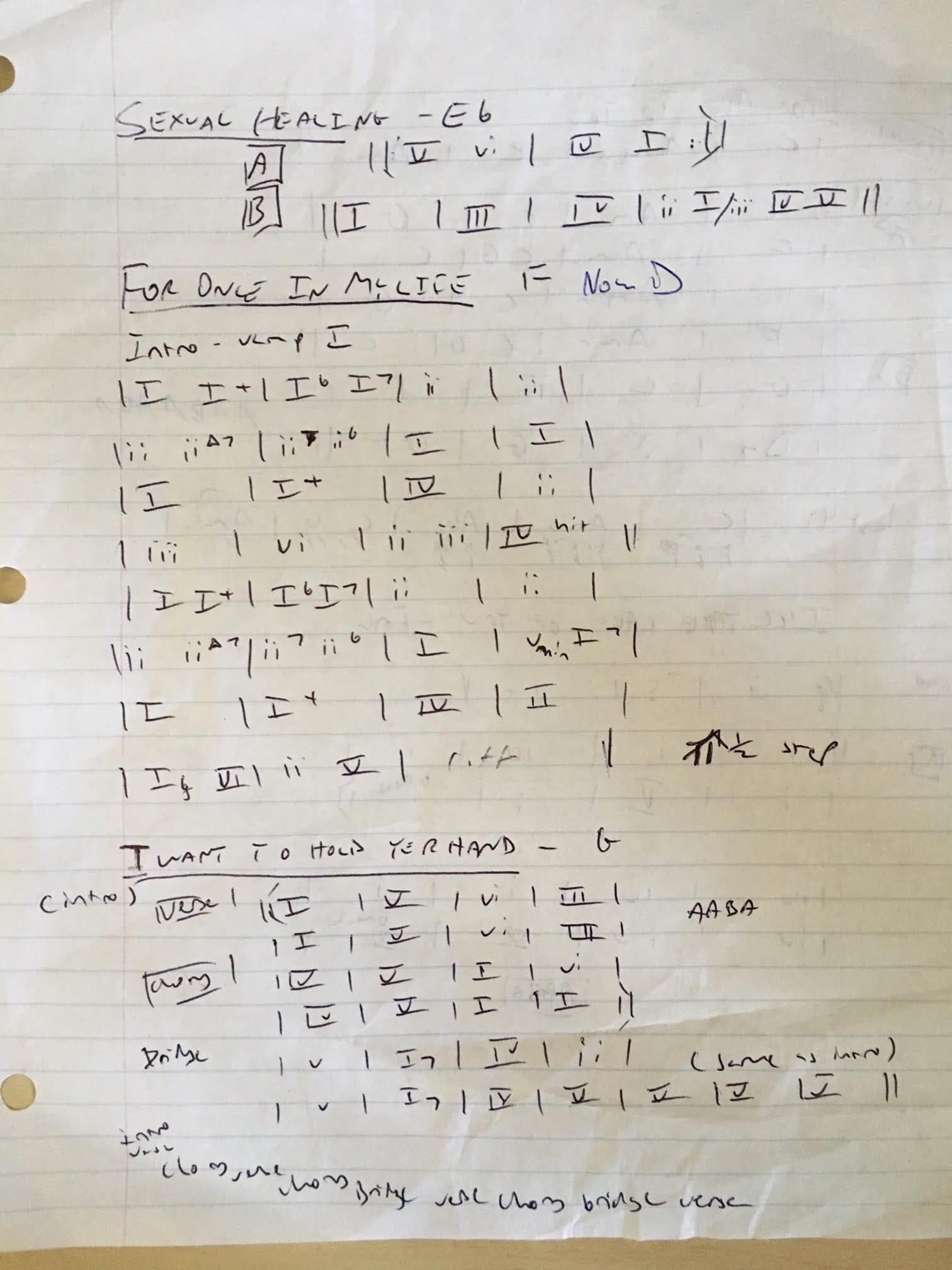
I think this is an important step, although the level of detail that goes into each chart can vary from person to person. Personally, writing things down helps me remember them. I don’t like reading charts at gigs, mostly because I feel that it takes away from the performance aspect. (We’re putting on a show, after all!) I’m not, however, opposed to other musicians reading at gigs if they need it. Charting the chord structure, making note of any special or iconic riffs on my instrument, helps me recall the structures while I’m in performance mode.Here’s a picture of some charts I jotted down for a recent performance. I wouldn’t expect others to feel that these are a complete portrait of the songs or be able to use them in any functional way. But after having spent time learning more specific information in the previous steps, this is enough to keep the music fresh in my mind’s eye and ear.I prefer to use Roman numeral notation instead of writing the specific chords because there will inevitably be a few key changes, and this will mean transposition. I find it easier to transpose chord numerals instead.