

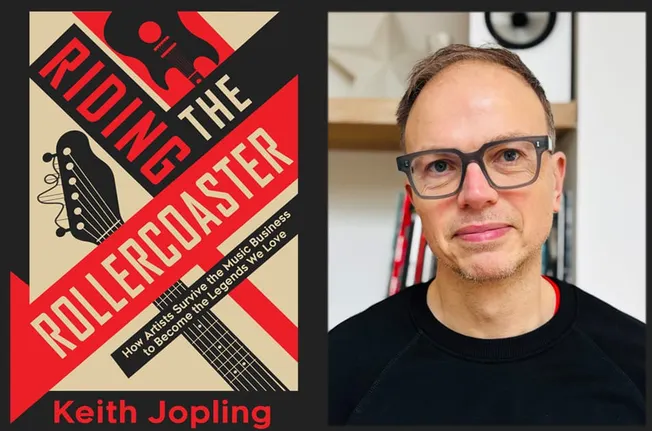
Excerpt from Riding The Rollercoaster by Keith Jopling
Longevity is the sacred cow of the music industry.
Having a hit song in the short term is fun, and lucrative, but most bands and artists would likely trade that in for a shot at being adored and sustained by their creative activities in the long term.
It's a lot easier said than done though to manifest longevity, and in some cases having a "hit song" may just be the most viable way of achieving it. Well, that's next to impossible. In Jopling's book, his research led him to five surefire pathways towards building a long, untouchable career in music:
- Have a ‘hit’ record.
- Get dropped by your record label.
- Make a ‘classic’ album.
- Establish “quiet legend” aka cult status.
- Build a brand aka become a band that is more than the sum of its parts.
Notably, none of these are easy to do. While he also eventually includes mastering the craft of live performance among these, Jopling sheds light on how the industry has changed around these methods for investing in long-term success, and why that matters for all artists.
Riding the Rollercoaster tells the story of how artists and bands carve out long and successful careers in the music business, despite the numerous pitfalls and pratfalls. Who lasts in the music industry — and why? The music business is defined by volatility. For every artist who sustains a career, many more fall away, despite talent, acclaim, or early success. Jopling examines why some musicians endure while others fade away.
Hypebot is proud to offer this excerpted chapter, which details the first "Route" to longevity, appearing in Part 2 of the book: "Crossing the Rubicon: Five Routes to Longevity."
ROUTE 1 – "Have a Hit Record"
“The bigger the hit, the bigger the liability.” — Donny Osmond
Historically, a hit meant a high chart position, but these days, an impressive streaming count is what you need. The music business is run on hits, full stop. It is one big hit factory and unlikely to ever change. But streaming has changed the nature of hits. In fact, although a hit is more important now than ever, there is no longer any clear definition of what a hit really means.
A hit song is one that has notable, measurable success. Indeed, if you are an artist with any level of success by way of a popular song, streaming services like Spotify will remind you of that every day of your life, by pinning that popular song to the top of your profile page, with the number of streams right next to it. This is to remind you of how great you used to be and how your old stuff is so much better than anything you can create these days. See it as motivation.
There is no real agreed or designated threshold for what constitutes a streaming hit. The music industry associations, like the RIAA (Recording Industry Association of America) and BPI (British Phonographic Industry), do have certifications for singles based on “units sold” but nobody really understands what this means anymore, nor takes much notice. There are no units sold now, just tracks streamed for more than 30 seconds.
What gets more attention is the Spotify Billions Club – the songs that have crossed the one billion streams threshold on the platform. Spotify has a rolling playlist and well over 1,000 songs have achieved a Spotify Billions Club plaque (yes, there is an actual plaque). One billion is an extremely large number, and the Billions Club remains out of reach for 99.99% of artists with music on Spotify.
That’s why the music writer Bobby Owsinski once summed up the question of how many streams it takes to make a hit with a simple:
“more zeros than you think”.
As a rule of thumb, if you have a song that reaches five million streams, you have something to shout about. Within a reasonable timeframe, accruing 10 million streams will give your label cause for excitement – the equivalent of hitting the top 20 in the 80s. At 50 million streams you have a bona fide hit from which you can make a reasonable amount of money – depending on the structure of your deal. More motivation. To be considered a major hit however, we’re talking over 100 million streams – perhaps even the potential to join the Billions Club one day. Even David Bowie hasn’t made it into the Billions Club (yet), unless you include “Under Pressure,” his 1982 hit with Queen.
There have been dozens of books (and a few companies have been created) dedicated to the science of having a hit. Of course, the irony is, there is no science to it. One of my favourite quotes from The Art of Longevity podcast is from Steve Berlin, saxophonist and de facto band leader of L.A. Latin rock band Los Lobos, who said:
“There is no formula for having a hit record; it’s 60% luck, 30% talent and 10% timing.”
That throwaway line may be as valid as any formula created about scoring a hit record. No one can tell you how to do it, but plenty will tell you that you need to at some point – and the sooner the better. A hit is the on-ramp to the shortest possible route to ‘success’. And record labels love “route one” (they are addicted to shortcuts).
Whether a band’s career began with a hit song, or whether the hit came later, few artists would ever turn away from the idea of having a hit. Spoon, the indie band from Austin, Texas, achieved longevity without a hit song by making consistently good albums, revered by critics, as well as being a formidable live act. But as Britt Daniel told me:
“It would be nice to have a hit”.
He’s right, it wouldn’t do the band any harm. Plenty of artists will, at some stage, make a song that sounds like a hit, but that’s a long, long way from having one. Indeed, it might be the wrong approach to even try, since most songs that sound like hits, sadly never become one. Matthew Caws, lead singer and songwriter for the New York indie guitar band Nada Surf (who have never had a hit in 30 years but have produced ten very good albums) has banned the notion that during the recording process someone might suggest that a song “sounds like a hit”, the very idea setting expectations that are bound to be a letdown.
But hits can “break” an artist. They are the silver bullets by which the artist can impress industry gatekeepers and subsequently introduce them to a wider audience. For this reason, hits are at the top of every rising artist’s priority list, certainly for those who have signed a record deal. A hit can take you a long way. The bigger the hit, the longer the halo effect. A hit can even provide you with a career that lasts for decades.
On the other hand, a hit can also be dangerous, in that it can too quickly come to define you. This is probably what Donny Osmond meant (see the above quote).
Here is another quote, this one from Maseo, member of hip-hop legends De La Soul, who told the UK Guardian:
“On our second album, we learned the importance of controlling the narrative. I learned early on that a hit record can hurt your entire body of work if you let the industry control your narrative”.
Weirdly, the music business can occasionally work a hit record against you by insisting that you repeat the trick, which has a dangerous potential to backfire should it box you into a corner, creatively.
Some artists’ biggest hit songs were released in a short, intense burst and these tracks were a springboard to a high-profile career. A prime example is KT Tunstall. Tunstall’s 30-year journey as a professional musician is something of a classic model for longevity: a decade-long struggle to get signed, a stratospheric rise to the top as a priority artist on a major label, followed by a steady drop in record sales after her sophomore album Drastic Fantastic (2007). She then had years of wrestling between her own creative instincts and the commercial demands of the industry. As she stressed on The Art of Longevity:
“There is a conflict of interest because you have made a piece of art that you love, and [the record label’s] job is to sell it. You are put upon with all these comparative statistics – charts, awards, numbers – it’s really unhelpful and not creative in any way”.
What Tunstall describes is the ongoing conflict that arises in the music business – the awkward conflict between the creative goals of the artist and the commercial interests of their record label. This conflict drives so many contradictions in the music business. To judge success, the industry obsesses over numbers: sales and streaming stats, viral spikes and follower counts. But these metrics do not matter as much to artists. Artists see faces in the crowd and judge their own success on the strength of connection through live performance or perhaps gaining recognition amongst their peers. Priorities set by the music industry are not the same priorities for the artist. Artists don’t want to make the same record twice, but labels (and maybe fans also) want them to repeat their success by sticking with the style that made them popular. Artists do not think in terms of genre, but the industry classifies them that way, with record stores and streaming playlists organised largely by genre definitions.
These contradictions are confusing and frustrating for artists. Elbow’s lead singer, enigmatic frontman Guy Garvey, describes this situation as the music industry mangle – since artists can feel like they are indeed being rinsed through a series of pain points. Success on their own terms is something to strive for once through “the mangle”.
KT Tunstall understood that the record label’s job is business, while her job is to make art. The Scottish singer-songwriter has released eight albums over two decades. Tunstall’s three biggest hits came from her debut album Eye to the Telescope (2004). That album remains by far her biggest seller and most well-known record. Some 20 years on, should you hear a KT Tunstall song on the radio, there is an excellent chance it will be one of those three big hits. In one sense, Tunstall made a rod for her own back by making a debut album that was something of a classic. She saw it as a good problem to have. Although she was under pressure to keep on making commercially successful music, what she did was make very good albums in line with her own creative instincts. Her 2013 release, Invisible Empire // Crescent Moon, was both a creative shift and a steep commercial drop-off – a risky moment for an established artist on a major label.
But, by that time, KT had already crossed the Rubicon to long-term success. Tunstall has managed to maintain high acclaim all the way to her most recent album, Nut, even though that album peaked at a mere 25 in the UK album chart.
Another superstar singer-songwriter, Norah Jones, has followed a similar path. Jones’ biggest hits come from her first two albums: three from the phenomenal debut Come Away With Me (2002) and one from her sophomore album Feels Like Home (2004). Those first two remain her biggest commercial successes (although third album Not Too Late also reached number one in both the USA and UK charts). Not only was she the top priority for her record label, Jones became the priority for the whole recording industry – a rare global success in the era of Napster and the height of internet music piracy.
Since then, commercial success has ebbed for Jones, with much lower chart positions for her recent releases. However, those albums were rated highly by critics and fans, despite being a creative departure from the output that brought her early fame. It’s this musical evolution that has been so critical to her longevity. As Jones crossed lanes musically, she developed as an artist.
It’s worth noting that both KT Tunstall and Norah Jones benefitted from long-standing relationships with their respective record labels: EMI/Virgin and Blue Note. They are both examples of what a productive long-term relationship between artist and label can achieve despite the creative and commercial tug of war experienced by both artists. They demonstrate why labels shouldn’t drop artists who want to change creative direction, even if they experience a dip in commercial performance. With great artists, creative and commercial success comes back around (we look at the impact of being dropped by labels next, and it’s not what you might expect).
In the streaming era, songs rather than albums have been the music industry’s growth engine. Consequently, songwriting has become industrialised on a grand scale. New York-based Hit Songs Deconstructed (which does indeed deconstruct the elements that make a hit song) has reported a steady rise in the number of songwriters per hit. In the year 2000, the average number of songwriters per Billboard Top 10 hit was 2.4. This has increased to four in 2020. Artist services company iMusician analysed the top 100 songs in the UK Official Singles Charts (in June 2023), concluding that it took an average of five songwriters and 2.5 producers to produce a top 40 hit.
This is a worry, from the point of view of access for young bands and solo songwriters, who don’t have the backing of major labels or publishers and can’t afford to attend songwriting camps to cook up hit songs to a tried-and- trusted formula that tickles Spotify’s algorithms. Neither KT Tunstall nor Norah Jones ever wrote songs to a formula in the hope of having a hit.
The Future of Hits
The technologization of hits is a phenomenon that has led to rock/indie bands effectively being locked out of the charts. In 2024, The Rest Is Entertainment podcast compared the first half of the 80s and 90s with the period 2020–2024. Host Richard Osman found that bands occupied number one in the UK chart for 146 weeks in the first half of the 80s and 141 weeks in the first half of the 90s. Yet during 2020–2024, bands were at number one for three weeks (with one of those being The Beatles’ 2023 song “Now and Then”). Bands just can’t get on the charts. That may be why many bands of longevity have expressed gratitude to have begun their careers before streaming changed the music industry.
Some attribute the absence of bands from the charts to social media channels that are dominated by individual personalities, leading labels to find and subsequently market solo artists with better results (again, shortcuts). Others suggest changing tastes, such as the dominance of rap, hip-hop, country and pop over genres such as rock and indie, in the past two decades. The economics of the music industry make it a lot harder for bands to become viable (compared to individual artists), too.
Rick Beato – our YouTube music guru – traces the problem back to how songs are marketed by major labels and how those songs are written, produced and recorded. Beato assessed the Top 400 global artists on Spotify (based on monthly listeners), finding that only three of the bands featuring on the list were formed within the last ten years – less than one percent of the artists in the top 400. If forming a band is a minor miracle, having success in the music industry with your band is a revelation.
The technologisation of songwriting demonstrates just how important songs have become to a growing industry. Streaming has amplified the importance of hit songs, even if the process for how songs become hits is harder to pin down, with the rise of the ‘viral hit’ and the murky role of algorithms. Hitmaking will continue to be an essential part of an artist’s skill set for as long as we continue to have a music industry, although it looks like the success rate for bands will get even lower as songs are constructed around a formula. Constructing the hit as shortcut to popularity has long tempted songwriters to create something radio friendly (or now, algorithm friendly). Using tried-and-trusted song structures and precision tooled production methods can make modern pop songs less like music and more like ear candy. The Baffler writer and author of Spotify critique Mood Machine, Liz Pelly describes this as “stream bait pop” songs:
“Inherently connected to attention, whether it’s hard-and-fast attention-grabbing hooks, pop drops and chorus-loops engineered for the pleasure centres of our brains, or music that strategically requires no attention at all – the background music, the emotional wallpaper, the chill-pop-sad-vibe playlist fodder.”
With the enormous popularity of ‘lean back’ or ‘focus’ music on playlists such as Spotify’s Peaceful Piano, even the classical world has succumbed to this form of hitmaking. Composers began writing piano pieces made for such playlists, a practice hilariously exposed by the piano and rap star Chilly Gonzales in his song “Neoclassical Massacre”.
As social media proliferates, artists now preview their new songs on social media platforms before official release, in an attempt to gain feedback and build buzz around the song. In effect, the viral moment is now coveted before release, not after. Things are turning weird, with sped up songs becoming a trend on TikTok, something no one in the music business predicted. Initially uploaded by users, major labels now release official sped up, slowed down, reverb and pitched versions of singles alongside original tracks. Streaming services have sped up songs playlists. Sounds – mere snippets of songs – also trend on TikTok, which the algorithm promotes, making videos more watchable. Artists and labels can now link a sound to a streaming track via TikTok’s own distribution platform SoundOn, closing the loop between TikTok and streaming platforms. As we speak, AI technology is enabling the creation of sounds, even wholly generated songs (and, gulp, ‘artists’) at unprecedented speed and volume.
In 2025, Spotify filed a patent for an AI feature that can automatically generate song ‘mashups’. The technology will analyse song elements (vocals, instrumental parts, tempo, key, harmony) and combine parts of different songs, to create personalised mashup versions for users. Mashups are not new. Originally (illegally) uploaded by underground mashup creators, EMI adopted the trend and released a compilation, Mashed, in November 2007. It took the major label over a year to produce but at the time was a commercial flop and wasn’t repeated.
It’s hard to determine how much these developments impact listeners’ ability to enjoy actual songs, unencumbered by all the tech paraphernalia that comes with them. It may come as a relief to human songwriters and artists that so far, all these rapidly emerging technologies have failed to produce anything that replaces genuinely good pop songs. That hasn’t stopped AI generating chart hits, however, so who are we to judge? Worryingly, a survey commissioned by Deezer, done by research firm IPSOS in November 2025, reported that 97% of listeners couldn’t tell the difference between AI-generated and human-created songs. AI-generated songs, created with minimal or no human input, are flooding streaming services.
As this book went to print, Deezer reported some 50,000 AI-generated songs being uploaded onto its service every day (one third of all tracks uploaded onto the service), although the majority are subsequently identified as related to royalty fraud scams. The real concern is what happens when the fraud schemes are removed but ‘official’ AI tracks begin to land on streaming playlists and are served up by their algorithms (and perhaps even promoted ahead of real songs that cost more for those services to license from labels). Precious discovery and listening slots will get clogged by what is commonly referred to as “AI slop”.
Yuk. All this means that the stakes are higher for aspiring and emerging bands and artists, now obliged to release their best songs with no idea whether these will rise above the clutter to attract the attention they deserve.
When it comes to written-to-formula hit songs, labels will claim they are responding to consumer trends, what listeners want, and yet listeners often complain how bland music has become and lament the death of “real music”. But pop music seems to be in perfectly good health, with new scenes such as hyperpop generating feverish levels of fandom. If songs are under threat from the various alternative technologies, it’s hard to explain why country music – the genre of “three chords & the truth” – is seeing a new wave of global superstars drawing bigger audiences than at any time in the history of the genre.
However, the more successful the type of song, the more AI will be trained on it. As this book was written, several major US chart hits in the country genre were by AI artists, causing some consternation amongst the country music community. This is happening just as music in general is on the rise culturally, with alternative pop, indie, post-punk and even rock all thriving creatively and making something of a comeback – all driven by the humble vessel of the popular song.
As someone once said, “without songs, we’re all just jamming”. For artists, the song remains the same – the purest form of communication and rite of passage to an audience. But if your song doesn’t make the charts don’t worry about it – the only people noticing chart positions these days are record label executives. If, when you play a song live, the crowd draws in and the fans sing the lyrics back to you, keep on playing it and consider it to already be a hit, one that AI can’t steal.
Keith Jopling is a strategy & growth leader, author, and speaker, whose work can be found on The Song Sommelier. He's worked in the music business for 25 years, most recently as an executive consultant in the music industry’s key organizations: major labels, indies, startups, trade bodies and Spotify. Read more about Riding The Rollercoaster.