

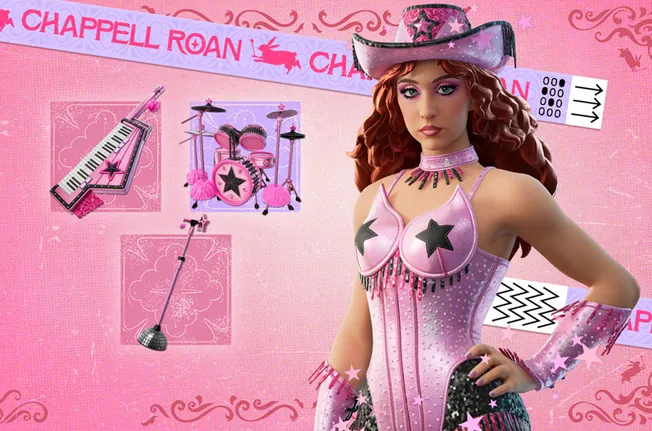
On February 3, Chappell Roan was announced as the headliner of Fortnite's Festival Season 13.
This appearance includes themed performances, exclusive costume fits and accessories, as well as dances and tracks (Emotes) that bring fans, gamers, and the crossover communities of music and virtual reality together in a glammed up spectacle.
Fortnite Festival has already featured some of the most globally influential artists of our time, and so on the surface, this feels like yet another high-profile music crossover for Epic Games. But Roan’s arrival carries a different kind of symbolism with it, too.
Her rise has been built on unapologetic femininity, camp spectacle, and a fan culture that celebrates queer identity and female empowerment confronts qualities that haven’t historically been centered in mainstream gaming spaces.
Here’s why this moment is a true Femininomenon.
1. A Historically Male-Dominated Gaming Space Gets a Radically Feminine Pop Star
Online gaming culture has long struggled with gender equity. That's certainly no secret. Even though women make up roughly half of all players globally, the culture around major titles has historically skewed male in both representation and visibility, and women tend to feel pretty uncomfortable in this space.
According to a study from the journal, Sex Roles, women feel excluded from gaming culture and experience "guilt" and "shame," often keeping their excitement a secret, despite genuine enthusiasm for the hobby.
As for Fortnite, the free third-person battle royale game has hosted huge musical collaborations before (ie: Travis Scott, Ariana Grande, The Weeknd), but Roan's presence brings an alternative magnetic anchor to the perspective of the gamer that skews hyper-feminine and queer. Bringing that energy directly into a massive gaming ecosystem means millions of players are encountering a kind of femininity that goes beyond representation; this feels more like cultural infiltration.
2. It Bridges Two Historically Separate Fan Cultures
For decades, pop fandom and gaming fandom evolved separately:
- Pop fandom → often female-dominated, emotionally expressive and theatrical, community-driven.
- Gaming fandom → historically male-dominated, competitive, sometimes gatekept, the loudest voices usually win out.
Fortnite was already trying to blur the lines between these two communities, but Roan’s inclusion welcomes even more "Pop Girlies" to feel belonging in gaming spaces, and may transform gaming events into celebrations of performance and identity, not just competition.
3. Empowering the Image of Femininity Away From Misogyny
While this is not omipresent, it is still typical in video games, comics and manga, that female and feminine characters are given limited complexity and lean towards hyper sexualized avatars, as well as marginalized or mocked aesthetics.
Roan flips that script. Her entire artistic identity is built around performative femininity turned up to 11 — huge makeup, theatrical costuming, and exaggerated stage personas. Her aesthetic goal isn’t to fit into established gaming norms, it's to break them open and make space for a more drag-inspired fluidity and complexity.
Rather than adjusting to fit a smaller, virtual identity, it forces the space itself to expand in order to accommodate its grandiosity. And that's powerful.
4. Gaming Is Truly Now a Major Stage for Music Culture
Epic Games' music strategy around Fortnite Festival has turned the game world itself into a new kind of performance platform, similar to how Roblox and Minecraft have experimented with virtual concerts.
Roan is not the first female artist to be featured in this space by any stretch — recent examples include:
- Ariana Grande’s Fortnite concert event
- Doja Cat’s gaming and streaming collaborations
- Charli XCX’s deep integration with internet culture and gaming aesthetics
But this shows that music fandom no longer has to be thinned out at the gates of entry. And women are becoming more comfortable participating in gaming culture, as well as shaping it.
5. Queer Visibility in a Time of Suppression
Roan’s career has been openly tied to queer identity and drag culture, something that historically hasn’t always been embraced by mainstream gaming audiences. These days, a fractured and Culture War supercharged political discourse has made everything even tougher for the queer community.
Perhaps putting an allied artist like this at the center of a global gaming event will help shift an unsafe moment of suppression towards open and empathetic dialogue. Perhaps it will make gaming companies actively court a more diverse cultural stakeholdership. Perhaps it will help dissolve boundaries between club culture, pop music, and video games.
In the very least, for young LGBTQ players, seeing that identity reflected in a game they spend hours in each week can be deeply meaningful.
Chappell Roan 2026 Tour Dates
MAR 13-15 — Santiago, Chile @ Lollapalooza Chile 2026
MAR 13-15 — San Isidro, Argentina @ Lollapalooza Argentina 2026
MAR 20-22 — São Paulo, Brazil @ Lollapalooza Brasil 2026