

How to Make Epic Music: The Most Successful Band No One Seems to Like
By Ian Temple of Soundfly Weekly
Note: Hey all, I spent wayyy too long on this one! I knew this band before starting, but didn’t know them nearly as well as I thought, and I’ll admit I fell down a rabbit hole. You can download the audio version, or now find it on Spotify as well. As always, if you enjoy it, please share it! It means the world to me. Or consider supporting me with a subscription. Enjoy!!!
12.29.94.
7.31.13.
8.17.96.
12.31.95.
To most of us, these numbers are meaningless. To the more perceptive of you, you might have already figured out they’re dates.
But to a certain subset of the population, these numbers are immediately recognizable and near-sacred.
Mine is 8.3.03. It was 2 am on a Sunday morning. I found myself unexpectedly camped out in Maine with some friends on a former Cold War Strategic Air Base known for housing the kinds of airplanes that carried nukes. But on this occasion, we were instead surrounded by an impromptu interactive city 60,000 strong that was one of the biggest population centers in Maine for the weekend.
We were standing below an old flight tower watching as colors and smoke exploded off the top while dancers performed suspended down the sides, hundreds of feet off the ground — all while a band that had already played for some 4 hours earlier that day and would play for 5 more the next played an entirely improvised (and unannounced) jam on top of the tower.
If you don’t know what I’m talking about yet, I’m hesitant to even tell you.
For a variety of reasons, some fair, some not, this specific band gets a bad wrap in the music world. When I say their name, it’s almost guaranteed that certain associations will jump to mind, and probably not good ones. Smelly crowds of drugged out hippies. Self-indulgent jamming. Nonsensical songs that most people don’t really get. To the uninitiated, this group and people who listen to them have become something of a punchline.
But this band is so undeniably epic. Since their start in 1983, they’ve played more than 2,000 shows without ever repeating a setlist. They once played 13 shows in a row night after night without ever repeating a single song. To see in the new millennium in 1999, they played 8 hours straight from midnight til sunrise, the largest concert on earth that night. They’ve hosted multi-day festivals, played while jumping on trampolines, and rode giant hot dogs into stadiums.
Basically, they’re one of the most creatively independent and successful acts in modern music without ever having had a hit and while being written off by vast parts of the listening population. I can put numbers on that. Since 1980, they’re actually the 33rd highest grossing live band, one step above Lady Gaga. They’re 12th highest in terms of ticket sales.
Welcome to Episode 2 of How to Make Epic Music, the series where I explore artists and songs that push the limits of musical propriety and common sense. My name is Ian Temple, and today, we’re talking about the band Phish, and specifically the unbridled, unrivalled, and uncontainable world of a live Phish jam.
A small request to start…
Phish inspires strong opinions. We’ll get into it, but the fans can be kinda intense, the haters scornful. I’ll admit to being a bit of an outsider. I used to listen to Phish in high school, then didn’t listen much for about 20 years before going to a show this past New Year’s and loving it. I’ve only ever been to a handful of shows, but the thing is, that small handful of shows stand out in my memory way more than most.
Because Phish do extraordinary things on stage. They are the rarest of things, a truly unique act and one so at odds with the modern world of quick hits, algorithms, social media, corporate acts, and streaming. And I think the general disdain they receive in many parts, as well as the somewhat justified connotation of drug use, is causing some people to miss all that. As Amanda Petrusich wrote in The New Yorker last year, “Phish requires commitment — a subversive idea in our era of miniscule attention spans.”
So I’m asking you to suspend your preconceptions here, because whatever else it is, Phish offers a great story with a lot to learn. And they’re undeniably epic. So let’s dive in, starting with the music.
“Phish requires commitment — a subversive idea in our era of miniscule attention spans.” — Amanda Petrusich, The New Yorker
Long songs with strange structures
Phish has a number of different types of songs. They have traditional songs with verses and choruses, folk and pop songs, rock songs built on guitar riffs, etc. But they’re perhaps most famous for songs that are through-composed, meaning there’s no obvious structure beyond going from one idea to the next. There aren’t usually big sectional repeats.
Through-composed songs pop up in prog-rock, in musical theater sometimes, and definitely in experimental music.
The way Phish’s through-composed songs tend to work is that the first half is very intricately composed, every member of the band doing something totally unique that fits together really tightly, while the second half often gives way to a looser jam. In fact, the band has said that playing the intricate first part prepares them to be in sync for the second, more jammy part at the end.
An example of a through-composed song is “The Divided Sky” off Phish’s very first record Junta from 1989 and a mainstay of live shows to this day. This song is kinda weird. And long. On the record it’s a tidy 12 minutes, but live it can go 20+ minutes.
It starts with a nice major chord idea, then has a simple, slightly absurd chant, before embarking on a weird atonal section, meaning there’s no obvious key center. This is classic Phish. There’s a chromatic walk up to build tension. There’s some whole tone nonsense. The whole section plays as a palindrome, forward, then backward, then forward again. You feel like you’re totally lost as a listener right up until it resolves in triumph.
In the audio above, I try to actually play this song on the piano. It’s… not easy.
Regardless, there are a number of patterns here that are very common to Phish songs: The through-composed structure, the way it oscillates between moments of tension and moments of release, the number of pretty hook-like melodies, the way each badn member has their own unique part separate from the others, even the slight absurdity of it all. Then, as already mentioned, it ends in a jam.
The jam is where things can really open up live. “Divided Sky” is usually what’s called a Type I jam by fans, where the band continues to improvise within the chord progression of the song. A Type II jam on the other hand can go anywhere. We’ll get to that.
The whole song ends in a slightly slapstick manner, with a little chromatic walk up and a musical theater-ish button on the end.
But there’s more to it than that
Writing songs like this is certainly part of what makes Phish epic, musically speaking. But let’s go deeper.
The story starts in Vermont, in 1983, at the University of Vermont. Guitarist Trey Anastasio met drummer Jon Fishman and bassist Mike Gordon and they began jamming together and playing some shows. They met the fourth member keyboardist Page McConnell in 1986. Trey and Jon promptly joined Page at the alternative school he was attending called Goddard, which allowed them to study whatever they wanted. Jon majored in drums, Page’s thesis focused on improvisation, and Trey… well, Trey’s thesis was a prog-rock concept album about a retired colonel who falls through an imaginary door into a fantastical world called Gamehendge populated by a people called the Lizards who follow the teachings of a book called the Helping Friendly Book that gets stolen by a power-hungry tyrant named Wilson.
Welcome to the world of Phish!
Actually, the songs and story in Trey’s thesis would go on to feature heavily in Phish’s lore and live shows. The entire prog-rock opera has been played live on four legendary occasions (with a fifth that’s considered cusp-y) — although individual songs from it like Divided Sky are more common.
A few traits common to the members of Phish: One, humor. They’re all described as funny and light-hearted, with an expansive sense of the absurd. Two, self-discipline — they all take the music quite seriously. Three, they’re all musical omnivores, with a wide array of influences.
“Phish has command over so many different grooves and spaces. They can be funky. They can be shredded metal. They can be calypso, they can be folky. They just inhabit all these spaces so readily.” That’s Fred Kosak, the guitarist and singer of the band Stillhouse Junkies. Fred’s one of the best musicians I know, and an avid Phish fan. “I think the last 5 years I’ve seen about 20 shows or so, which is a lot for me, not a lot by Phish standards.”
I asked Fred why he liked Phish. “Uniqueness is such a hard thing. If somebody was like, what kind of band are they? Some people would call them a rock band, but like that’s a stretch. What is Reba? I don’t even know. Is it prog? Not really. It’s kind of jazz. It’s not really jazz. I can’t think of too many bands that I really could not describe using terms like musical terms.”
There are a few influences that often come up with Phish: King Crimson for the long compositions, Frank Zappa for the surrealism, the Grateful Dead for the improvised jams and hippy vibes, Jimi Hendrix for the rock experimentation, Schoenberg for the atonal elements. But honestly, evoking influences almost feels too limiting.
Fred says: “If Phish were a person, they would be the kind of person I would like to hang out with because they’re not trying to copy anybody. They’re not self-conscious. They’re not worried about what anybody thinks. They’re like: We think this is cool. We’re going to get as good at it as we can.”
The corollary to all this is that they have experienced a lot of hate over the years, in part because they do things so unapologetically their own way. They don’t tone it down or try to reach new audiences. They have had some absolutely terrible reviews over the years, like this one in Vice: “Phish has been a band for 30 years now and they’ve sucked the entire time.” Their audiences are also not the most diverse crowds you’ve ever encountered.
As my bandmate in Sontag Shogun (and an exceptional solo artist) Jeremy Young says, “I’m exactly what a Phish fan is. I’m sort of like a suburban, white, middle class person who grew up with a certain amount of music in the landscape, looking around and being like, yeah, this is good, but do I identify with this? And then you find a band like Phish and they’re a traveling circus of weirdos making really high quality music, but not taking things too seriously, and the crowd is living this free life or whatever. I hate to say it, but it’s the music of privilege. I think a lot of young people that were not sure what to do with their privilege could find something in that.”
It’s perhaps unsurprising that’s turned some people off over the years.
Primarily a live band
It’s impossible to understand Phish’s success or allure without understanding that they are primarily a live band and always have been. They didn’t even release a studio album until 6 years into their existence, and their 2nd most successful album is A Live One. It’s quite possibly their most defining characteristic that every single show is unique, a one-off spectacle never to be repeated.
“No bands do that.” That’s Jeremy Young again. I called him up because he has one of the widest breadths of musical knowledge of anyone I know. He says even in jazz, there’s usually a vague structure people are improvising around. But with Phish: “It’s like: ‘let’s play the first half of this song. Then we’re going to do some nonverbal gestures on stage to each other and pop ourselves with a rubber chicken and then start another song right in the middle of that and then play that for 25 minutes and then come back for one minute and finish the first.’ It doesn’t make any sense.”
This relentless on-stage experimentation and risk-taking is what got people coming back and bringing friends in the band’s early days. It started in the ‘80s at local clubs in Burlington, like Nectar’s. It moved to literal farms where they’d invite fans by mailing them postcards with directions.
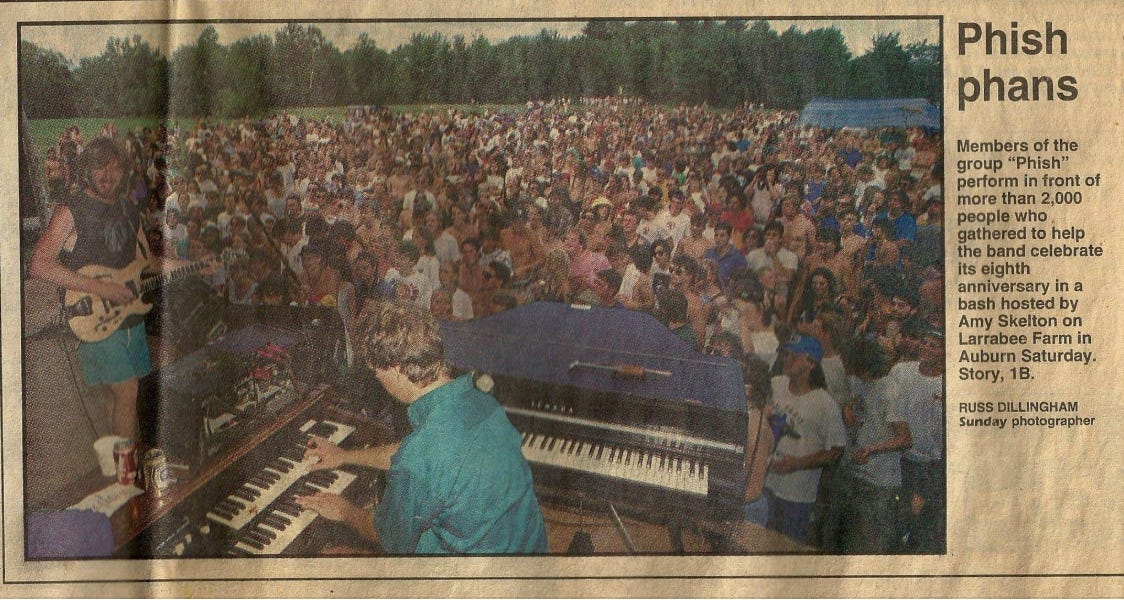
When they tried to expand beyond Vermont, promoters wouldn’t pick them up, so they ended up just renting out venues themselves — and their fans would bus in to attend. This led to them controlling every part of their shows, from the lights to the sound to the production to the backdrops, which in the early days were painted by the bassist Mike’s mom.
It’s quite possibly their most defining characteristic that every single show is a unique, one-off spectacle never to be repeated.
Phish are often compared to the Grateful Dead for their scene, but as Trey pointed out in The New Yorker last year, they’re actually more similar to the punk scene in some ways: the DIY approach, the “beg-forgiveness-rather-than-ask-permission” ethos, the willingness to do a lot with a little. (There’s a nice quote in that New Yorker piece from Fugazi frontman Ian McKaye about how much he admires Phish’s approach.)
Along these same lines, the band has always had an obsessive dedication to the fans, way above what would make sense for commercial considerations. That dedication plays out in the music, but also in how they chose to develop their career. They allowed fans to tape and trade their shows from the get-go. They were one of the first to offer direct downloads of live recordings and an online community. They innovated epic multi-day festivals, with art, games, carnivals, rides, and lots of surprises, that ended up inspiring modern festivals like Bonnaroo. After one of them, their team actually went through the lost and found and tried to return each item to its owner. They even once brought the ashes of a hardcore fan who died with them on tour, at the request of his bereaved father.
That’s probably why by 1996, they couldn’t get a song on the radio but they could sell 70,000 tickets to a weekend festival. In fact, that specific festival called the Clifford Ball was the biggest concert in North America that year.
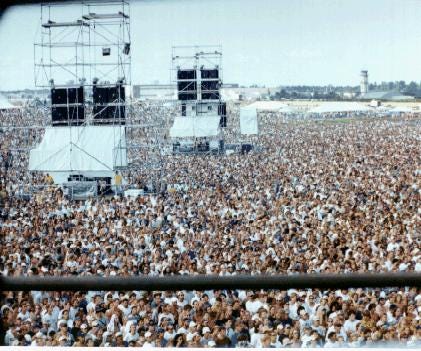
As Jeremy says: “Back then, nobody was doing what they do. And even today nobody does what they do, which is play basically three hours across two sets and then come back for an encore that could last anywhere between ten minutes and a half an hour or 40 minutes. They basically play an entire other set as an encore.”
“What is an epic band or an epic musical experience? Somebody that commands the stage and just fully fills it. It’s just four guys on a stage and then there are insane lights, the sound is enveloping, and they use their songwriting and their understanding of a grand narrative to fill an entire space. It’s like a band that is much bigger than the sum of its parts. That’s epic. That’s crazy epic.”
“What is an epic band or an epic musical experience? Somebody that commands the stage and just fully fills it.” — Jeremy Young
The discipline of an athlete
If there’s one thing I think outsiders miss about Phish, it’s this: They approach performing with the discipline and ambition of an elite athlete.
There are lots of stories of them rehearsing for hours at a time: 8 hours, 10 hours, 12 hours straight. They devised games to help them get better at listening and responding to one another. For instance, they would practice blindfolded. Or play with a set of rules, like every time the jam gets faster it needs to get quieter and vice-versa. They even hired trainers to go on tour with them, to help them work on discreet skills like how to be a barbershop quartet.
One of the famous games from the early days was called “including your own hey.” The details on how it worked are a little hazy, but the basic idea is this: One member starts a little riff and says “hey.” Then another joins with another “hey,” finding a gap for their own part. Then another, and so on — each member finding their own specific spot in the groove. Then, when everyone’s in, the first person changes their riff and the whole thing continues.
Apparently, there was another version of the same game called “Get out of my hey hole.”
“Think about a conversation.” Fred Kosak again. “Think about three other people, and you sit down at a coffee shop and you start to talk and think of how many different forms that could take. And then think of a version where you get up and feel like, ‘you know what? That was a really enjoyable hour, and I learned a lot, and I got to say what I wanted to say.’ It’s an improbable thing! Somebody is going to want to dominate the conversation. Somebody’s going to want to tell a story. It’s a bit of a high wire act where you have to be listening and choosing your moment to assert yourself but not be too assertive. And all of that is happening non-verbally.”
In some ways Phish’s innovation was to decide to work on this, as a skill like any other, to work on their patience to let the conversation evolve over time and their ability to listen and respond to each other in the moment.
I spent way too long on this. Worth it? If so, please consider subscribing.
The secret language
A consequence of this intense discipline and listening to each other is that they were able to develop a specific language to communicate musically. There might be a specific guitar line that indicates a change is about to come or that the jam should move on. Or Trey would play the riff from The Simpsons Theme song, and no matter where the band was in a song or in a jam, the other members of the band would respond and also go into The Simpsons Theme song live, and then go back into what they were playing before.
Here’s Jeremy again: “If you know anything as a fan, you can go into the show expecting the unexpected. Something is going to happen that’s going to surprise you. It can be kind of small — and usually the small stuff is like some of the fan favorite stuff, like when they bust out little trampolines in the middle of the 20 minute song called ‘You Enjoy Myself.’”
“Why is that epic? Your attention is so crucial to making this relationship work between band and fan. You have to give the band all of your attention. But then when you give it to them, they make good on that promise.”
“If you know anything as a fan, you can go into the show expecting the unexpected. Something is going to happen that’s going to surprise you.” — Jeremy Young
In the era fans call Phish 1.0, in the early 1990s, they made parts of this secret language explicit to fans. So for instance, they’d play a chromatic descending scale and everyone in the crowd was expected to fall down — which must have been absolutely wild for people in the audience who didn’t know it was coming, especially the intoxicated ones.
Over time, the language has grown more organically and expanded, so that it’s not unusual at Phish shows to suddenly hear the entire audience engage in a ritualistic “hey!” or randomly clap three times at a specific moment.
Fred says: “So much of Phish is context. You can go to a show with none of that context and be like ‘damn that band is good.’ But the deeper you get into the context, you can never be too nerdy, you can never go too deep. And the band knows and is paying attention.”
“There was a moment last summer where the encore was this song ‘46 days,’ and then somebody noticed that the next show was 46 days later. They do shit like that, and the band leaves us all guessing. But that’s part of why the fandom is so deep. You’re never going to out-phish Phish. They’re always going to be one step ahead of you as far as like these references and constantly surprising fans.”
The epic peaks of a Phish jam
OK, so we have this band of four members working really hard to be great improvisers and obsessed with the fan experience. All of that is pretty epic, but it’s not why I wanted to do this episode. I learned most of this stuff during research.
Instead, what’s most epic about Phish to me is those rare, unplanned moments during a jam where everything comes together, often unexpectedly. You might be deep into a Type II jam, a jam where they’ve left the song structure completely behind. The band itself is experimenting and listening and poking and prodding, trying to figure out where to go. It feels risky and dangerous, and sometimes it doesn’t work out.
But then suddenly it all locks in. All four members sync up, and the crowd electrifies. There’s often a sense of leaving your body. As Fred puts it: “It’s this incredibly, complex organism, this thing that can at any moment move in any direction. And on an ON night, it’s kind of flowing in this totally unimpeded, organic way. Everybody is in this flow state that we all have read and watched plenty of things on. You can really sense when that’s happening.”
That might sound like the effect of the drugs, but these days, in the era fans are calling Phish 3.0 which started after the band returned from their hiatus in 2009 or so, there are actually a lot of sober people around, including Trey himself. I was pleasantly surprised on a recent deep dive down a Phish Reddit rabbithole to read all the stories of people who have given up drugs or sobered up — and for whom Phish’s music hits as hard as ever.
Definitionally, the word “epic” refers to an epic poem, like The Odyssey. It’s a long, difficult journey. And sometimes, that’s what a Phish jam can seem like too, a fellowship embarking on what theorist Joseph Campbell calls Hero’s Journey.
In fact, if we take Campbell’s theory and apply it, there’s the Call to Adventure when the song ends and the jam begins. There’s the Crossing of the Threshold, when they leave the song structure behind and embark into the unknown. There’s the Tests and the Ordeal, the moments in the jam where you’re not quite sure if it’s all going to work, where you worry the band is lost and that things are too dissonant. And then there’s the Resurrection when it all comes back together in ecstatic glory.
For me, these peak moments are often led by Trey, the guitarist. All four members of the fellowship are critical, but Trey is the leader. It’s his searing, soaring, wailing guitar tones that often push the band further than you thought possible.
There’s a famous jam from 2013 that’s now referred to as the “Tahoe Tweezer” in the lore. This jam starts with one of their more absurd lyrical songs: “Won’t you step into the freezer / Seize her with a tweezer.” None of it makes sense. There’s a moment where they mimic an evil uncle stuck in a freezer maybe? The jam starts with a funky section. Then, there’s a spaced out section. There’s this glitchy electro section.
And then about 25 minutes in, the band stumbles on this happy major key riff a little reminiscent of the Allman Brothers’ song “Revival.” You can kinda hear them working out together that they’re going to stop. One by one they start joining the stop. And then gradually the audience starts responding to the pause with a “Woo!”
The band then starts moving the stop around harmonically. It builds and builds and builds… until finally Trey soars in on a massive guitar note leading into a giant resolution, and the jam takes off again. It’s this giddy moment of release where the entire stadium, band, fans, everyone realizes for a brief moment they’re all on the exact same page.
It’s the feeling of letting go completely, of something risky coming together and being worth the risk. Like four happy dudes from Vermont starting an off-kilter band with undefinable songs about silly things like Lizard people who get put down by promoters and labels and reviewers constantly and yet lay it all on the line every single night for their audience, and it all pays off.
What’s the most epic part of it all
In doing research for this piece, I ended up watching Phish’s Tiny Desk Concert on NPR from last year. I was a little skeptical. How’s this going to work? Phish out of their context. A mainstream stage. No massive Chris Kuroda light show. No time for massive jams. No diehards in the audience for the secret language cues.
And yet, it’s really fun! They play a few short newer songs, then a few short versions of old classics. They bring mini-trampolines. They do some choreographed jumping. They end by walking off the stage and into the crowd singing and giving out high fives. And then they come back and play two mini-encores.
Here’s a smattering of the comments:
- “I’ve actively avoided Phish my entire life for no real good reason, so I guess it’s time to finally give them a listen.”
- “These dudes just radiate joy and share it freely with others. Truly a gift.”
- “I’ve always been aware of Phish but I never really listened to their stuff. This is just so delightful and feels so good.”
- “Daaaannng. I now understand that one guy in all our lives that won’t stop talking about Phish. I’m now going to turn into that guy.”
It turns out that when you strip away the production, the arenas, the massive jams, the huge audiences and light shows and everything else, what are you left with?
Joy. The joy of four guys who love making music together and love sharing it with others. What else really matters?
That’s pretty epic.
“Daaaannng. I now understand that one guy in all our lives that won’t stop talking about Phish. I’m now going to turn into that guy.” — some YouTube commenter
So… how do you make epic music?
The biggest lessons I’m taking from Phish are: First of all, ignore the haters. Find people you love making music with, and then work at it together until you get really good at doing what you want to do. Don’t be afraid to take risks, to leave structure behind, and to listen deeply to each other while doing it.
I think personally, the things that have settled most deeply into my creative practice is the excitement of playing something differently every time you play it, and not being afraid to launch into an improvised piece of music with no structure and no idea where it will take you.
And if you should be so lucky as to come together in a precious, unrepeatable moment of ego-less musical connection with other people, well, then appreciate it. Because that is truly a beautiful moment.
Ian Temple is the Founder and CEO of Soundfly. Follow his Substack, Soundfly Weekly, or join the growing community of musicians and educators on Soundfly for free today.
Epic Notes
Weirdest Phish Fact: Trey was suspended from UVM in the ‘80s for stealing a severed hand and a heart from the anatomy lab on campus and mailing them to a friend with the message, “I gotta hand it to you kid, you’ve got heart.”
Personal Favorite Phish Jam: Hmmm… it’s gotta be “Reba.” The jam on that song has always felt particularly meaningful to me. Maybe 10.31.94.
Interviewees:
- Fred Kosak of the Stillhouse Junkies. Listen to them on Spotify, Apple, etc.
- Jeremy Young of Sontag Shogun or solo act. Listen to his solo stuff on Bandcamp.
Main Sources:
- Phish: The Biography by Parke Puterbaugh.
- Phish.net, reddit.com/r/phish on Reddit, Phish.in, and other Phish fan forums.
- “Anatomy of a Jam” YouTube channel
- “After 40 years, Phish isn’t seeking resolution” by Amanda Petrusich, The New Yorker.
Phish 2026 Tour Dates
APR 16 — Las Vegas, NV @ Sphere
APR 17 — Las Vegas, NV @ Sphere
APR 18 — Las Vegas, NV @ Sphere
APR 23 — Las Vegas, NV @ Sphere
APR 24 — Las Vegas, NV @ Sphere
APR 25 — Las Vegas, NV @ Sphere
APR 30 — Las Vegas, NV @ Sphere
MAY 01 — Las Vegas, NV @ Sphere
MAY 02 — Las Vegas, NV @ Sphere
JUL 07 — Madison, WI @ Kohl Center
JUL 08 — Madison, WI @ Kohl Center
JUL 10 — Noblesville, IN @ Ruoff Music Center
JUL 11 — Noblesville, IN @ Ruoff Music Center
JUL 12 — Noblesville, IN @ Ruoff Music Center
JUL 14 — Savannah, GA @ Enmarket Arena
JUL 15 — Savannah, GA @ Enmarket Arena
JUL 17 — Raleigh, NC @ Coastal Credit Union Music Park At Walnut Creek
JUL 18 — Columbia, MD @ Merriweather Post Pavilion
JUL 19 — Columbia, MD @ Merriweather Post Pavilion
JUL 21 — Syracuse, NY @ Empower Federal Credit Union Amphitheater
JUL 22 — New York, NY @ Madison Square Garden
JUL 24 — New York, NY @ Madison Square Garden
JUL 25 — New York, NY @ Madison Square Garden
JUL 27 — New York, NY @ Madison Square Garden
JUL 29 — New York, NY @ Madison Square Garden
JUL 31 — Boston, MA @ Fenway Park
AUG 01 — Boston, MA @ Fenway Park
SEP 04 — Commerce City, CO @ Dick's Sporting Goods Park
SEP 05 — Commerce City, CO @ Dick's Sporting Goods Park
SEP 06 — Commerce City, CO @ Dick's Sporting Goods Park