


A Visualization Technique That Can Reduce (or Increase) Performance Anxiety
By Dr. Noa Kageyama, PhD of The Bulletproof Musician
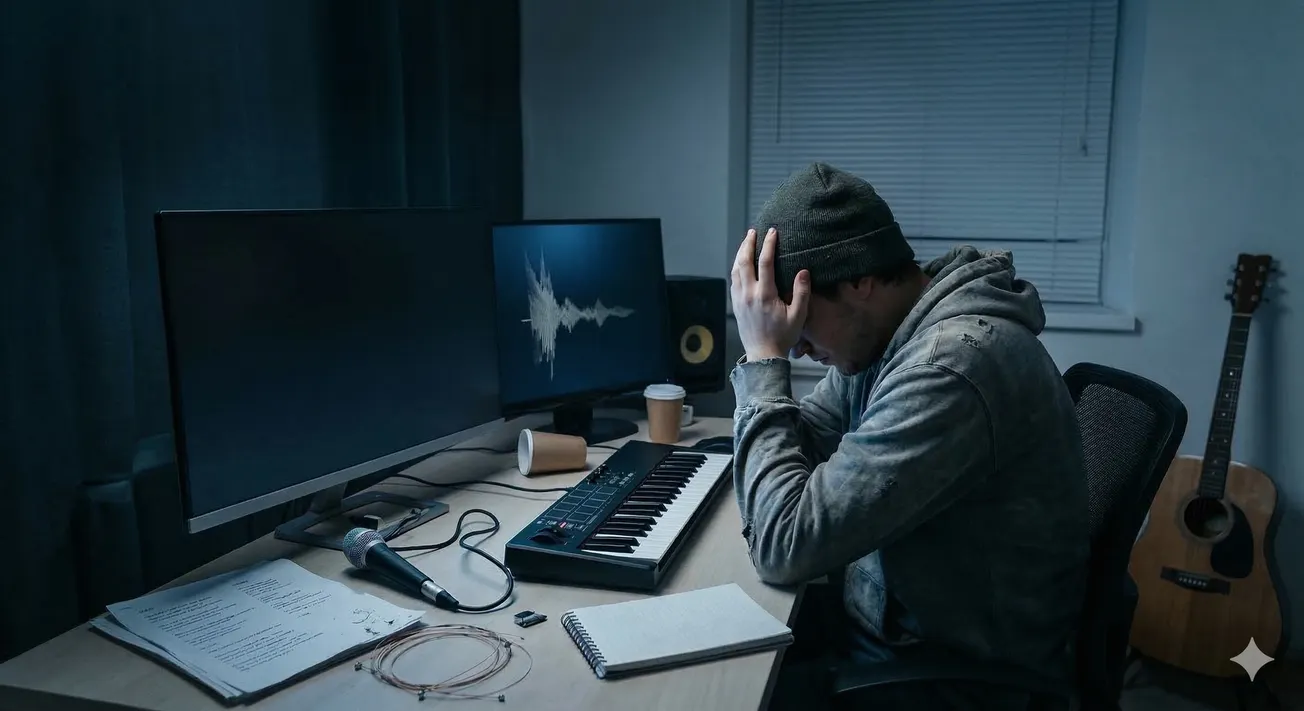
Ever notice how easy it is to imagine everything going wrong right before a performance?
Backstage, your mind starts running through all the possibilities. Like having a memory slip, your bow starting to shake during the quiet part, or missing big shifts or leaps.
Sometimes these thoughts are so automatic, that we don’t even really notice them starting to intrude. They’re just part of the background mental chatter we experience on concert or audition days.
This is not a very pleasant thing to experience, of course. But the bigger question might be…what sort of impact do these mental images have on our performance?
And, is there anything we can do to have a more positive experience in the minutes and hours leading up to a performance? Maybe even on stage too?
A study!
A British team of researchers (Hirsch, Mathews, Clark, Williams, & Morrison, 2006) recruited 60 university students and staff members to participate in a public speaking study.
Everyone started off with a short anxiety questionnaire, to get a baseline of their anxiety level.
Then, a third of the participants engaged in a negative imagery exercise, another third engaged in a positive imagery exercise, and the remaining third participated in a control imagery exercise.
Negative imagery script
Participants in the negative imagery group were asked to recall a time when they had to give a speech to an audience, and were worried they wouldn’t do a good job.
They were then given five minutes to imagine giving a speech in that same context, where they perform terribly and the speech goes badly. After which they were asked to describe to the experimenter, as vividly as they could, all the details of this imagined failure, closing their eyes, and really imagining how they would look, sound, and perform in front of this crowd.
Positive imagery script
Participants in the positive imagery group on the other hand, were asked to imagine a time when they felt like their speech was going to go really well, and to also identify what about the speech they thought would be so great.
Then, they were asked to not only imagine giving that speech, and see it going awesomely, but to imagine and describe to the experimenter the “best possible outcome of giving the speech” as well.
Neutral imagery script
The control imagery participants were asked to recall, describe, and imagine an experience, in exactly the same way that the other participants did, except that their imagery was of a more neutral experience.
Specifically, a shopping trip. 🤣
A speech!
Then, the participants were told that they would be given 30 seconds to prepare a 4-minute speech on the pros and cons of living in London. And that this speech would be videotaped, to be watched and evaluated later by a group of psychologists.
After their prep time was up, they delivered their speech to the camera, while the experimenter sat behind them.
A few assessments…
After completing their speech, they took the anxiety questionnaire once again. But instead of rating the anxiety they were feeling now, they were asked to rate the level of anxiety they felt during their speech.
They also rated their speaking performance from 0 to 10 (0=not at all good; 10=extremely good).
There was also a negative thought questionnaire, to get a sense of how active their inner critic was during their speech.
Like, how frequently did they have negative thoughts like “I could lose my train of thought” or “people could think I am boring” or “people might see I am nervous” while speaking?
The questions also got at how valid they thought these thoughts were. As in, when the thought about people seeing them become visibly nervous popped into their head, were they able to dismiss that? Or did they find themselves believing that the thought was true? That people really could see how nervous they were?
Lastly, they completed an 18-item “Behaviour Questionnaire.” This is an instrument used to evaluate some of the outwardly visible aspects of nerves and performance, and has a list of items like “confident,” “relaxed,” “sweating,” “blushing,” “uncomfortable,” and “awkward,” and you’re supposed to use a 0-8 scale (0=not at all; 8=extremely) to assign a score to each aspect of performance.
+Read more: "What Artists Can Do to Bounce Back From a Subpar Performance"
Evaluation of their speaking performance
And to get a sense of how accurate the participants’ self-perceptions of their performance might be, the researchers had a research assistant watch the videos and evaluate each performance using the Behaviour Questionnaire too.
So…were there any differences between the negative and positive imagery groups?
Differences in their performance experience
Yup, there absolutely was!
For one, the participants who imagined a performance going poorly felt more anxious during their speech, than the participants who imagined a performance going well (42.17 vs. 33.92, where higher scores = more anxiety).
The negative imagery group also thought they performed worse than those in the positive imagery group (4.83 vs 6.25, where higher scores = better perceived performance).
They also thought that they came across as being more anxious (56.83 vs. 35.67, where higher scores = more visibly anxious).
Furthermore, the negative group experienced more frequent negative thoughts during their speech (40.33 vs. 26.83, where higher scores = more negative thoughts), and reported that their intrusive thoughts felt more valid (37.17 vs. 18.08, where higher scores = thoughts feel more true), than those in the positive imagery group.
Differences in self-perception vs. reality
Meanwhile, there was quite a discrepancy between how participants thought they came across in their speech, and how nervous they appeared to an external observer.
Essentially, both groups thought they performed worse and came across as being more nervous than they actually did to the research assistant who evaluated their speeches.
However, the negative imagery group overestimated how badly their speech went to a significantly greater degree than the positive imagery group – with an average difference between self-rating and observer rating of 37 (negative group), compared to 21.93 (positive group).
So what are we to do with all of this?
Takeaways
There was a moment in one of the episodes of ESPN’s The Last Dance, where Michael Jordan asks a rhetorical question related to imagery and mindfulness – something like:
“Why would I imagine missing a shot that I haven’t even taken yet?”
For me, the main takeaway of this study is that what we think about and imagine before a performance can carry over into our mental experience during the performance too. And indeed, why spend time envisioning something we don’t want to happen?
Of course, visualizing positive moments doesn’t necessarily come naturally. Especially backstage, when our thoughts tend to wander off to the bad place…
So even though it might feel a little silly to do so, taking a few minutes before lessons, rehearsals, or studio classes, to practice some positive imagery scripts like the one in this study, might be a good way to make it easier to get into a good headspace when you need to, and pave the way for more performances where it’s not just a positive experience for the audience, but for you the performer too.
+Read more: "How to Manage Mental Health on Tour: Practical Tips for Artists on the Road"
References
Hirsch, C. R., Mathews, A., Clark, D. M., Williams, R., & Morrison, J. A. (2006). The causal role of negative imagery in social anxiety: A test in confident public speakers. Journal of Behavior Therapy and Experimental Psychiatry, 37(2), 159–170. https://doi.org/10.1016/j.jbtep.2005.03.003