

By David Moss of Personata Studios
I've spent decades in radio and music production. Over the years I've watched the industry predict its own death more times than I can count. And almost every time, the "end of music" turned out to be the beginning of a new chapter.
Now AI music is here, and the familiar chorus has started again. "This is the end of real music." "Artists will be replaced." "The industry is doomed."
I've heard this song before. I'm not buying it this time either.
I'm writing this because I want to work with industry leaders — labels, publishers, PROs, platforms, artist advocates — to shape a framework that embraces what's coming, protects legitimate rights, and regulates it in a way that encourages creativity instead of freezing it. Especially around derivative works, licensing, and fair compensation.
Because whether we like it or not, this is happening. The only real question is whether we guide it or get dragged by it.
I Watched Napster Die. I Also Watched What Came Next.
I was a heavy Napster user. I remember the lawsuits, the shutdown, the industry declaring victory over piracy. Mission accomplished.
Except it wasn't. The demand didn't go away. It just scattered — Limewire, Kazaa, BitTorrent, a dozen other platforms the labels spent years chasing. Meanwhile, revenue cratered and kept cratering.
Then streaming finally arrived, the industry got on board, and recorded music revenue climbed back to historic highs. More people pay for music today than most of us would have predicted during the darkest days of the early 2000s.
The sky didn't fall. It shifted. And the people who adapted fastest came out ahead.
+Read more: "9 Non-Generative AI Tools Artists Can Use to Get More S#*t Done in 2026"
The Pattern Never Changes
Every major technological shift in entertainment follows the same script: panic, resistance, reluctant adaptation, then an explosion of creativity nobody saw coming.
I was at NAB years ago when an interviewer asked a station manager from a major news radio outlet how he thought podcasting would affect radio listenership. This guy — a professional, an industry leader — basically said podcasting sounded like something a three-year-old would do on a fifty-dollar cassette recorder. He really said it that way. Dismissive. Confident. Completely wrong.
Then the audience showed up. Not for amateur noise, but for voices and formats radio never made room for. Long-form interviews. True crime. History. Niche expertise. The things terrestrial radio had abandoned because they didn't fit the format clock.
Same thing happened with YouTube. Same thing happened with self-publishing — Andy Weir serialized The Martian online, self-published it as an e-book because readers asked for it, and ended up with a traditional publishing deal and a blockbuster film. That path didn't exist in the old gatekeeper model.
And I've watched it happen in my own backyard with internet streaming radio. Most stations are rough — bad processing, weak imaging, no programming philosophy. But the ones that got it right? They serve formats mainstream radio walked away from. Scott Shannon's True Oldies Channel is a perfect example. Nothing like it on terrestrial radio. Huge audience. Built by a legendary programmer who understood that democratization doesn't destroy quality — it expands the menu for people who were never being served in the first place.
AI Music Is the Next Chapter
AI music tools are doing to creation what YouTube did to video, what podcasting did to audio, what self-publishing did to books.
I know this because I lived it.
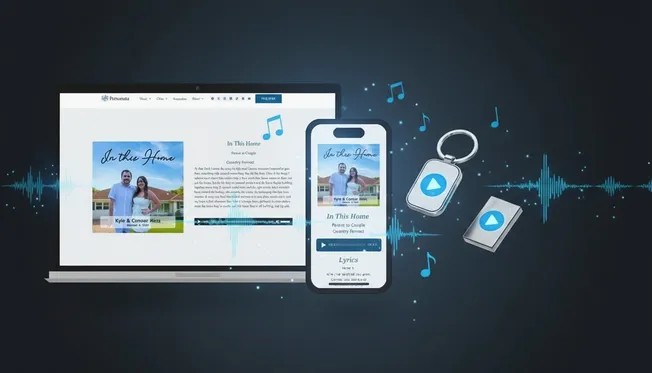
When my son got married, I didn't want to give a speech. I wanted to give him something that would last. So I built him a song — a real song, about his actual story, his relationship, the moments that mattered. I wrote the lyrics. I shaped the production. AI was a tool in the process, not a replacement for the human work.
When he heard it, the reaction wasn't "that's a nice track." It was something deeper. It landed because it was his. Not a generic love song. Not somebody else's story set to music. His.
That's what's possible now. A lyricist who can't play an instrument can finally hear their words as a finished song. A composer can sketch ideas and bring them to life without spending years mastering Pro Tools. A family can have a lullaby with their child's name in it, a memorial piece that feels like a tribute instead of a template.
That's not replacing musicians. That's expanding who gets to participate.
The Real Concerns — And What to Actually Do About Them
I'm not pretending there aren't legitimate issues. There are. If we handle this badly, we'll create chaos.
Yes, there will be a flood of amateur content. Just like YouTube. Just like podcasting. Just like self-publishing. Just like streaming radio. You'll hear some truly bad songs. That's always part of democratization. But amateur work doesn't automatically destroy professional markets. It usually increases the overall pie and raises demand for quality. The signal finds a way through.
The licensing and derivative-works framework has to evolve — but it has to evolve intelligently. The current system isn't built for an era where millions of amateur creators are making music. You can't require every hobbyist to run clearance searches on every riff they build. You can't expect someone who just wants to put their song on Spotify to pay thousands of dollars to an entertainment lawyer first. The "Blurred Lines" precedent chilled the entire songwriting community for a reason.
We need a framework that protects legitimate IP, encourages new creation instead of paralyzing it, and gives independent creators a realistic path to clear influences and derivatives without needing a legal team. Protection and access. Both.
And professional artists need fair compensation. AI models trained on copyrighted music raise real questions about attribution, consent, and economics. But the goal shouldn't be "ban AI music." The goal should be "build compensation models that are fair and enforceable." Streaming royalties weren't perfect, but a functional framework emerged. AI music needs the same kind of work.
A Message for the Industry: Don't Make the Same Mistake Again
Here's what I really want to say, and I'm saying it directly.
The labels held off streaming for years. They fought it in court, lobbied against it, treated it as an existential threat. And while they were fighting, they bled revenue. By the time they got on board, they'd handed years of growth to platforms that didn't need their permission.
If the TV networks had embraced amateur video capability early, there might not have been a YouTube. There wouldn't have been the need for it. Instead, they dismissed it, fought it, and lost. Then they had to figure out how to coexist with a platform that had already won.
Same pattern. Same mistake. Same outcome.
The artists, record companies, and license holders have to get their act together this time. AI music is not going away. You can shape a sane set of rules that protects creators and encourages innovation — especially around licensing and derivative works — or you can let the future arrive as a messy, lawsuit-driven free-for-all while someone else builds the infrastructure.
I'd rather build the bridges now.
+Read now: "How AI-Curious Artists Can Move Beyond ChatGPT"
The Opportunity Is Real
At Personata Studios, our model is intentionally human-led with AI-enhanced production. Humans do the meaning — the story, the lyric, the emotional choices. AI helps us move faster, explore more options, and deliver professional quality at a scale that used to be impossible.
That combination creates something neither side can do alone. And it points toward where this industry is heading: more demand for human songwriters who can capture real stories, more demand for producers who can refine and elevate drafts, more demand for businesses built around personalization and connection.
The sky isn't falling. It's opening up.
The only question is who's going to be ready for it.
What's your take? What should the framework actually look like — and is the industry going to get it right this time, or repeat the same pattern?

David Moss is the CEO and Founder of Personata Studios, a Fort Lauderdale-based music production company creating custom songs through a human-driven, AI-enhanced approach. With decades of experience in radio broadcasting, music production, and entrepreneurship, he's watched — and survived — every "death of music" prediction the industry has made.