

By Ian Temple of Soundfly Weekly
*This post was written by Ian Temple, the Founder and CEO of Soundfly. Follow his Substack, Soundfly Weekly, for more essays on creativity.
One job of a good therapist is to help unearth the stories we tell ourselves about how the world works, often unconsciously, and decide if they’re helping or hurting us.
Humans are relentless pattern recognizers, perhaps one of our defining features. We see things and immediately want to insert them into narratives, categories, or trends so we can understand them. These become the stories we use to explain the world — a helpful way to not down tools in the face of the universe’s pounding complexity.
But that doesn’t mean the patterns we see are accurate. If we’re talking foundational stories, one of mine is that human thinking is relentlessly faulty, filtered as it is through a patched together mush machine (the brain) that’s been constructed piecemeal over millennia by a relentless flood of new evolutionary feature requests. Reality filtered through our perception is no longer actually reality, more of an approximated simulacrum, a series of internal Lego builds using only the bricks we have available. Still impressive, often practical, but not always load-bearing.
"I loved playing music and wanted to play, so I developed a story to support it. I told myself natural ability doesn’t matter. It’s all about how much effort you put in."
That said, sometimes you find a pattern or story that really does seem to work for you. I’d like to tell you about one of mine. I don’t know if it’s fully accurate. I probably do need to examine it from time to time, since at best it’s built on a pop science understanding of how the world works. But I’ve found it to be extremely helpful all the same, so I’m keeping it.
This story began when I was young, as a cope. I wanted to learn guitar, so I asked my parents to sign me up for a guitar lesson. I did it, and afterwards, I remember my dad asking something along the lines of: “Well, what did the teacher say? Do you have any affinity for it? Does he think you’re musical?”
Totally fair question, especially if you’re the one about to drop a bunch of money on classes. But the reason I remember it is that I’ve always had this sneaking suspicion that the answer to that question was (and remains) No.
Nowadays, that’s kind of an absurd thing to say. I’ve released multiple albums, scored films, scored podcasts, toured the world, and played shows for hundreds maybe even thousands of people. If you asked a random friend of mine about me, they would likely describe me as a musician in the same breathe as a father and a friend. Music is a huge part of my life and identity.
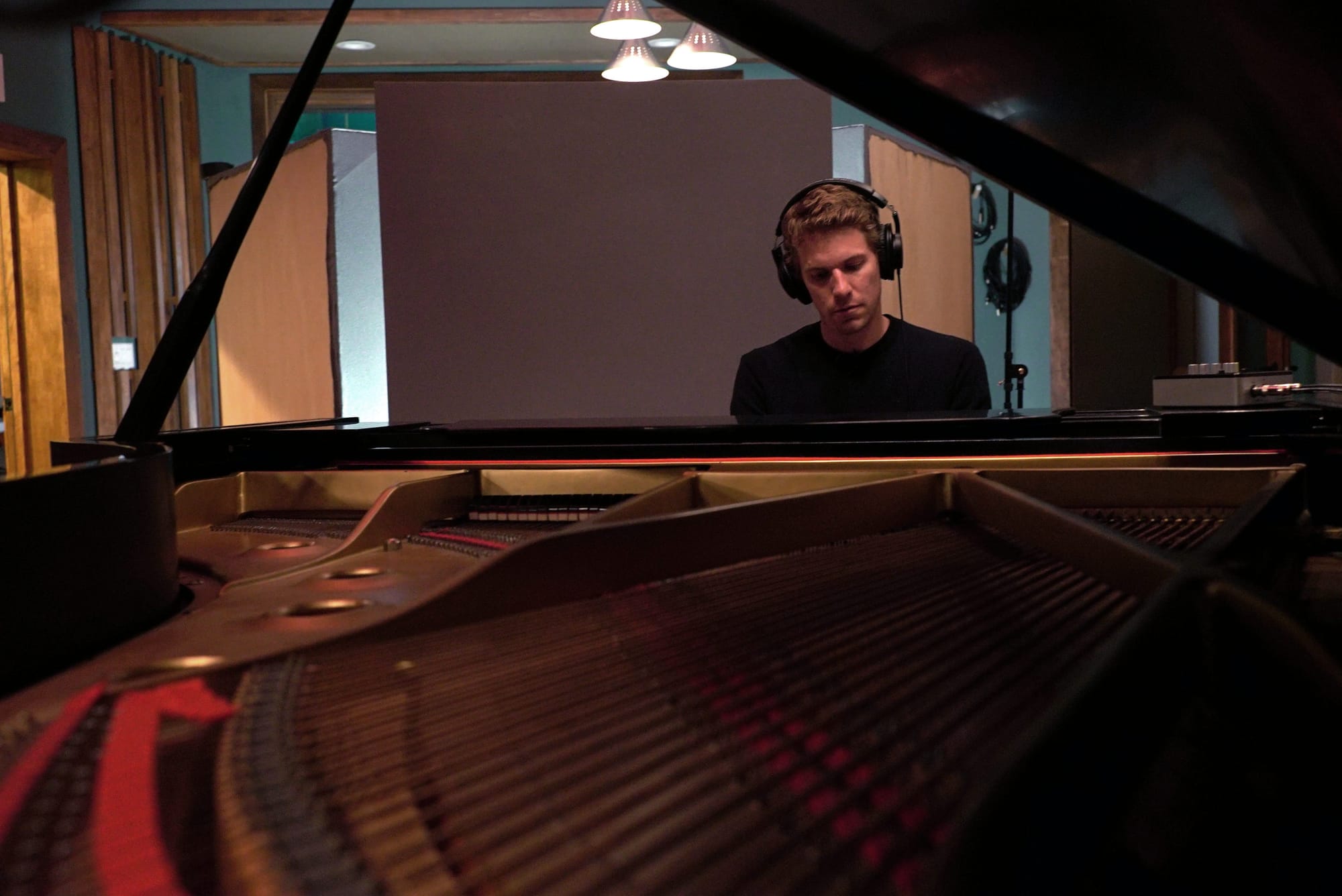
But music never came easily for me. My guitar playing has barely progressed since 7th grade. My singing is atrocious. I’ve got a totally untrained friend who can whip a gorgeous melody out at a moment’s notice without thought in a way I can only admire. As a pianist, my fingers have always seemed like plodding, lazy toads, doing their stumbly best to play the chords and melodies I demand of them, while many of my friends’ hands seamlessly glide across the same keys with the ease of a dove. None of that was helped by the hand accident I’ve written about before.
Beyond that, no one else in my extended family is particularly musical, at least in terms of playing instruments or singing. My dad used to play a mean “Für Elise” on piano, my mom loves musical theater, and my older brother helped me sign up for one of those BMG music clubs where you got 21 CDs for the price of one back in the day (for which I’m endlessly grateful), and that’s about the extent of it.
But I loved playing music and wanted to play, so I developed a story to support it. I told myself natural ability doesn’t matter. It’s all about how much effort you put in.
Over time, I’ve realized the truth is more complicated than that, but that story offered me huge value for a long time. Namely, it made it so I worked hard and didn’t give up. It also made playing piano feel like a little rebellion against the natural order of things. Sticking it to the Man by playing scales. Hell yeah.
When I started working in education, I was able to update that story a bit by reading about how people learn. The book that stuck with me the most was probably Peak: Secrets from the New Science of Expertise by K. Anders Ericsson and Robert Pool.
What Ericsson describes in it is an approach to learning that he calls deliberate practice — the idea that people become experts not primarily through natural gifts but through pursuing specific practice techniques consistently over time. In particular, Ericsson says that all effective practice techniques share the same general principles, regardless of field, by building on the natural adaptability of the brain.
Right away, you can probably see the connection to my story. Here’s one of the foremost researchers in the field of expertise validating my high school belief that natural musicality doesn’t matter as much as effort. But Ericsson also complicates and illuminates that picture. For one thing, not all effort is equal, and effort alone won’t lead to expertise.
"When you engage in deliberate practice, you’re curating your brain’s wiring, but it only works gradually over time. Your brain responds like a muscle that you’re strengthening."
Here’s the high level summary: Most of us reach an acceptable level of performance on some skill and stop improving from there. We’ve learned how to ride a bike or shoot hoops well enough to do it casually with friends, and that’s cool. It’s become automatic, including the mistakes we make. Doing it more just deepens those same grooves.
The best performers break past that point by developing highly specific goals, pursuing them with focus, getting feedback, and incrementally pushing themselves outside their comfort zone. In other words, they isolate specific elements of the task at hand they struggle with, and then push themselves to work on them repeatedly over time until they’ve mastered them, and then move on to the next one.
An example Ericsson gives is of a golfer who wants to improve their handicap at golf. That’s too vague a goal. Instead, they would need to figure out what part of golf is holding them back — driving, putting, approach shots, etc. — and then isolate and challenge themselves relentlessly to improve that aspect of the game. They would do thousands of putts from distances that challenged them. Or work to improve their drive, getting feedback on their swing until they can reach the green quicker.
The reason this works has to do with the new story that I tell myself, at least insofar as I understand it. It goes something like this: Because the brain is adaptable, you can train it in ways remarkably similar to how we train muscles. Experts call this “neuroplasticity.” It means the brain’s structure and functions are not hardwired and fixed, but respond to how we use them over time, editing connections and networks to make the ones we use a lot more efficient and let others we don’t fade into the background.
When you engage in deliberate practice, you’re curating your brain’s wiring, but it only works gradually over time. Your brain responds like a muscle that you’re strengthening. You have to put in the reps and keep making it more challenging to build up the parts of the brain that will support what you’re trying to do.
This story is optimistic because it means we are not working against natural limits as much as we might think we are. But it’s also brutally honest in the way it acknowledges that doing so takes a lot of focused, deliberate work over time, and most of the time we probably won’t put that work in because we don’t want to or it’s not worth it. And that’s fine too.
"The greatest value of this story I tell myself is in living the life I want to live."
This story underpins how I think about learning music. If I want to improve at piano, I need to isolate specific aspects of my playing and work them. Right now, I’m working on the rhythm and time feel of my playing, so there’s a lot of practicing to beats and focusing on my rhythm. If I want to improve at mixing, I need to isolate aspects of mixing and practice with some way to get feedback.
But it also underpins a lot of other aspects my life. It underpins how I think about exercise. If I want to train for a marathon, I need to work on my distance incrementally and find ways to support my body in doing so. It underpins how I think about creativity. If I’m not stretching my brain with new varied inputs of all sorts and drawing on them regularly, I can’t expect to have novel and interesting ideas when I want them. I’ll get stuck in a rut. It underpins how I think about parenting, about how teaching my kids good behavior requires a focused and steady application of feedback over time.
It also means giving myself a break sometimes. It’s unreasonable to expect perfection from myself in certain areas if I’m not pursuing a deliberate strategy to improve in those areas. Not as good as my buddies at singing melodies? Well, have I put in the time and effort and disciplined practice to make it so? Do I want to? The answer is No, so it’s all good.
But the greatest value of this story I tell myself is in living the life I want to live. Because it means that with focused application and practice, I can take on many aspects of my life and bend them in the direction I want. Yes, this sounds cliché and overcooked. But it’s also extremely practical.
My wife has mastered one of the most important skills in life. It’s one of the things I admire most about her. The skill I’m talking about? Laughter. She can laugh at almost anything. Her laugh fills a room. It’s always threatening to burst forth, even at inappropriate times like when she’s meant to be disciplining one of our kids but is cry-laughing instead. And it turns out life is a lot better with a lot of laughter in it.
One thing I’ve noticed through my time with her is that… well, I can actually laugh more too if I work on it. I’m certainly not at her level of expertise yet, but maybe with a few more years of practice, I’ll get there.
And that’s a skill worth practicing.
Some Interesting Things
1. Songwriting course with Betty Who starts next week! Last chance to join is NOW.
2. If you haven’t seen it yet, the choreography in the back half of this video for this song “Storm” by French artist GENER8ION tis absolutely stunning. It’s done by ballet choreographer Damien Jalet, who has worked with Marina Abramovich, Ryuichi Sakamoto, and others.
3. I really enjoyed the podcast “60 Songs That Explain the ‘90s” where this music journalist Rob Harvilla goes on extended absurdist tangents to try to understand some of the most important songs from the ‘90s. Now, he’s back with the 2000s, and I enjoyed episode 1 on The Killers’ “Mr. Brightside,” which includes the host scouring the internet and emailing professors to try to find horny poems by great poets in history.
4. A couple friends with some songs you should listen to:
- “Field of Coincidence” by TRELLIS is maximalist ambient synth music.
- “When My Lover Is Across the Ocean” by Cloud Circuit is recited poetry and analog electronics.
- ”slowly” by Maximilian Konrad is a beautiful and atmospheric solo piano piece.
5. I listened to more than 300 pop songs in the past two weeks for the next episode of How to Make Epic Music. It’s going to be wild, I promise! If you haven’t listened to my episode on Chopin or Phish yet, please do so here.
Ian Temple is the Founder and CEO of Soundfly. Follow his Substack, Soundfly Weekly, or join the growing community of musicians and educators on Soundfly for free today.